
Story
Powell's Hawkish Jackson Hole Speech Aims to Restore Fed Credibility, CICC Says
Summary
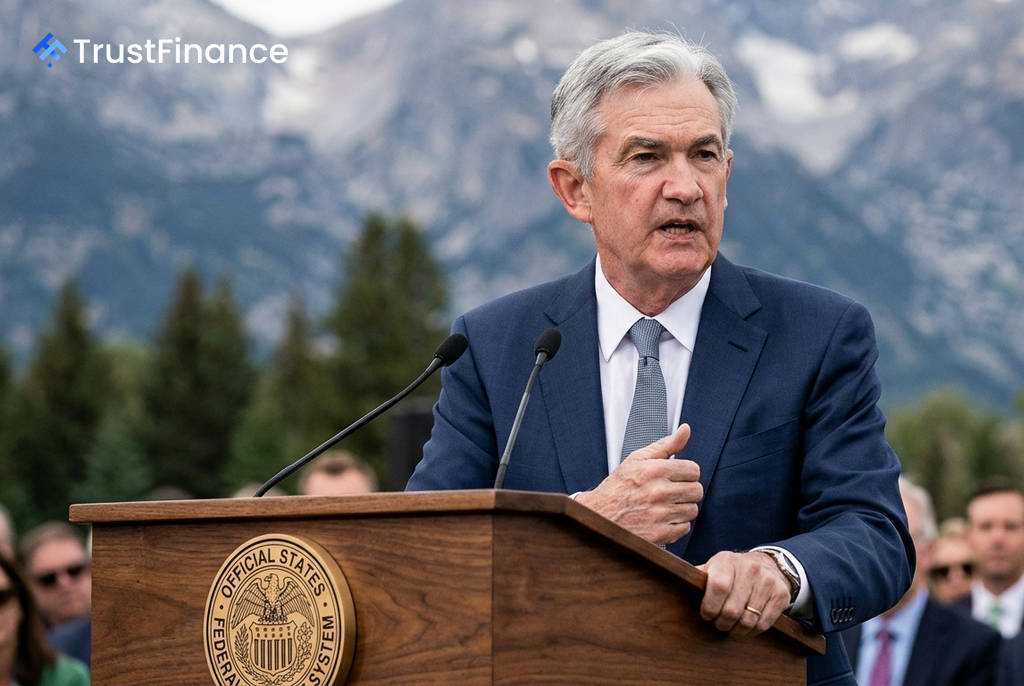
Federal Reserve Chair Jerome Powell delivered a hawkish speech signaling a readiness for further rate hikes, a move analysts at CICC view as a crucial effort to reassert the central bank's inflation-fighting credibility.
Federal Reserve Chair Jerome Powell delivered a decidedly hawkish speech at the Jackson Hole Economic Symposium, a move analysts at China International Capital Corporation (CICC) interpret as a deliberate effort to restore the central bank's inflation-fighting credibility.
In a research note, CICC stated that Powell's remarks corrected earlier, more ambiguous communications and signaled a renewed determination to bring inflation back to the 2% target, even if it requires further policy tightening.
A Commitment to Restoring Price Stability
Powell's address directly tackled market concerns about the Fed's resolve, emphasizing several key points to reassert the central bank's position.
- Inflation Remains Too High: The Fed Chair acknowledged that while recent inflation data has been encouraging, it is not enough to build confidence that price pressures are on a sustainable downward path. He noted that 54% of the Personal Consumption Expenditures (PCE) price index basket still shows inflation above 3%, far from the pre-pandemic average of 32%.
- Rates are the Primary Tool: Powell reaffirmed that short-term interest rates remain the Fed's main instrument for achieving its dual mandate. He clarified that while balance sheet reduction is ongoing, it is not the primary tool for combating near-term inflation.
- Readiness for Further Action: The speech included a clear signal that the committee is prepared to “act as circumstances might require” if inflation remains stubborn, adding that “we have work to do.”
- Taking Ownership: CICC analysts highlighted Powell's statement taking direct responsibility for the past 65 months of above-target inflation. They see this as a pivotal move to repair credibility by avoiding blaming external factors like supply chains or fiscal stimulus.
Market Impact and Investor Implications
Financial markets interpreted the speech as hawkish, according to CICC's analysis. The U.S. Dollar Index strengthened, gold prices fell, and the Treasury yield curve flattened as the 2-year yield rose while the 30-year yield remained relatively stable. U.S. stocks closed lower, though the declines were limited.
 Ad
AdHowever, CICC suggests that the prospect of another rate hike is not necessarily a purely negative development for markets. The report argues that investors currently value policy discipline and predictability more than excess liquidity. A Fed that acts decisively to contain inflation reduces the risk of falling “behind the curve,” a scenario that forced the rapid and disruptive rate hikes of 2022.
If a rate hike is a response to a resilient economy and strong corporate earnings, it may not trigger a sustained market downturn. In the medium term, successfully taming inflation could prove beneficial for risk assets.
Economic Resilience and Long-Term Outlook
Powell's hawkish stance is underpinned by his assessment of the U.S. economy's resilience. He pointed to strong business investment, partly driven by AI development, as well as healthy consumer spending and a labor market near full employment as signs that the economy can withstand restrictive monetary policy.
Looking beyond immediate policy, Powell also discussed long-term structural shifts, particularly the economic impact of artificial intelligence (AI). He raised key questions about its potential to boost productivity and alter the labor market, signaling the Fed is considering how such changes might reshape the economic landscape.
Finally, Powell reiterated his skepticism of explicit forward guidance, which he believes can create a “hall-of-mirrors problem” where the Fed and markets become overly reactive to one another's signals rather than underlying economic data.
Read next
More on Stocks
ExxonMobil in Advanced Talks for Venezuela Return, Eyeing Former Orinoco Project
The U.S. oil major is reportedly negotiating a return to the Petromonagas heavy oil project, a significant reversal nearly two decades after its assets were nationalized by the Venezuelan government.

US House Passes Bill Targeting Data Center Power Grid Costs
The U.S. House of Representatives has advanced the Ratepayer Protection Act, the first legislation of its kind aimed at making large power users like data centers bear the costs of new electricity infrastructure.

New Zealand's Q2 GDP Growth Exceeds Forecasts but Remains Tepid at 0.2%
New Zealand's economy grew 0.2% in the second quarter, topping analyst and central bank forecasts, according to official data. However, the pace of expansion remains slow amid persistent economic headwinds and recent interest rate hikes.

Snap Partners With Salesforce, Nvidia to Target Enterprise Market With AR Glasses
Snap Inc. has announced strategic partnerships with Salesforce, Nvidia, and Amazon Web Services to integrate enterprise-grade AI and software tools into its Specs augmented-reality glasses, signaling a major push into the corporate market.