
Story
Novo Nordisk Shares Plunge After Cardiovascular Drug Fails in Late-Stage Trial
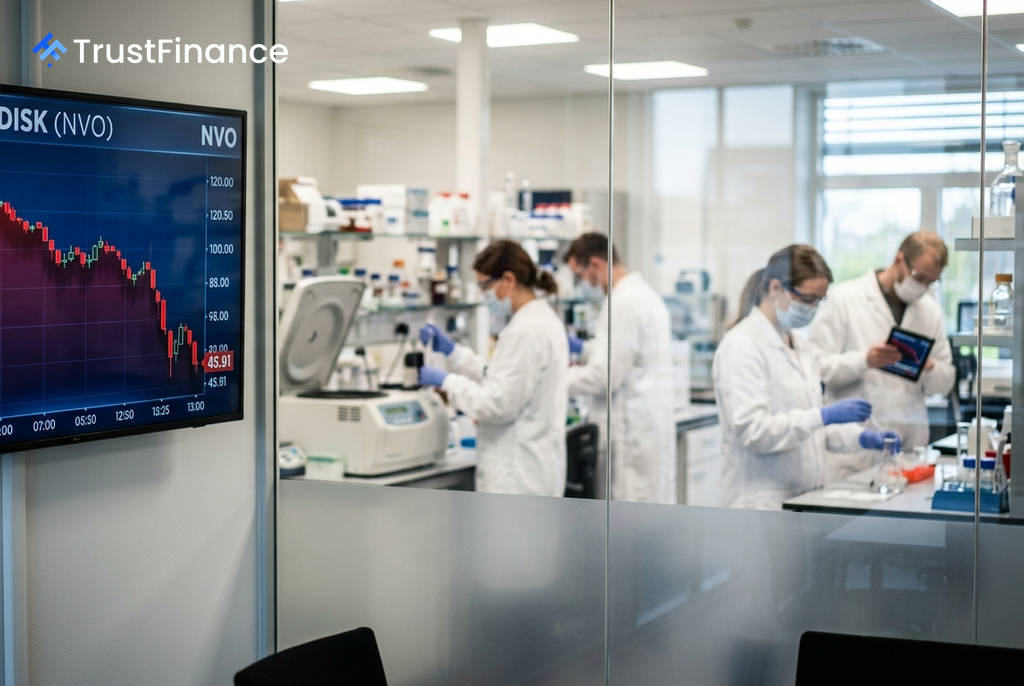
Novo Nordisk shares plunged in pre-market trading after the company announced its experimental cardiovascular drug, ziltivekimab, failed a critical late-stage clinical trial. The sell-off was intensified by a recent court ruling allowing a shareholder lawsuit related to its weight-loss drug pipeline to proceed.
Key Pipeline Asset Fails
The company disclosed that its IL-6 inhibitor, ziltivekimab, did not meet its primary endpoint in the Phase 3 ZEUS trial. The study, which involved over 6,300 patients with cardiovascular disease and chronic kidney disease, was designed to assess if the drug could reduce major adverse cardiovascular events.
According to the announcement, ziltivekimab showed no therapeutic benefit compared to a placebo, posting a hazard ratio of 0.99. For investors, this result effectively eliminates a promising pipeline asset outside of Novo Nordisk's core GLP-1 franchise, removing a significant source of potential future revenue that had been priced into the company's valuation.
Legal and Competitive Pressures Mount
 Ad
The trial failure comes just days after a U.S. District Court judge ruled that Novo Nordisk must face a shareholder securities fraud lawsuit concerning its next-generation weight-loss drug, CagriSema. The lawsuit alleges the company concealed a mid-trial protocol change that misled investors about the drug's efficacy and tolerability.
These internal challenges are compounded by fierce competition from Eli Lilly, whose Zepbound has already outperformed CagriSema in a head-to-head study. The confluence of a major clinical trial failure and mounting legal risk creates a significant headwind for Novo Nordisk.
Market Reaction
In response to the news, shares of Novo Nordisk fell 11.0% to $45.91 in pre-open trading, approaching the lower end of its 52-week range. The decline was company-specific, occurring while broader U.S. market indices like the S&P 500 and Nasdaq were pointing to a higher open, underscoring the severity of the market's reaction to the dual setbacks.
Read next
More on Stocks
FTC Orders Walmart, Uber, Delta to Disclose Data on Personalized Pricing
The U.S. Federal Trade Commission is demanding nine major companies, including leading retail, travel, and gig economy firms, to provide information on how they use consumer data for setting individual prices and wages.

Google Launches Gemini 4 Carbon AI Model to Bolster Cybersecurity Capabilities
Alphabet's Google has unveiled Gemini 4 Carbon, its latest AI model specifically designed for advanced cybersecurity tasks like vulnerability detection and secure code generation. The launch escalates competition with rivals OpenAI and Anthropic in the enterprise AI market.

Oracle Shares Surge After Unveiling $225 Billion Revenue Target for 2030
Oracle stock rose sharply after the company presented a long-term financial outlook targeting at least $225 billion in annual revenue by fiscal 2030, driven by its expanding AI infrastructure business.

DOJ Scrutinizes Nvidia's $12.9B Hugging Face Deal Amid Broader Antitrust Probe, Sources Say
The U.S. Department of Justice is reportedly examining Nvidia's planned $12.93 billion acquisition of AI platform Hugging Face as part of a wider, ongoing antitrust investigation into the chipmaker's market conduct.