
Story
Individual Treasuries vs. Bond ETFs: Navigating Trade-Offs in a High-Yield Environment
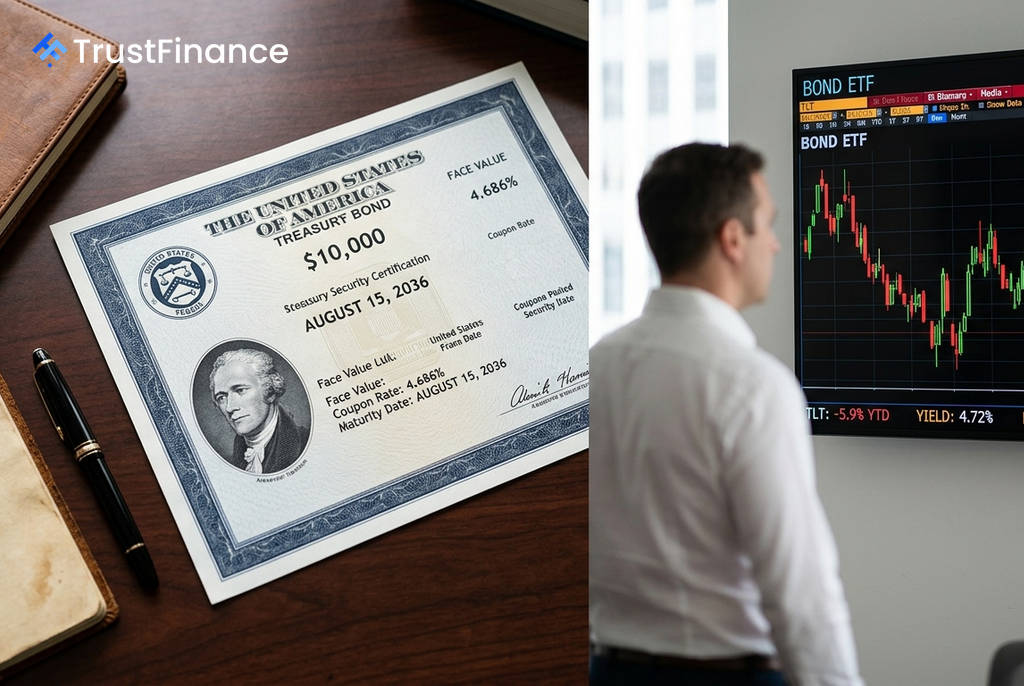
Investors are confronting a critical choice in the fixed-income market: lock in some of the highest U.S. Treasury yields in years with individual bonds or opt for the liquidity and diversification of bond ETFs, which have suffered price declines as interest rates have climbed.
The Yield and Return Divergence
The current landscape highlights a stark contrast between the yields offered and the recent performance of bond funds. According to data from Investing.com on August 11, the trade-offs are clear:
- U.S. 2-Year Treasury: Yield of 4.22%
- U.S. 10-Year Treasury: Yield of 4.69%
- U.S. 30-Year Treasury: Yield of 5.24%
Meanwhile, popular bond ETFs show negative year-to-date total returns due to falling bond prices:
- iShares 20+ Year Treasury Bond ETF (TLT): Yield of 4.72%, but down -5.90% YTD.
- iShares Core U.S. Aggregate Bond ETF (AGG): Yield of 4.04%, but down -2.64% YTD.
- iShares iBoxx $ Investment Grade Corporate Bond ETF (LQD): Yield of 4.65%, but down -3.86% YTD.
A Structural Divide: Maturity vs. Perpetuity
 Ad
The core difference lies in their structure. An individual Treasury bond is a direct loan to the government with a set maturity date. An investor who holds it to maturity is guaranteed to receive their principal back, plus periodic interest payments, making interim price swings caused by rate changes irrelevant to the final outcome.
In contrast, a bond ETF is a perpetual portfolio of bonds that managers continuously buy and sell to maintain a target duration or index. It has no maturity date. When interest rates rise, the prices of the bonds within the ETF fall, directly reducing its net asset value (NAV). While the ETF's yield increases for new buyers, existing investors have experienced a loss of principal.
Market Implications for Investors
This structural difference makes the choice highly dependent on an investor's view on the future path of interest rates. For those who believe rates have peaked, buying an individual 10-year Treasury to lock in a 4.69% yield for a decade offers certainty and protection from further price volatility.
Investors who prioritize liquidity or require broad diversification may still favor ETFs like the iShares AGG, which holds over 13,000 securities for a low expense ratio of 0.03%. However, they must accept the associated duration risk—the sensitivity of bond prices to rate changes. Long-duration funds like TLT are particularly vulnerable, as their steep year-to-date losses demonstrate. The decision ultimately rests on whether an investor prefers a guaranteed rate of return or the flexibility of a traded fund in an uncertain rate environment.
Read next
More on Stocks
FTC Orders Walmart, Uber, Delta to Disclose Data on Personalized Pricing
The U.S. Federal Trade Commission is demanding nine major companies, including leading retail, travel, and gig economy firms, to provide information on how they use consumer data for setting individual prices and wages.

Google Launches Gemini 4 Carbon AI Model to Bolster Cybersecurity Capabilities
Alphabet's Google has unveiled Gemini 4 Carbon, its latest AI model specifically designed for advanced cybersecurity tasks like vulnerability detection and secure code generation. The launch escalates competition with rivals OpenAI and Anthropic in the enterprise AI market.

Oracle Shares Surge After Unveiling $225 Billion Revenue Target for 2030
Oracle stock rose sharply after the company presented a long-term financial outlook targeting at least $225 billion in annual revenue by fiscal 2030, driven by its expanding AI infrastructure business.

DOJ Scrutinizes Nvidia's $12.9B Hugging Face Deal Amid Broader Antitrust Probe, Sources Say
The U.S. Department of Justice is reportedly examining Nvidia's planned $12.93 billion acquisition of AI platform Hugging Face as part of a wider, ongoing antitrust investigation into the chipmaker's market conduct.