
Story
Gold Slips Below $4,000 as Middle East Tensions Stoke Inflation Fears
Summary
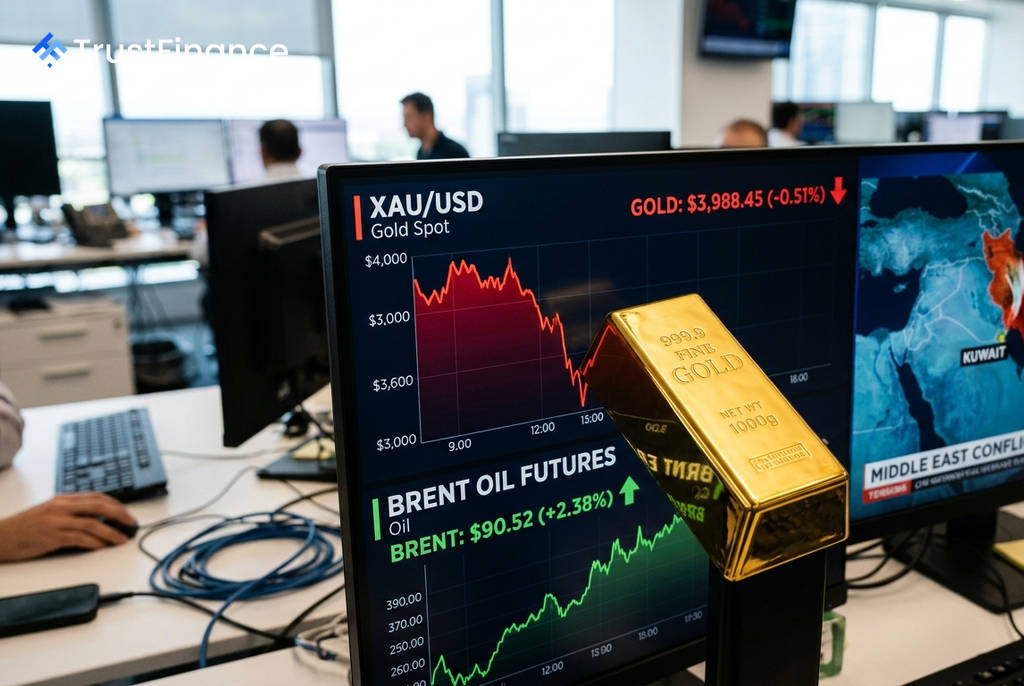
Gold prices fell as escalating U.S.-Iran hostilities drove oil prices above $90 a barrel, renewing concerns that persistent inflation could force the Federal Reserve to maintain a restrictive monetary policy.
Gold prices slipped below the key $4,000-an-ounce level on Monday, pressured by a surge in oil prices following an escalation in U.S.-Iran hostilities. The move is fueling investor concerns that renewed inflationary pressures could complicate the Federal Reserve's path on monetary policy, diminishing the appeal of the non-yielding metal.
As of 21:37 ET (01:37 GMT), spot gold (XAU/USD) was down 0.4% at $4,003.68 an ounce, while gold futures for August delivery fell 2.2% to $4,008.25 an ounce, according to data from Investing.com.
Geopolitical Tensions Drive Oil Higher
The primary driver for gold's decline is the market's reaction to heightened conflict in the Middle East. Tensions flared over the weekend with intensified military operations, including an attack on a key Kuwaiti oil facility and strikes on vessels near the Strait of Hormuz, a critical global oil shipping route.
In response, Brent crude futures climbed above $90 a barrel, reviving fears about energy-driven inflation. This development comes after recent U.S. economic data had pointed to a cooling in price pressures, but a sustained rise in energy costs could reverse that trend.
Federal Reserve Outlook in Focus
 Ad
AdThe surge in oil prices has put the Federal Reserve's policy outlook back under intense scrutiny. Higher inflation could force the central bank to keep interest rates elevated for a longer period to ensure price stability.
Higher interest rates typically boost the U.S. dollar and Treasury yields, which increases the opportunity cost of holding gold. According to ANZ analysts cited by Investing.com, market expectations for a Fed rate hike at its July 29 meeting briefly jumped to 40% amid the conflict before settling back to around 10%.
Market Context
Gold has been trading in a narrow range around the psychologically important $4,000 level after a difficult second quarter, where it fell 14%—its worst quarterly performance since 2013. The price action underscores how expectations for U.S. monetary policy are currently a more dominant driver for gold than its traditional role as a safe-haven asset.
ANZ analysts noted that the bar for another Fed rate hike remains high and expect policymakers may look through the energy price spike unless it creates broader inflationary effects. The bank sees a potential support range for gold between $3,800 and $4,000 an ounce as expectations for further Fed tightening fade.
Read next
More on Commodities
Soybean Futures Hold Steady as Traders Await U.S.-China Summit Outcome
CBOT soybean futures traded nearly flat on Tuesday as the market adopted a wait-and-see approach ahead of a high-stakes diplomatic meeting between the U.S. and China. Investors are watching for potential new purchase agreements and the removal of key tariffs.

US to Continue Canadian Potash Imports, Trump Says, But Notes Cheaper Belarus Offer
President Trump said the U.S. will maintain its potash supply from Canada, but highlighted that Belarus has offered to sell the crucial fertilizer ingredient at a 'much lower price,' potentially signaling a new trade pressure point.

Trump Backs Potential Ban on US Diesel Exports to Curb Record-High Prices
President Donald Trump said he supports the idea of banning U.S. diesel exports, a measure his administration is reportedly examining as a way to lower soaring domestic energy costs ahead of midterm elections.

Trump Says US-Iran Talks Ongoing, Believes a Deal Will Be Reached
U.S. President Donald Trump said on Tuesday that talks with Iran are continuing and that he expects a settlement to be reached, adding the key condition that Tehran cannot be allowed to obtain a nuclear weapon.