
Story
Equipment Rental Sector Sees Structural Growth Amid Margin and Leverage Headwinds

Summary
The U.S. equipment rental and leasing sector is experiencing a structural demand shift, fueling growth for industry leaders like United Rentals and Sunbelt, while high leverage and margin pressures present key risks.
The U.S. equipment rental and leasing sector is demonstrating notable resilience, buoyed by a structural shift from equipment ownership to rental. This trend is providing a significant tailwind for the industry, allowing for sustained growth even amid periods of economic uncertainty.
Structural Tailwinds Drive Demand
A key driver of the sector's strength is the deepening penetration of rental services across various industries. According to comments from Sunbelt Rentals CEO Brendan Horgan at a Morgan Stanley conference on September 16, 2026, the industry proved its pricing power by raising rental rates over 4% during a 28-month decline in local non-residential construction.
This resilience is underpinned by a secular trend of municipalities, data center developers, and large-scale contractors opting to rent rather than own heavy equipment. The market is further supported by a pipeline of so-called mega-projects in energy, transportation, and manufacturing, estimated at $2 trillion with the majority of the opportunity expected through April 2030, according to Investing.com analysis.
Industry Leaders Post Strong Growth
The sector's largest players have capitalized on these trends to deliver significant expansion. Key performance indicators include:
 Ad
Ad- United Rentals (URI): The market leader has grown its revenue by approximately 65% over the last five fiscal years, from $9.72 billion to $16.10 billion, while consistently generating over $2 billion in annual levered free cash flow (FCF).
- Sunbelt Rentals (SUNB): The company has also seen substantial growth, scaling revenue from $7.96 billion to $11.15 billion. It reported a record $2.01 billion in FCF for fiscal year 2026 and raised its guidance by 2% after its first-quarter fiscal year 2027 results.
Margin Compression and Leverage Risks
Despite strong top-line growth, the industry faces headwinds from cost pressures and high debt levels. United Rentals saw its gross margin decline from 43.1% in 2022 to 38.4% in 2025. Similarly, its net margin eased from a peak of 18.1% to 15.5%.
The impact is more pronounced for modular space provider WillScot (WSC), whose net margin fell from 20.1% in 2023 to a negative 2.3% in 2025, largely driven by higher financing costs. Leverage is a key characteristic of the asset-heavy rental model, with debt-to-equity ratios reported at 166.8% for URI, 153.4% for SUNB, and 416.7% for WSC, amplifying interest rate risk.
Read next
More on Stocks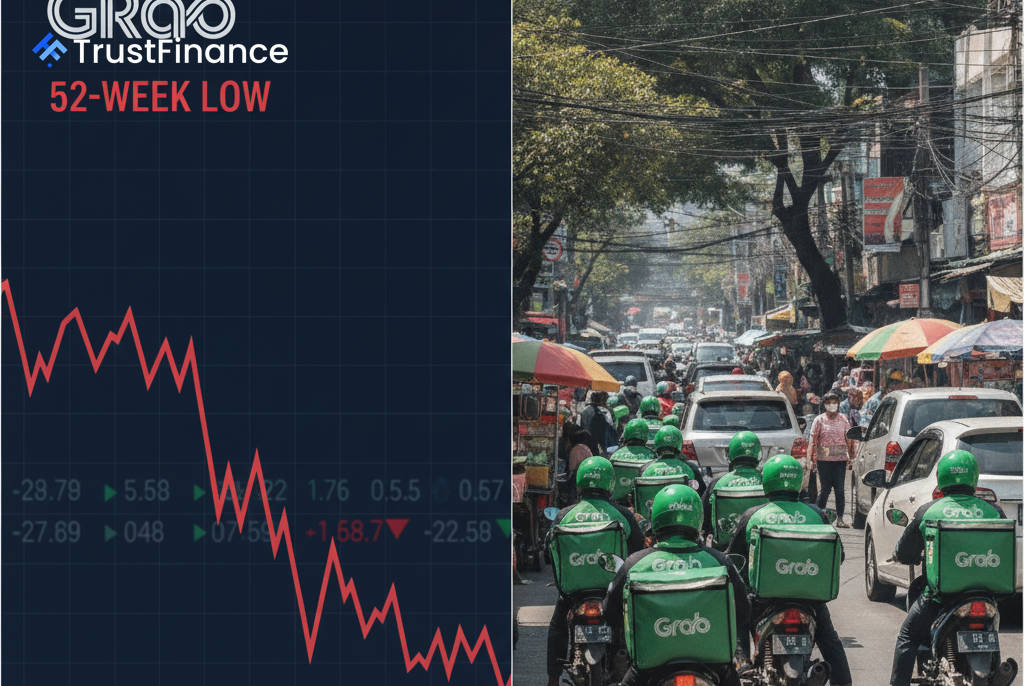
Grab Stock Hits 52-Week Low Despite Significant Profitability Gains
Shares of Grab Holdings are trading near 52-week lows, a stark contrast to the company's improving fundamentals, which include 18 consecutive quarters of EBITDA growth and a significant earnings beat in its most recent quarter.

FAA Halts Flights to Philadelphia and Newark Airports Citing ATC Communication Failure
The Federal Aviation Administration issued a temporary ground stop for flights into Philadelphia and Newark airports due to a communication systems failure, causing over 600 delays and highlighting ongoing infrastructure challenges.

Opendoor Stock Rebounds Sharply, But Technicals and Fundamentals Signal Caution
Opendoor Technologies (OPEN) shares saw a significant intraday rally, but the bounce comes after a 73% annual decline and masks persistent fundamental issues, including collapsing revenue and a history of significant earnings misses.

US Lawmakers Urge Trump to Uphold Ban on Chinese Automakers
A group of 27 Democratic lawmakers has called on President Donald Trump to maintain a ban on Chinese automakers and related technologies from entering the U.S. market. The request comes ahead of a scheduled meeting between the two nations' leaders.