
Story
Grab Stock Hits 52-Week Low Despite Significant Profitability Gains
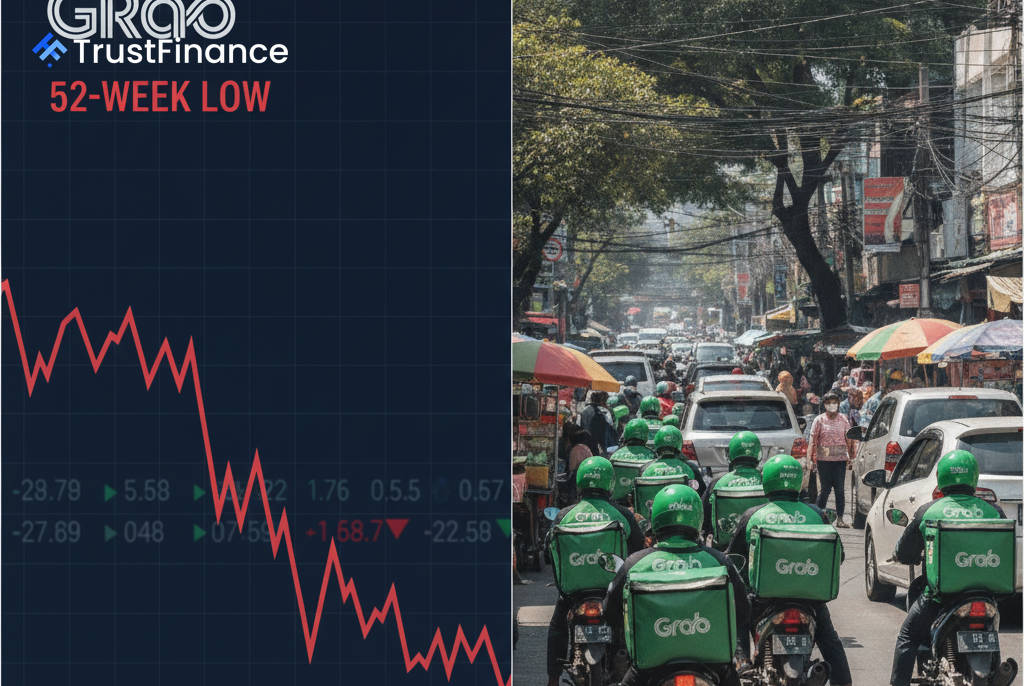
Grab Holdings (NASDAQ: GRAB) shares are trading near their 52-week low, presenting a sharp disconnect between the company's stock market performance and its significant operational turnaround. Despite a one-year return of -56.3%, the Southeast Asian tech firm has demonstrated substantial improvements in profitability and growth, raising questions among investors about the factors weighing on its valuation.
A Fundamental Turnaround
Grab's financial results show a clear pivot toward profitability. The company has engineered a remarkable swing in adjusted earnings, moving from a substantial EBITDA deficit in previous years toward projected profitability. This progress was highlighted in its second-quarter 2026 results.
Key figures from the company's Q2 2026 report include:
- Revenue: $997 million, an increase of 22% year-over-year.
- Earnings Per Share (EPS): $0.06, decisively beating the analyst consensus estimate of $0.02.
- EBITDA Growth: The company's CFO noted 18 consecutive quarters of growth in adjusted EBITDA.
A key caveat to the profitability story is that Grab's free cash flow (FCF) remained negative at -$160 million for the last twelve months, as of June 30, 2026. This is attributed to aggressive investments, including the transition to an electric vehicle fleet and the acquisition of Atome Financial.
Valuation and Market Sentiment
 Ad
The divergence between Grab's operational success and its stock price is reflected in its valuation metrics. While Wall Street analyst consensus points to a potential upside of over 100%, the stock continues to trend downward. For example, Macquarie raised its price target to $5.55 following the Q2 earnings, citing that Grab trades at just 13 times its projected 2026 EV/EBITDA against a 47% YoY EBITDA growth rate.
The persistent selling pressure suggests the market is focused on headwinds beyond the quarterly earnings reports. These include regulatory risks, such as an unexpected commission cap imposed in Indonesia in May 2026, and broader macroeconomic sentiment affecting emerging markets.
Catalysts and Headwinds Ahead
Technical indicators suggest the stock is in a deeply entrenched downtrend. While the Relative Strength Index (RSI) of 27.5 indicates the stock is technically oversold, the Average Directional Index (ADX) at 67.2 signals that the downward trend is extremely strong, cautioning against expectations of an immediate reversal.
Looking forward, investors will be watching several key catalysts that could alter the stock's trajectory. The company's management has pointed to its financial services division achieving profitability in the second half of 2026 as a major potential driver. Additionally, a recently authorized $1.75 billion share buyback program, representing a significant portion of its market capitalization, could provide support for the share price.
Read next
More on Stocks
FTC Orders Walmart, Uber, Delta to Disclose Data on Personalized Pricing
The U.S. Federal Trade Commission is demanding nine major companies, including leading retail, travel, and gig economy firms, to provide information on how they use consumer data for setting individual prices and wages.

Google Launches Gemini 4 Carbon AI Model to Bolster Cybersecurity Capabilities
Alphabet's Google has unveiled Gemini 4 Carbon, its latest AI model specifically designed for advanced cybersecurity tasks like vulnerability detection and secure code generation. The launch escalates competition with rivals OpenAI and Anthropic in the enterprise AI market.

Oracle Shares Surge After Unveiling $225 Billion Revenue Target for 2030
Oracle stock rose sharply after the company presented a long-term financial outlook targeting at least $225 billion in annual revenue by fiscal 2030, driven by its expanding AI infrastructure business.

DOJ Scrutinizes Nvidia's $12.9B Hugging Face Deal Amid Broader Antitrust Probe, Sources Say
The U.S. Department of Justice is reportedly examining Nvidia's planned $12.93 billion acquisition of AI platform Hugging Face as part of a wider, ongoing antitrust investigation into the chipmaker's market conduct.