
Story
Bank of America Offers Best Valuation as JPMorgan Leads on Quality in U.S. Banking Sector, Analysis Finds
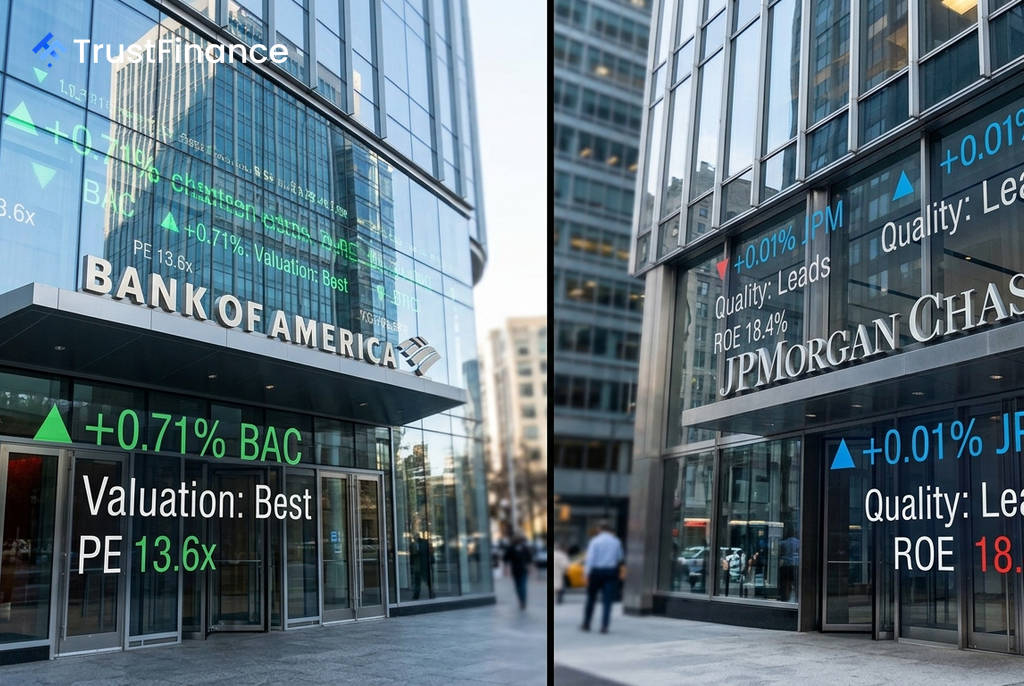
The U.S. banking sector presents a constructive but late-cycle investment landscape where stock selection is becoming critical, according to an analysis by Investing.com. The outlook favors Bank of America on valuation metrics, while JPMorgan Chase continues to be the benchmark for quality and consistent execution.
A Divergent Market
While sentiment for bank stocks is broadly positive, performance has been uneven year-to-date. The divergence highlights investor selectivity as the economic cycle matures.
- Bank of America (BAC) has gained 13.45% year-to-date, with investors anticipating stronger net interest income.
- JPMorgan Chase (JPM) is up 10.07%, reflecting its premium for operational excellence.
- Wells Fargo (WFC) has lagged its peers, declining 4.72% over the same period.
This selective performance comes as analysts, including those at Goldman Sachs, warn of potential late-cycle volatility stemming from interest rates, geopolitical factors, and the possibility that earnings revisions have peaked.
By the Numbers: Valuation vs. Profitability
Fundamental data reveals a clear trade-off between valuation and profitability among the largest U.S. banks. JPMorgan leads on key efficiency metrics, but Bank of America and Wells Fargo offer more attractive valuations based on current prices and fair-value estimates.
A comparison of key metrics shows:
 Ad
- Bank of America: A price-to-earnings (P/E) ratio of 13.6x, a Return on Equity (ROE) of 11.6%, and a potential fair-value upside of 21.3%.
- JPMorgan Chase: A higher P/E of 14.9x, a sector-leading ROE of 18.4%, and a fair-value upside of 8.2%.
- Wells Fargo: The lowest P/E at 12.4x, an ROE of 13.1%, and the highest fair-value upside at 22.1%.
Return on Equity (ROE) is a critical measure of how efficiently a bank generates profit from the capital invested by its shareholders. JPMorgan's superior ROE demonstrates its durable scale and profitability.
Key Risks on the Horizon
Investors must weigh the sector's positive momentum against several significant risks. These fault lines could impact bank earnings and share prices as the economic cycle progresses.
Key risks include:
- Interest Rates: Falling rates could compress net interest margins, particularly for banks with large deposit bases.
- Credit Quality: An economic slowdown could increase loan delinquencies in commercial real estate and consumer portfolios, forcing banks to raise provisions for losses.
- Operating Costs: Heightened competition for deposits, combined with spending on technology and compliance, may limit profit growth.
- Valuation: A portion of the sector's recovery has already been priced into stock valuations, potentially limiting near-term gains.
Read next
More on Stocks
FTC Orders Walmart, Uber, Delta to Disclose Data on Personalized Pricing
The U.S. Federal Trade Commission is demanding nine major companies, including leading retail, travel, and gig economy firms, to provide information on how they use consumer data for setting individual prices and wages.

Google Launches Gemini 4 Carbon AI Model to Bolster Cybersecurity Capabilities
Alphabet's Google has unveiled Gemini 4 Carbon, its latest AI model specifically designed for advanced cybersecurity tasks like vulnerability detection and secure code generation. The launch escalates competition with rivals OpenAI and Anthropic in the enterprise AI market.

Oracle Shares Surge After Unveiling $225 Billion Revenue Target for 2030
Oracle stock rose sharply after the company presented a long-term financial outlook targeting at least $225 billion in annual revenue by fiscal 2030, driven by its expanding AI infrastructure business.

DOJ Scrutinizes Nvidia's $12.9B Hugging Face Deal Amid Broader Antitrust Probe, Sources Say
The U.S. Department of Justice is reportedly examining Nvidia's planned $12.93 billion acquisition of AI platform Hugging Face as part of a wider, ongoing antitrust investigation into the chipmaker's market conduct.