
Story
AMD Stock Slides After-Hours Despite Record Revenue and Earnings Beat
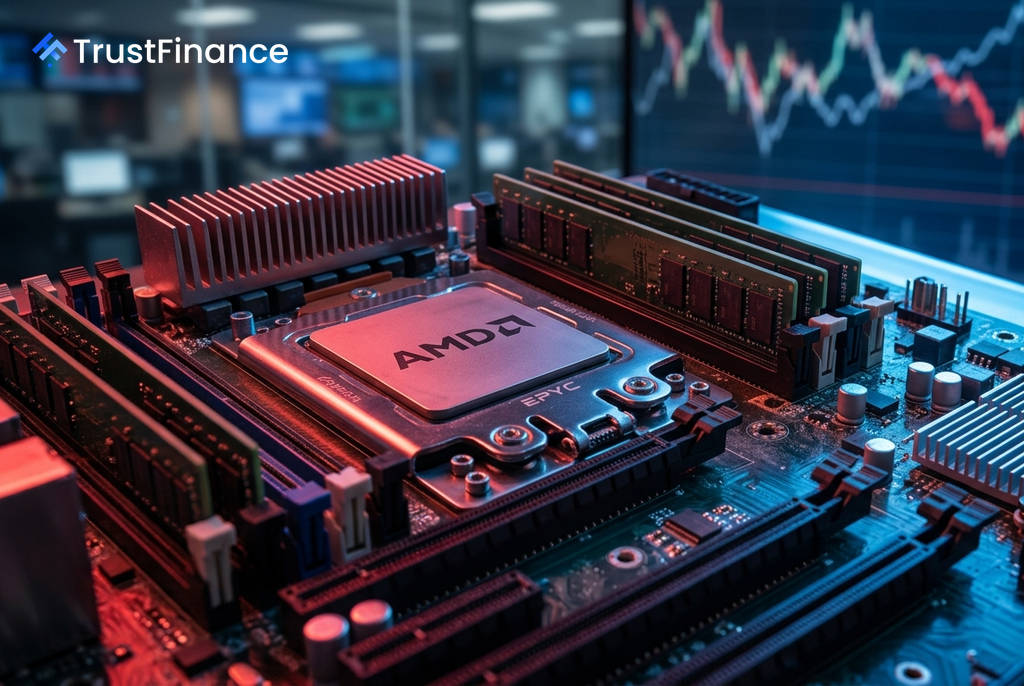
Shares of Advanced Micro Devices (NASDAQ: AMD) fell 9.1% in after-hours trading Tuesday, even after the company reported record second-quarter financial results that surpassed Wall Street estimates. The negative reaction highlights a market where strong performance was not enough to satisfy the lofty expectations built into the stock following a significant year-to-date rally.
Results Surpass Estimates
AMD announced record-breaking quarterly results, driven by exceptional growth in its Data Center business. The company's performance beat analyst consensus on both the top and bottom lines.
- Q2 Revenue: $11.54 billion, a 50% increase year-over-year and above the consensus estimate of $11.28 billion.
- Q2 Adjusted EPS: $1.66, topping the Wall Street consensus of approximately $1.62.
Despite the official beat, the earnings per share fell short of the informal "whisper number" of $1.69 that some traders had anticipated. The Data Center segment was a key growth driver, with revenue more than doubling to $6.72 billion and swinging to a $2.1 billion operating income from a $155 million loss a year prior.
Guidance and Market Reaction
 Ad
For the third quarter of 2026, AMD projected revenue of approximately $13 billion, plus or minus $300 million. This forecast is ahead of the average analyst estimate of roughly $12.52 billion. CEO Lisa Su cited accelerating demand for EPYC server CPUs and the initial ramp of the new Helios platform.
However, investors appeared to be looking for an even more aggressive outlook to justify the stock's valuation, which stood at roughly 54 times forward earnings. The after-hours decline is a classic example of a "sell-the-news" event, where a stock that has run up significantly ahead of a report sells off even on good news.
Broader Sector Pressure
The selloff in AMD shares reflects a wider trend impacting the semiconductor industry. Capital has been rotating away from high-multiple technology stocks and into more defensive sectors. The Philadelphia Semiconductor Index (SOX) experienced its worst month in July since October 2008, indicating broad-based pressure on the sector.
AMD's post-earnings drop appears to be more a function of extremely high investor expectations and market sentiment rather than a commentary on the company's strong underlying business fundamentals. Investors may be waiting for greater certainty on revenue from new products like the MI450 GPU before pushing the stock higher.
Read next
More on Stocks
FTC Orders Walmart, Uber, Delta to Disclose Data on Personalized Pricing
The U.S. Federal Trade Commission is demanding nine major companies, including leading retail, travel, and gig economy firms, to provide information on how they use consumer data for setting individual prices and wages.

Google Launches Gemini 4 Carbon AI Model to Bolster Cybersecurity Capabilities
Alphabet's Google has unveiled Gemini 4 Carbon, its latest AI model specifically designed for advanced cybersecurity tasks like vulnerability detection and secure code generation. The launch escalates competition with rivals OpenAI and Anthropic in the enterprise AI market.

Oracle Shares Surge After Unveiling $225 Billion Revenue Target for 2030
Oracle stock rose sharply after the company presented a long-term financial outlook targeting at least $225 billion in annual revenue by fiscal 2030, driven by its expanding AI infrastructure business.

DOJ Scrutinizes Nvidia's $12.9B Hugging Face Deal Amid Broader Antitrust Probe, Sources Say
The U.S. Department of Justice is reportedly examining Nvidia's planned $12.93 billion acquisition of AI platform Hugging Face as part of a wider, ongoing antitrust investigation into the chipmaker's market conduct.