
Story
10-Year Treasury Yield Nears 5% Milestone, Forcing Market Reassessment
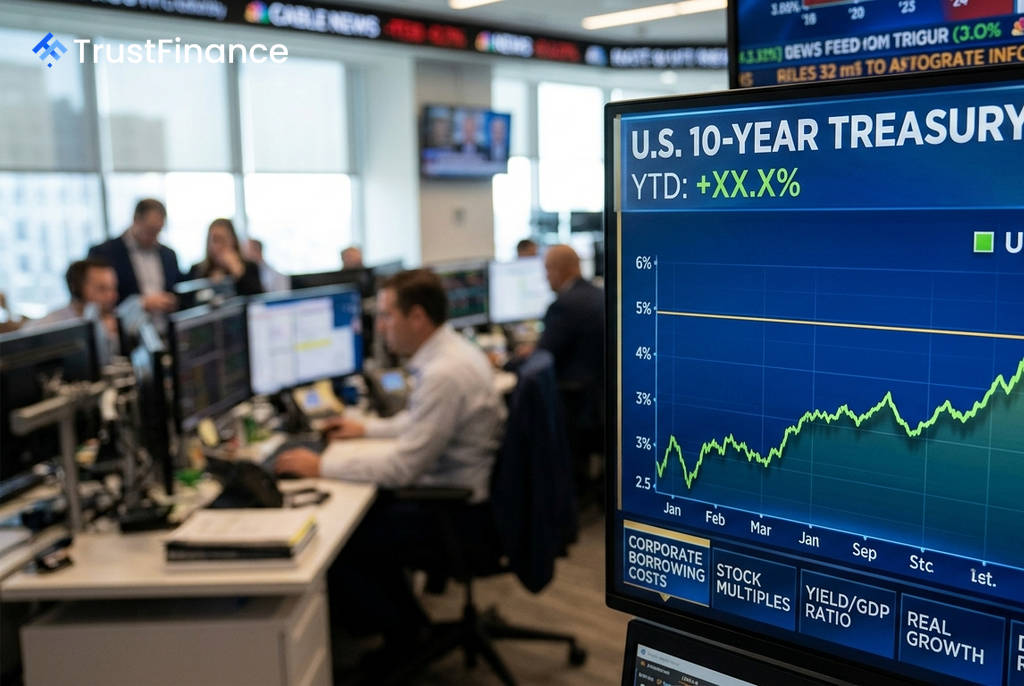
The U.S. 10-year Treasury yield is approaching the critical 5% threshold, a level not sustained for nearly two decades. This bond market selloff is forcing investors to reassess the outlook for everything from stock valuations and corporate finance to the sustainability of U.S. government debt.
Pressure Mounts on Equities and Corporate Finance
Higher benchmark yields directly translate to increased borrowing costs for companies. This could make it more expensive to refinance existing debt or fund new capital expenditures, potentially weighing on corporate earnings just as firms are ramping up investments in areas like artificial intelligence.
The surge in borrowing costs is also casting a shadow over dealmaking. According to Reuters, some investors report a more cautious mood and are bracing for a potential slowdown in mergers and acquisitions as the higher cost of capital makes financing large transactions more challenging.
As bond yields rise, they offer a more competitive, lower-risk return compared to equities. Albert Edwards of Societe Generale noted in a recent commentary that the ratio of the 30-year Treasury yield to the stock dividend yield is at its highest since the dot-com bust of 2000, suggesting that highly valued stock markets may be more vulnerable to negative news.
The Macroeconomic Backdrop
A key debate among investors is whether rising yields reflect economic strength or fiscal weakness. Some analysts contend the trend points to a strong economy where heavy demand for capital, driven by an AI investment boom, is pushing up rates. This view is supported by the fact that much of the yield increase has been driven by real rates—yields adjusted for inflation—which is consistent with expectations for solid economic growth.
 Ad
"The recent rise in long-end Treasury yields has been driven predominantly by real rates," said Gennadiy Goldberg, head of U.S. Rates Strategy at TD Securities, in a comment cited by Reuters.
A competing view points to expansive government spending as a primary driver. With U.S. government debt recently surpassing $40 trillion and the fiscal deficit widening, some investors worry the bond selloff could be a precursor to more pain if buyers demand higher compensation for holding U.S. debt.
The Growth vs. Yield Calculus
A crucial metric for assessing debt sustainability is the relationship between the 10-year Treasury yield and nominal economic growth. As long as the rate of GDP growth remains above the government's borrowing costs, the national debt burden is considered manageable.
The benchmark 10-year yield recently touched 4.8%, while nominal year-over-year U.S. GDP growth was 6.56% in the second quarter, according to the source. While this provides a cushion, analysts note that the margin for error is narrowing as yields continue to climb.
Read next
More on Forex
Polish Zloty Hits 11-Month Low Against Euro on Energy Price Pressure
The Polish zloty weakened to 4.410 against the euro, its lowest point since November 2023, as rising energy prices and caution ahead of a U.S. Federal Reserve decision weighed on the currency.

Sterling Slips as Dollar Strengthens Ahead of Fed Decision and UK Budget
The British pound lost ground against a resurgent U.S. dollar on Wednesday as market attention shifted from tech sector volatility to upcoming central bank decisions and the UK budget announcement.

Eurozone Bond Yields Climb as French Fiscal Concerns Return Ahead of Fed, ECB Decisions
Yields on French and German government bonds rose as relief from a ratings affirmation for France proved temporary, with investors refocusing on fiscal challenges and awaiting key policy verdicts from the U.S. Federal Reserve and the European Central Bank.

Canadian Dollar Slips as Markets Await Bank of Canada, Fed Decisions
The Canadian dollar edged lower against its U.S. counterpart, snapping a seven-day winning streak as investors adopted a cautious stance ahead of Wednesday's key interest rate announcements from both the Bank of Canada and the U.S. Federal Reserve.