
Story
U.S. Treasury Yields Hit Multi-Year Highs, Testing Stock Market Resilience
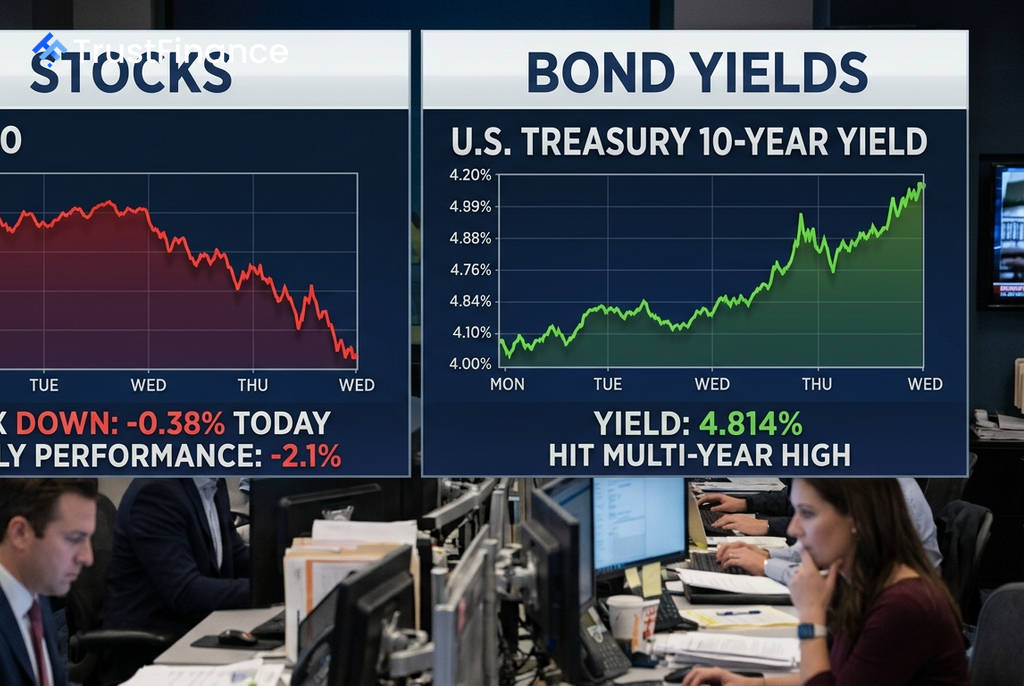
A global bond market selloff, intensified by a stronger-than-expected U.S. jobs report, has pushed benchmark Treasury yields to their highest levels since early 2025, renewing investor concerns over the potential impact on equity valuations.
Yields Surge on Strong Labor Data
The yield on the benchmark U.S. 10-year Treasury note briefly touched 4.81%, while the 2-year yield climbed to 4.42%. The move followed an August labor market report showing the economy added 162,000 positions, well above expectations, with the unemployment rate holding at 4.1%.
This data has increased market expectations that the Federal Reserve could implement another interest rate hike at its upcoming meeting on September 15-16 to combat persistent economic strength that could fuel inflation.
Why Rising Rates Challenge Stocks
Higher government bond yields present a multi-faceted challenge for equities. They increase the "risk-free" rate of return, making stocks, a riskier asset class, relatively less attractive. This dynamic can reduce the premium investors are willing to pay for equities.
Furthermore, higher yields are used to discount companies' future profits to their present value. This particularly pressures high-growth stocks whose valuations are heavily dependent on earnings expected far in the future. The surge in benchmark rates also translates into higher borrowing costs for corporations and consumers, which can slow business investment and spending.
 Ad
Growth Signal or Inflation Warning?
According to analysis from BCA Research, the critical factor for equity markets is not the absolute level of yields, but the reason for their ascent and the speed of the move. The relationship between stocks and yields can be positive when rising rates are driven by strong economic growth, which also boosts corporate earnings.
However, the relationship typically turns negative when yields rise due to inflation fears, as investors begin to price in more restrictive monetary policy from central banks. BCA Research notes that equities tend to struggle with sharp, sudden spikes in yields, making interest-rate volatility a more useful gauge of risk than the yield itself.
A Dangerous Combination
Investors now face the challenge of determining whether the current economic strength can be sustained without reigniting inflation. While the jobs data points to a resilient economy, factors like rising oil prices and significant government borrowing add to inflation concerns.
The most damaging scenario for stocks would be a combination of rising yields, stubbornly high inflation, and weakening economic growth. This would limit the Federal Reserve's ability to support the economy, increase financing costs, and severely compress equity valuations. Consequently, upcoming consumer price data will be a critical test for markets.
Read next
More on Stocks
FTC Orders Walmart, Uber, Delta to Disclose Data on Personalized Pricing
The U.S. Federal Trade Commission is demanding nine major companies, including leading retail, travel, and gig economy firms, to provide information on how they use consumer data for setting individual prices and wages.

Google Launches Gemini 4 Carbon AI Model to Bolster Cybersecurity Capabilities
Alphabet's Google has unveiled Gemini 4 Carbon, its latest AI model specifically designed for advanced cybersecurity tasks like vulnerability detection and secure code generation. The launch escalates competition with rivals OpenAI and Anthropic in the enterprise AI market.

Oracle Shares Surge After Unveiling $225 Billion Revenue Target for 2030
Oracle stock rose sharply after the company presented a long-term financial outlook targeting at least $225 billion in annual revenue by fiscal 2030, driven by its expanding AI infrastructure business.

DOJ Scrutinizes Nvidia's $12.9B Hugging Face Deal Amid Broader Antitrust Probe, Sources Say
The U.S. Department of Justice is reportedly examining Nvidia's planned $12.93 billion acquisition of AI platform Hugging Face as part of a wider, ongoing antitrust investigation into the chipmaker's market conduct.