
Story
UBS Upgrades Drax to Neutral, Citing Priced-In Headwinds and Solar Deal Impact
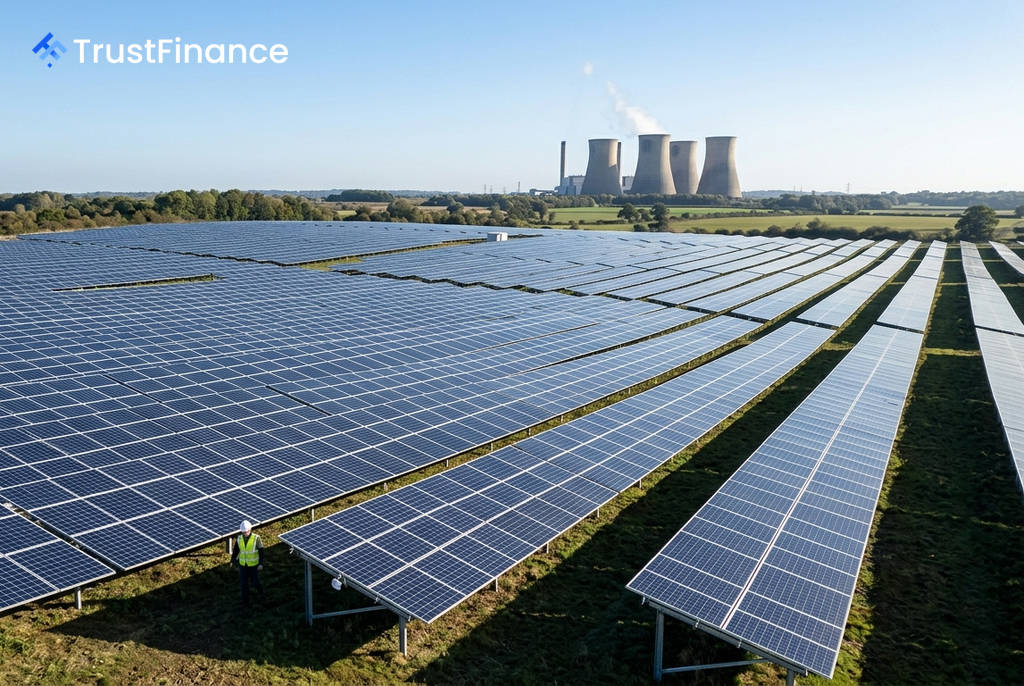
UBS has upgraded its rating on British power producer Drax Group to "Neutral" from "Sell," asserting that the company's shares now adequately reflect near-term headwinds. The bank also raised its 2026 earnings forecast for Drax, citing the ahead-of-schedule completion of its Bluefield Solar acquisition.
Revised Forecasts and Price Target
In a note to clients, UBS stated it "no longer sees sufficient downside" to maintain its sell rating, as the stock appears to have priced in much of the recent disappointment. The bank set a new 12-month price target of 745 pence.
The upgrade was accompanied by a mixed revision of earnings estimates, reflecting both new assets and rising costs:
- The 2026 adjusted earnings-per-share (EPS) forecast was increased by 9% to 83.90 pence, above the consensus estimate of 78.79 pence.
- Conversely, the bank cut its 2027 EPS forecast by 12%, attributing the reduction to expectations of higher biomass costs.
Capital Allocation in Focus
 Ad
According to UBS, capital allocation remains the central medium-term issue for investors. The company's recent strategic moves, including the £1.08 billion acquisition of Bluefield Solar and £460 million in battery storage investments, are intended to offset declining earnings from its legacy biomass operations.
These large investments are expected to keep the company's leverage near its target of 2.0 times net debt to EBITDA through 2028. Consequently, UBS now anticipates that the remaining £325 million of Drax's share buyback program will be delayed from 2025-28 until early 2027, pending the refinancing of the acquisition's bridge loan.
Future Catalysts and Downside Risks
UBS outlined several potential sources of upside for Drax not currently reflected in its valuation. These include the possibility of government intervention to support flexible generation and UK power prices rising above £120 per megawatt-hour, which would allow for more favorable biomass procurement.
The bank also highlighted "data centre optionality," estimating that monetizing the first 100 megawatts of its development pipeline could add approximately £100 million in value. However, key downside risks remain, including further inflation in biomass costs, continued delays to capital returns, and a potentially underwhelming capital markets day.
Read next
More on Stocks
FTC Orders Walmart, Uber, Delta to Disclose Data on Personalized Pricing
The U.S. Federal Trade Commission is demanding nine major companies, including leading retail, travel, and gig economy firms, to provide information on how they use consumer data for setting individual prices and wages.

Google Launches Gemini 4 Carbon AI Model to Bolster Cybersecurity Capabilities
Alphabet's Google has unveiled Gemini 4 Carbon, its latest AI model specifically designed for advanced cybersecurity tasks like vulnerability detection and secure code generation. The launch escalates competition with rivals OpenAI and Anthropic in the enterprise AI market.

Oracle Shares Surge After Unveiling $225 Billion Revenue Target for 2030
Oracle stock rose sharply after the company presented a long-term financial outlook targeting at least $225 billion in annual revenue by fiscal 2030, driven by its expanding AI infrastructure business.

DOJ Scrutinizes Nvidia's $12.9B Hugging Face Deal Amid Broader Antitrust Probe, Sources Say
The U.S. Department of Justice is reportedly examining Nvidia's planned $12.93 billion acquisition of AI platform Hugging Face as part of a wider, ongoing antitrust investigation into the chipmaker's market conduct.