
Story
S&P Global Trades at Significant Valuation Discount to Moody's, Analysis Shows
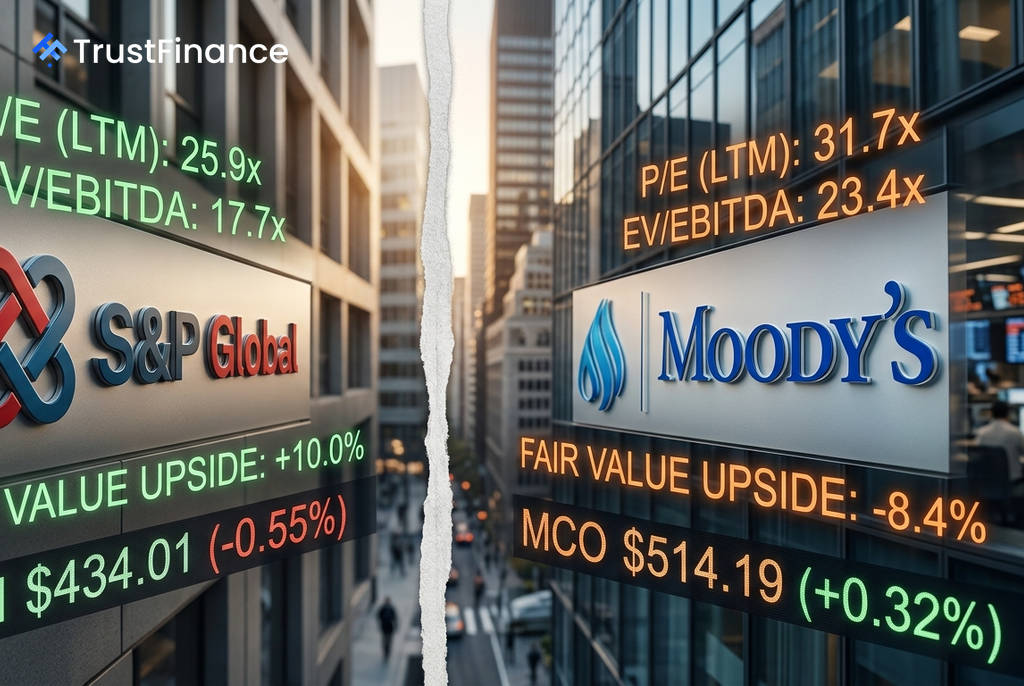
S&P Global (SPGI) appears to offer significantly better value than its primary competitor, Moody's Corporation (MCO), across most key valuation metrics, according to an analysis published by Investing.com. The report suggests SPGI trades at a notable discount despite operating in the same high-margin credit ratings duopoly.
The Valuation Gap
The analysis points to a clear gap in how the market is pricing the two financial data giants. S&P Global trades at a last-twelve-months price-to-earnings (P/E) ratio of 25.9x, compared to Moody's at 31.7x. This discount extends to other metrics, with SPGI's enterprise value-to-EBITDA ratio at 17.7x versus 23.4x for MCO.
According to the report, which cites analysis from WarrenAI, S&P Global is estimated to have a +10.0% upside to its fair value, while Moody's is seen as being -8.4% overvalued. S&P Global also leads on free cash flow yield, offering 4.4% compared to Moody's 3.3%.
Profitability and Balance Sheet Strength
While Moody's reports a significantly higher return on equity (ROE) of 80.2% compared to S&P Global's 15.2%, the analysis suggests this is largely a result of financial leverage. Moody's carries a debt-to-equity ratio of 251.9%, more than five times S&P Global's healthier ratio of 50.0%.
 Ad
S&P Global has also outpaced Moody's in revenue growth, posting a 5-year compound annual growth rate (CAGR) of 15.6% versus 7.5% for Moody's. This is partly attributed to successful acquisitions, such as the integration of IHS Markit, which has diversified SPGI's business beyond credit ratings.
Investor Considerations
Despite the favorable valuation, the report notes potential risks for investors. S&P Global's -15.9% one-year return could signal market concerns over integration costs or slowing momentum, raising the possibility of a "value trap."
For Moody's, the primary risk lies in its premium valuation, which makes it vulnerable to multiple compression in the event of a credit market slowdown. The analysis does note, however, that Moody's holds a slight edge on the PEG ratio (0.93 vs. SPGI's 0.99), reflecting stronger market expectations for near-term earnings growth.
Read next
More on Stocks
FTC Orders Walmart, Uber, Delta to Disclose Data on Personalized Pricing
The U.S. Federal Trade Commission is demanding nine major companies, including leading retail, travel, and gig economy firms, to provide information on how they use consumer data for setting individual prices and wages.

Google Launches Gemini 4 Carbon AI Model to Bolster Cybersecurity Capabilities
Alphabet's Google has unveiled Gemini 4 Carbon, its latest AI model specifically designed for advanced cybersecurity tasks like vulnerability detection and secure code generation. The launch escalates competition with rivals OpenAI and Anthropic in the enterprise AI market.

Oracle Shares Surge After Unveiling $225 Billion Revenue Target for 2030
Oracle stock rose sharply after the company presented a long-term financial outlook targeting at least $225 billion in annual revenue by fiscal 2030, driven by its expanding AI infrastructure business.

DOJ Scrutinizes Nvidia's $12.9B Hugging Face Deal Amid Broader Antitrust Probe, Sources Say
The U.S. Department of Justice is reportedly examining Nvidia's planned $12.93 billion acquisition of AI platform Hugging Face as part of a wider, ongoing antitrust investigation into the chipmaker's market conduct.