
Story
SoFi Stock Pressured by Rate Sensitivity Despite Strong Business Growth
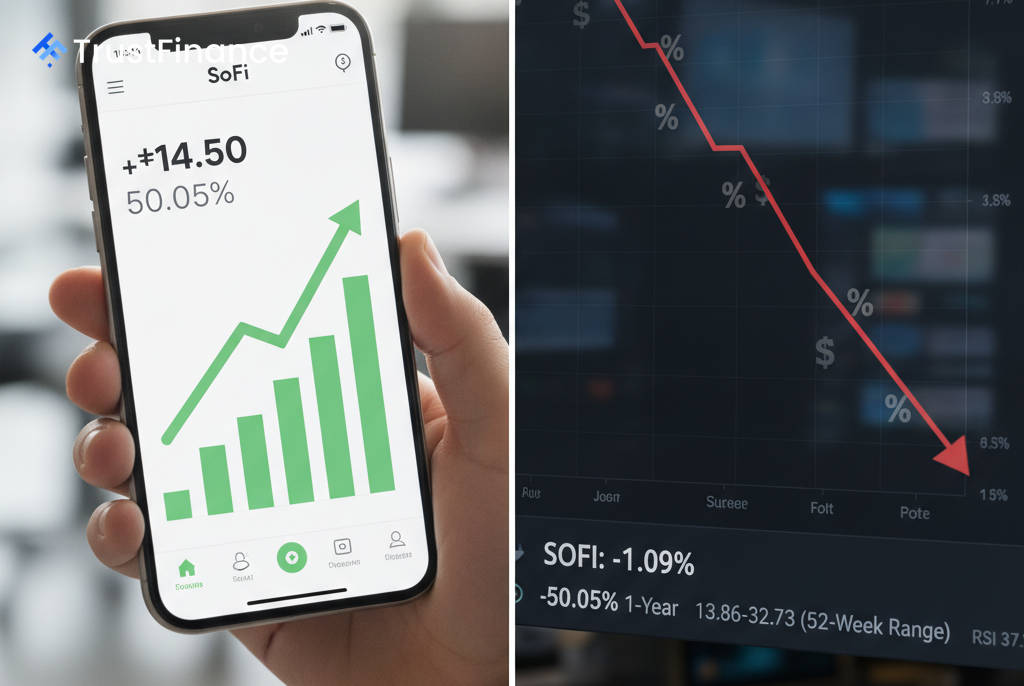
SoFi Technologies (NASDAQ: SOFI) shares have declined approximately 45.65% year-to-date, a move that starkly contrasts with the company's strong underlying business growth. The stock's performance has become increasingly tied to macroeconomic sentiment, particularly the outlook for interest rates, rather than its own operational results.
Growth Story vs. Market Reality
SoFi's financial results demonstrate a rapidly expanding business. The company has consistently beaten earnings per share estimates in three of the last four quarters and posted strong top-line growth. According to an analysis by Investing.com, key performance indicators highlight this momentum:
- Revenue Growth: Annual revenue is projected to grow from $1.52 billion in 2022 to $3.58 billion by 2025.
- User Growth: In the second quarter of 2026, SoFi reported member growth of 35% and product growth of 43%.
- Profitability: Net income is forecast to swing from a loss of $361 million in 2022 to a profit of $481 million in 2025.
Despite these figures, the stock has struggled. Shares fell 12.3% after its Q1 2026 report and 9.4% after its Q4 2025 results, even as it beat revenue expectations. As of October 26, the stock was trading near its 52-week low.
Macro Headwinds Dominate Sentiment
 Ad
The primary factor weighing on SoFi's stock is its sensitivity to interest rates. With a high beta of 2.33, the stock is significantly more volatile than the broader market and tends to react sharply to shifts in rate expectations. Rising rates could negatively impact demand for SoFi's key student-loan and home-loan refinancing products, a risk noted by the company's management.
This sensitivity was underscored in September when management adjusted its forecast from expecting two rate cuts to anticipating one or two hikes in the back half of the year. Analysts at Loop Capital have also noted that rate-hike risk and a shift toward more balance-sheet-heavy lending are likely to continue pressuring investor sentiment.
Upcoming Catalysts and Path Forward
SoFi's path to decoupling its stock from rate movements depends on proving it can grow its less rate-sensitive business lines. Management aims to increase its mix of fee-based income from its technology platform and other non-lending segments, such as crypto and business banking. The company has also guided for a long-term return on tangible equity of 25–30%, a significant increase from its current return on equity of 7.1%.
The next major test for the company comes with its third-quarter earnings report, scheduled for October 27. While analysts are watching for consensus estimates of $0.17 in EPS and $1.25 billion in revenue, the market's focus will be on management's guidance and commentary regarding the impact of the current interest rate environment.
Read next
More on Stocks
Tesla's 'No-Deal' Valuation Estimated in $355–$372 Range Amid SpaceX Merger Talk
Analysis suggests Tesla's current stock price includes a premium of roughly $20 to $40 per share based on potential merger talks with SpaceX. The electric vehicle maker's implied price without the deal is estimated to be between $355 and $372.

Ben & Jerry's Founders Explore ESOP-Based Carve-Out With KKR Executive, WSJ Reports
The founders of Ben & Jerry's are reportedly in discussions with a KKR executive to separate the ice cream brand from its parent company and restructure it under an employee ownership model.

Lycia Therapeutics Raises $365 Million in Upsized Nasdaq IPO
Clinical-stage biotech firm Lycia Therapeutics has closed its upsized initial public offering, raising approximately $365.1 million after underwriters fully exercised their option to purchase additional shares.

Broadcom, Major Banks Unveil $63 Billion AI Compute Financing for Anthropic
A consortium including Bank of America, Blackstone, Citi, and Morgan Stanley has committed $63 billion to finance the sale of Broadcom's AI hardware to Anthropic. The deal highlights the immense capital required for AI infrastructure and secures a long-term compute roadmap for the AI developer.