
Story
Robert Half Stock Slides as Q2 Margin Collapse Continues to Weigh on Investors
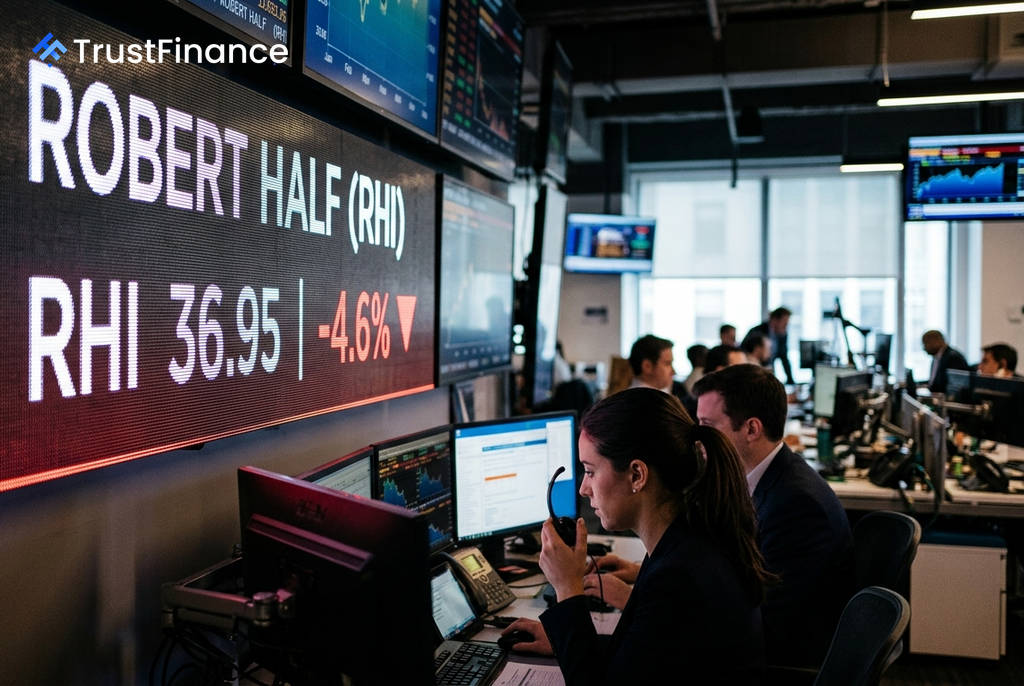
Shares of Robert Half (NYSE: RHI) fell 4.6% in pre-market trading Tuesday, changing hands at $36.95, as investors continued to react to the company's disappointing second-quarter profitability metrics released on July 23.
Profitability Miss Overshadows Revenue Beat
While Robert Half's second-quarter revenue of $1.34 billion narrowly surpassed analyst expectations of $1.32 billion, the report highlighted a significant deterioration in the company's financial health. The firm's operating margin swung from a positive 0.1% in the same period a year ago to a negative -4.7%, a development that alarmed the market.
This sharp decline in profitability pointed to mounting cost pressures and weakening operational efficiency. The negative margin overshadowed the slight revenue beat, signaling to investors that underlying business conditions remain challenging.
Sector Headwinds and Analyst Caution
The weakness in Robert Half's stock appears to be company-specific, as it comes on a day when major U.S. indices like the S&P 500 and Dow Jones posted modest gains. The staffing industry faces broad headwinds from a slowdown in white-collar hiring and a reluctance among corporate clients to increase discretionary spending on temporary labor and consulting services.
 Ad
Following the earnings release, analysts have largely maintained hold-equivalent ratings on the stock. According to Investing.com, concerns persist around softness in the company's core Finance, Accounting, and Administrative staffing divisions, as well as headwinds for its Protiviti consulting segment due to reduced regulatory remediation projects.
Dividend and Market Outlook
Robert Half's board recently declared a quarterly cash dividend of $0.59 per share, payable on September 15, 2026, to shareholders of record as of August 25. While this represents an annual yield of approximately 6.1% at current prices, the high yield is more a reflection of the stock's depressed valuation than a sign of fundamental strength.
With the stock trading well below its 52-week high of $42.25, investors appear to be waiting for clear evidence of a margin recovery before buying into the shares with renewed conviction.
Read next
More on Stocks
FTC Orders Walmart, Uber, Delta to Disclose Data on Personalized Pricing
The U.S. Federal Trade Commission is demanding nine major companies, including leading retail, travel, and gig economy firms, to provide information on how they use consumer data for setting individual prices and wages.

Google Launches Gemini 4 Carbon AI Model to Bolster Cybersecurity Capabilities
Alphabet's Google has unveiled Gemini 4 Carbon, its latest AI model specifically designed for advanced cybersecurity tasks like vulnerability detection and secure code generation. The launch escalates competition with rivals OpenAI and Anthropic in the enterprise AI market.

Oracle Shares Surge After Unveiling $225 Billion Revenue Target for 2030
Oracle stock rose sharply after the company presented a long-term financial outlook targeting at least $225 billion in annual revenue by fiscal 2030, driven by its expanding AI infrastructure business.

DOJ Scrutinizes Nvidia's $12.9B Hugging Face Deal Amid Broader Antitrust Probe, Sources Say
The U.S. Department of Justice is reportedly examining Nvidia's planned $12.93 billion acquisition of AI platform Hugging Face as part of a wider, ongoing antitrust investigation into the chipmaker's market conduct.