
Story
Passive S&P 500 ETFs Outpace Active Rivals ARKK, JEPI on 1-Year Returns
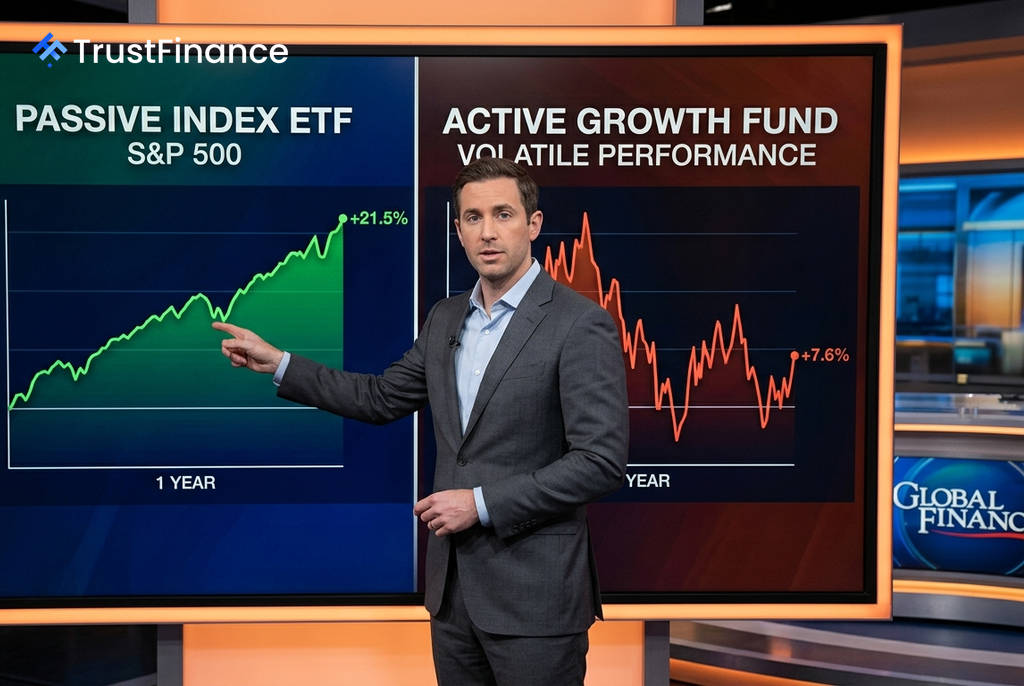
A performance comparison of popular exchange-traded funds highlights a stark divide between passive and active management strategies over the past year. Low-cost S&P 500 index trackers delivered returns of roughly 21.5%, while prominent active ETFs lagged significantly, underscoring the powerful impact of fees and strategy on investor outcomes.
According to data from Investing.com as of August 10, 2026, the performance gap is substantial. While the strategies serve different investor goals, the headline numbers reveal a clear trend.
- Passive S&P 500 ETFs: The Vanguard S&P 500 ETF (VOO) and SPDR S&P 500 ETF Trust (SPY) posted one-year returns of +21.45% and +21.46%, respectively. Their expense ratios are a minimal 0.03% and 0.09%.
- Active ETFs: The ARK Innovation ETF (ARKK) returned +7.61% with a much higher 0.75% expense ratio. The JPMorgan Equity Premium Income ETF (JEPI) returned +2.90% in price but offered a substantial 7.95% dividend yield, with a 0.35% fee.
The Advantage of Passive Management
For investors seeking broad market exposure, passive funds like VOO and SPY have demonstrated superior cost efficiency and consistency. With a beta of 1.00, they move in lockstep with the S&P 500, and their high Sharpe ratios (above 1.10) indicate strong risk-adjusted returns. The low portfolio turnover of just 1-2% further minimizes trading costs.
 Ad
The structural headwind for active funds is the fee differential. An active manager must outperform the benchmark by more than its expense ratio just to match the net return of a passive alternative. The data shows VOO is 25 times cheaper than ARKK, creating a high bar for the active fund to clear.
Where Active Strategies Diverge
The reviewed active funds offer two very different stories. ARKK, a high-conviction growth fund, serves as a cautionary tale. Its beta of 1.47 confirms it is nearly 50% more volatile than the market. It also generated a negative alpha of -30.88, meaning its active stock selection significantly destroyed value compared to a passive holding, according to the data.
In contrast, JEPI is designed for a different purpose: generating income with lower volatility. Its primary appeal is its 7.95% dividend yield, not capital appreciation. Its low beta of 0.18 and a worst three-month drawdown of just -7.1% (compared to -19.6% for SPY) make it a potential tool for income-focused or risk-averse investors who prioritize capital preservation and cash flow over mirroring market growth.
Read next
More on Stocks
FTC Orders Walmart, Uber, Delta to Disclose Data on Personalized Pricing
The U.S. Federal Trade Commission is demanding nine major companies, including leading retail, travel, and gig economy firms, to provide information on how they use consumer data for setting individual prices and wages.

Google Launches Gemini 4 Carbon AI Model to Bolster Cybersecurity Capabilities
Alphabet's Google has unveiled Gemini 4 Carbon, its latest AI model specifically designed for advanced cybersecurity tasks like vulnerability detection and secure code generation. The launch escalates competition with rivals OpenAI and Anthropic in the enterprise AI market.

Oracle Shares Surge After Unveiling $225 Billion Revenue Target for 2030
Oracle stock rose sharply after the company presented a long-term financial outlook targeting at least $225 billion in annual revenue by fiscal 2030, driven by its expanding AI infrastructure business.

DOJ Scrutinizes Nvidia's $12.9B Hugging Face Deal Amid Broader Antitrust Probe, Sources Say
The U.S. Department of Justice is reportedly examining Nvidia's planned $12.93 billion acquisition of AI platform Hugging Face as part of a wider, ongoing antitrust investigation into the chipmaker's market conduct.