
Story
Japanese Trading House Stocks Retreat on Profit-Taking, Stronger Yen
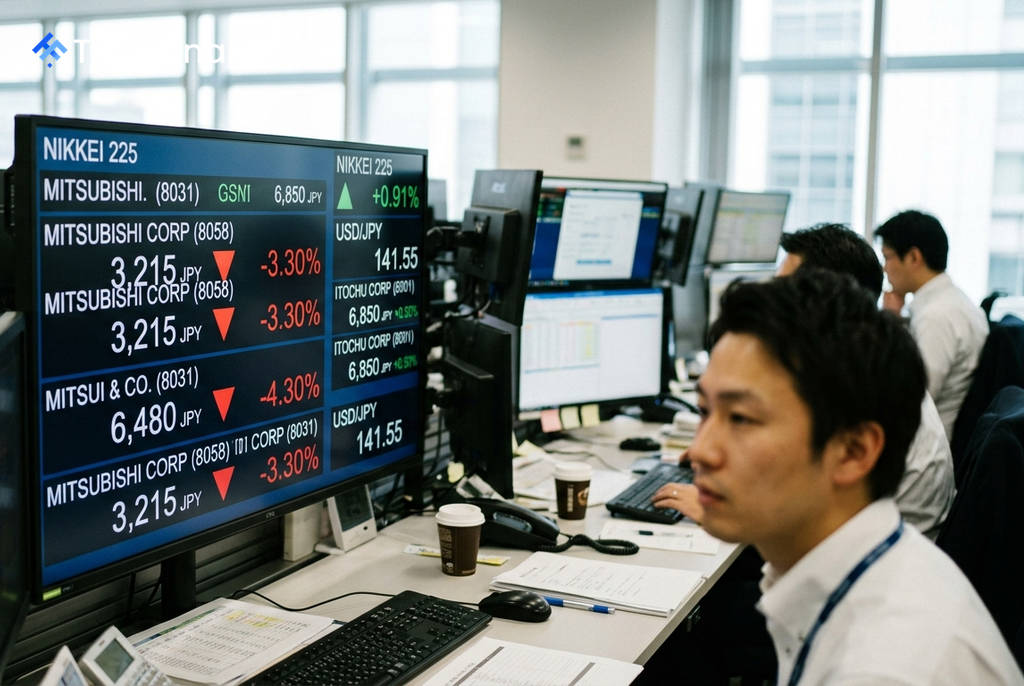
Shares in Japan's five largest trading houses, known as *sogo shosha*, declined on Friday, reversing a rally from the previous session. The pullback was driven by a combination of profit-taking and pressure from a strengthening Japanese yen, which negatively impacts firms with significant overseas earnings.
Market Reversal
The sell-off was notable across the sector, with most of the major trading houses underperforming the broader market. While the benchmark Nikkei 225 index climbed 0.9%, the trading firms saw significant declines:
- Mitsui & Co. (TYO:8031) fell by 4.3%.
- Mitsubishi Corp. (TYO:8058), which had led gains earlier in the week, dropped 3.3%.
- Marubeni Corp. (TYO:8002) slid 2.4%.
- Sumitomo Corp. (TYO:8053) was down 0.4%.
Itochu Corp. (TYO:8001) was the sole outlier, bucking the trend with a modest gain of 0.5%.
The Berkshire Effect and Headwinds
 Ad
The previous day's rally was sparked by comments from Berkshire Hathaway CEO Greg Abel, who indicated the investment firm was considering increasing its positions in the five companies. According to the source, Berkshire Hathaway already holds stakes of between 9% and 11% in each of the trading houses.
However, macroeconomic factors weighed on investor sentiment Friday. The Japanese yen firmed on growing speculation that the Bank of Japan could raise interest rates in September. A stronger yen reduces the value of profits earned abroad when converted back into the local currency, directly affecting the bottom line of these globally-focused conglomerates.
Investor Focus Shifts
The downturn in trading house stocks also coincided with a broader market rotation into growth-oriented sectors, particularly technology and artificial intelligence. This shift was reportedly encouraged by a recent drop in government bond yields, prompting some investors to move capital away from value-heavy sectors like the *sogo shosha*.
Read next
More on Stocks
FTC Orders Walmart, Uber, Delta to Disclose Data on Personalized Pricing
The U.S. Federal Trade Commission is demanding nine major companies, including leading retail, travel, and gig economy firms, to provide information on how they use consumer data for setting individual prices and wages.

Google Launches Gemini 4 Carbon AI Model to Bolster Cybersecurity Capabilities
Alphabet's Google has unveiled Gemini 4 Carbon, its latest AI model specifically designed for advanced cybersecurity tasks like vulnerability detection and secure code generation. The launch escalates competition with rivals OpenAI and Anthropic in the enterprise AI market.

Oracle Shares Surge After Unveiling $225 Billion Revenue Target for 2030
Oracle stock rose sharply after the company presented a long-term financial outlook targeting at least $225 billion in annual revenue by fiscal 2030, driven by its expanding AI infrastructure business.

DOJ Scrutinizes Nvidia's $12.9B Hugging Face Deal Amid Broader Antitrust Probe, Sources Say
The U.S. Department of Justice is reportedly examining Nvidia's planned $12.93 billion acquisition of AI platform Hugging Face as part of a wider, ongoing antitrust investigation into the chipmaker's market conduct.