
Story
International Paper Stock Slides on Revenue Miss, $1.38 Billion Impairment Charge
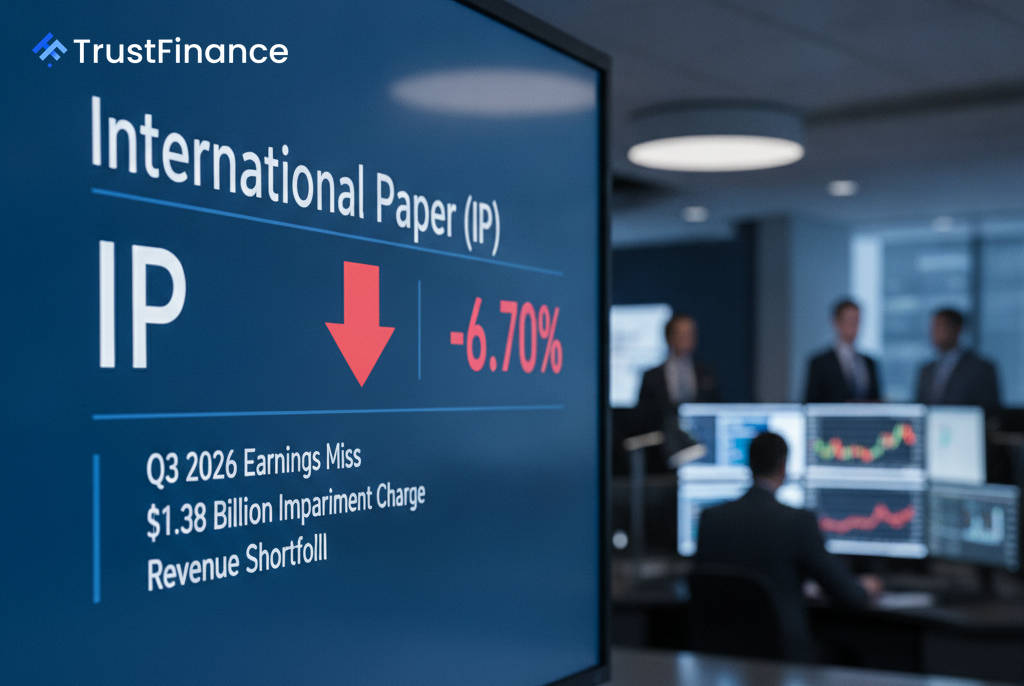
Shares of International Paper (IP) slid 6.7% in pre-market trading after the company's third-quarter 2026 earnings report disappointed investors with a revenue miss and a substantial impairment charge that outweighed a better-than-expected adjusted profit.
Earnings Report Breakdown
International Paper reported adjusted earnings per share of $0.37, comfortably beating the analyst consensus of approximately $0.28. However, this positive result was overshadowed by several negative factors.
Net sales for the quarter came in at $6.20 billion, falling short of Wall Street expectations, which ranged from roughly $6.26 billion to $6.29 billion. More significantly, the company recorded a $1.38 billion non-cash goodwill impairment charge related to its Packaging Solutions EMEA segment. This write-down pushed the reported loss from continuing operations to $1.10 billion, more than double the loss from the same period a year ago.
Weakening Cash Flow and Reduced Visibility
Underlying financial metrics pointed to further pressure on the business. The company's cash flow deteriorated significantly during the quarter, adding to investor concerns.
 Ad
- Free Cash Flow: Swung to a negative $267 million from a positive $150 million in the prior-year period.
- Operating Cash Flow: Dropped sharply by 44% year-over-year to $339 million.
Compounding the negative news, International Paper announced it will no longer provide financial guidance for its EMEA segment. The company cited the planned separation of the business and U.K. regulatory requirements for the change, which reduces forward-looking visibility for investors.
Context and Market Impact
In a statement, CEO Andy Silvernail acknowledged that "persistent macro headwinds" continued to weigh on results, particularly in the EMEA region where soft demand offset progress on cost reductions. The stock's pre-market decline sent it toward its 52-week low of $29.26.
For investors, the combination of a revenue shortfall, the large scale of the EMEA write-down, deteriorating cash flow, and the suspension of guidance for a key segment created a decidedly negative outlook. These factors prompted a reassessment of the company's turnaround progress, overwhelming the adjusted earnings beat and triggering a sharp sell-off in its shares.
Read next
More on Stocks
EQT to Acquire Range Resources for $13 Billion, Creating Top US Gas Producer
EQT Corp. will acquire Range Resources in a $13 billion all-stock deal, forming the largest natural gas producer in the U.S. The move highlights a wave of consolidation as companies position for rising demand from LNG exports and data centers.

LCI Industries Shares Surge on $101-per-Share Takeover Bid from Monomoy Capital
LCI Industries received an unsolicited cash offer from a private equity firm, complicating its existing all-stock merger agreement with Patrick Industries and sending its shares higher.

Intel to Acquire Quantum Software Firm Classiq for a Reported $2.3 Billion
Intel has agreed to acquire Israeli quantum software developer Classiq in a deal reportedly valued at $2.3 billion, a major investment signaling the chipmaker's long-term commitment to the nascent quantum computing sector.

Boston Scientific Stock Falls After Q3 Earnings Miss, Guidance Cut
Shares of Boston Scientific plunged after the medical device maker missed third-quarter profit estimates and significantly lowered its forward guidance, citing the lingering operational impact of a recent cyberattack.