
Story
Healthcare ETFs IXJ and IYH Offer Contrasting Defensive Strategies
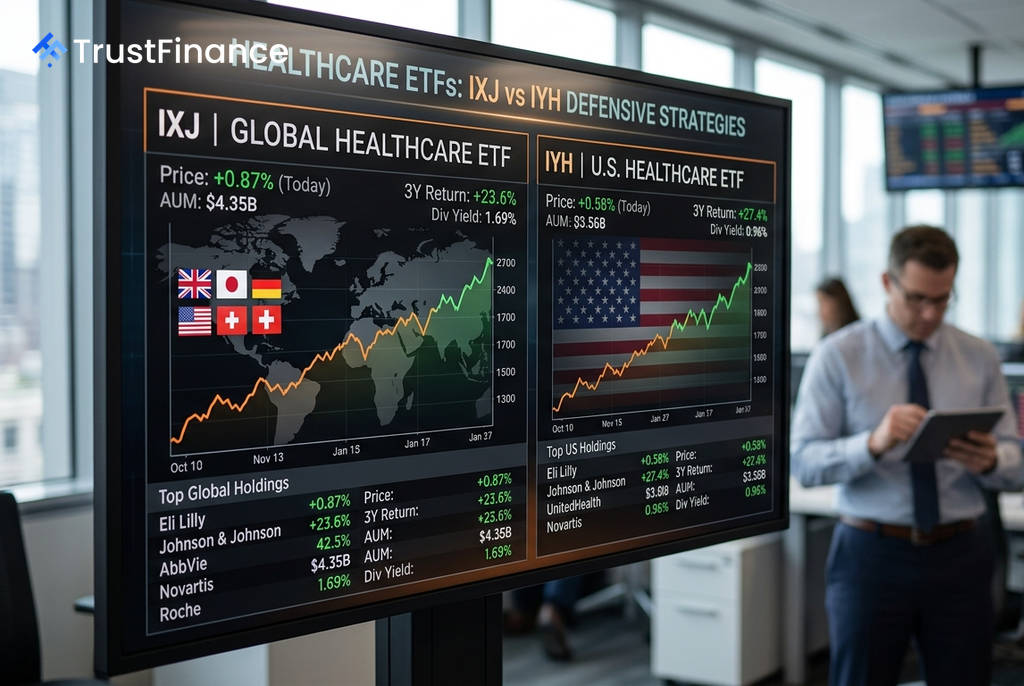
Investors looking to add defensive assets to their portfolios are closely examining two major healthcare exchange-traded funds (ETFs) that offer different approaches to sector exposure. According to an analysis by Investing.com, the iShares Global Healthcare ETF (IXJ) provides broad international diversification, while the iShares U.S. Healthcare ETF (IYH) offers a more concentrated, domestic-focused strategy with a stronger recent performance record.
Contrasting Fund Profiles
The two funds present a clear trade-off between global risk mitigation and U.S.-centric growth. While both are managed by iShares and have similar expense ratios, their construction and recent returns highlight their distinct strategic roles.
- iShares Global Healthcare ETF (IXJ): Manages $4.35 billion in assets with an expense ratio of 0.46%. It has delivered a 3-year return of +23.6% and offers a dividend yield of 1.69%.
- iShares U.S. Healthcare ETF (IYH): Manages $3.56 billion in assets with a 0.43% expense ratio. Its 3-year return is higher at +27.4%, but its dividend yield is lower at 0.96%.
IXJ: The Global Diversifier
The iShares Global Healthcare ETF is structured to reduce single-country risk by spreading its investments across different regions. According to Investing.com, its portfolio is allocated with 72.8% in North America, 22.2% in developed European markets, and 4% in Asia. This geographic diversification can help insulate the fund from US-specific policy shifts, such as changes to drug pricing or Medicare regulations.
IXJ's top holdings are anchored in global pharmaceutical and medical technology giants. Its largest positions include Eli Lilly (LLY) at 10.3%, Johnson & Johnson (JNJ) at 7.0%, AbbVie (ABBV) at 5.0%, Roche (ROPC) at 3.9%, and Novartis (NOVN) at 3.7%.
 Ad
IYH: A Concentrated U.S. Play
In contrast, the iShares U.S. Healthcare ETF focuses almost exclusively on U.S.-listed companies, offering a more direct bet on the domestic market. This concentration is reflected in its top holdings, with Eli Lilly representing a substantial 15.1% of the portfolio and Johnson & Johnson making up 10.2%.
While this US focus has contributed to IYH's stronger performance over the past three years, it also exposes investors to greater concentration risk. Any significant regulatory or political developments affecting the U.S. healthcare industry could have a more pronounced impact on the fund's value.
What This Means for Investors
The choice between IXJ and IYH hinges on an investor's risk tolerance and outlook on U.S. regulatory policy. The analysis from Investing.com suggests IXJ's global footprint and higher dividend yield provide a more traditional defensive cushion against market volatility and policy shocks.
Conversely, IYH may appeal to investors who are confident in the continued outperformance of the U.S. healthcare market and are willing to accept the associated concentration risk. The analysis notes that other funds, like the iShares U.S. Healthcare Providers ETF (IHF), are less suited for a defensive strategy due to higher volatility tied to factors like medical loss ratios.
Read next
More on Stocks
FTC Orders Walmart, Uber, Delta to Disclose Data on Personalized Pricing
The U.S. Federal Trade Commission is demanding nine major companies, including leading retail, travel, and gig economy firms, to provide information on how they use consumer data for setting individual prices and wages.

Google Launches Gemini 4 Carbon AI Model to Bolster Cybersecurity Capabilities
Alphabet's Google has unveiled Gemini 4 Carbon, its latest AI model specifically designed for advanced cybersecurity tasks like vulnerability detection and secure code generation. The launch escalates competition with rivals OpenAI and Anthropic in the enterprise AI market.

Oracle Shares Surge After Unveiling $225 Billion Revenue Target for 2030
Oracle stock rose sharply after the company presented a long-term financial outlook targeting at least $225 billion in annual revenue by fiscal 2030, driven by its expanding AI infrastructure business.

DOJ Scrutinizes Nvidia's $12.9B Hugging Face Deal Amid Broader Antitrust Probe, Sources Say
The U.S. Department of Justice is reportedly examining Nvidia's planned $12.93 billion acquisition of AI platform Hugging Face as part of a wider, ongoing antitrust investigation into the chipmaker's market conduct.