
Story
Gundlach Warns Next Recession Could Trigger U.S. Debt Crisis, Shatter Treasury's Safe-Haven Status
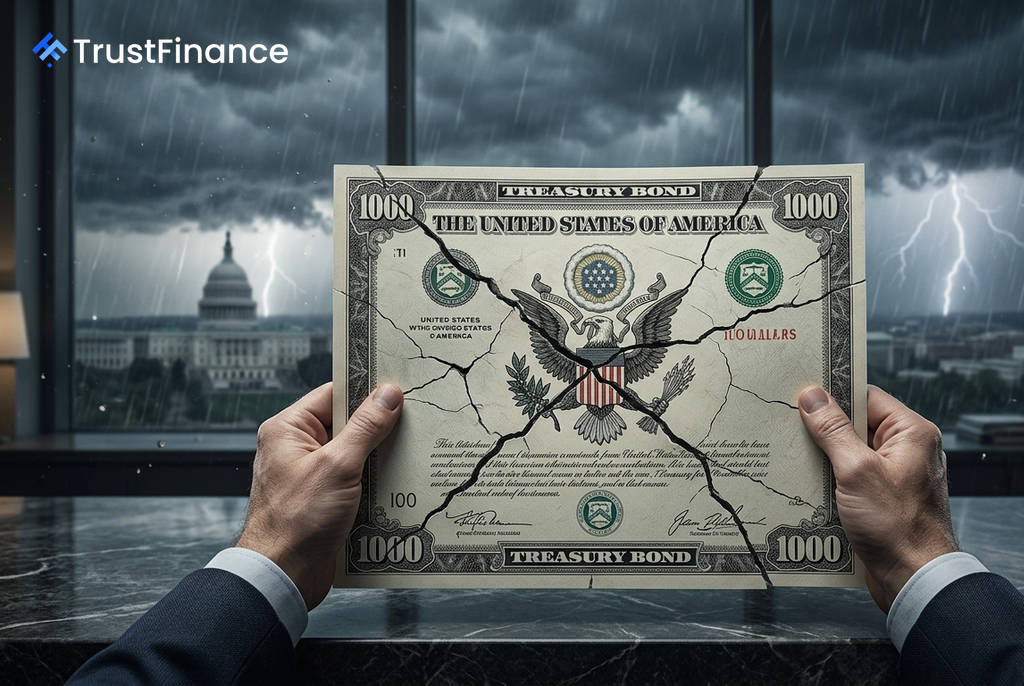
DoubleLine Capital CEO Jeffrey Gundlach has issued a stark warning that the next U.S. economic recession could trigger a severe debt crisis, upending the decades-long convention of U.S. Treasury bonds acting as a safe haven during market turmoil. He predicts that in such a scenario, long-term Treasury yields would rise sharply, not fall, as investors grapple with the nation's deteriorating fiscal health.
An Unsustainable Fiscal Path
Speaking at an event in New York, Gundlach argued that an economic downturn would place intense focus on the U.S. fiscal situation. He projected that the budget deficit could easily swell to 12% of GDP, leading to an unsustainable interest expense burden of approximately $3 trillion per year.
"We're in a world turned upside down where, in the next recession, long-term interest rates are going to go up, and they're going to go up because of the debt crisis that the recession will trigger," Gundlach stated. He pointed to the breakdown of several key market correlations since 2020—including between gold, copper, and Treasury yields—as evidence that markets have entered a new regime of a long-term uptrend in interest rates.
Implications for Investors
This forecast challenges the foundational role of fixed income as a tool to buffer equity portfolio losses during economic contractions. Gundlach, whose firm DoubleLine Capital managed $95 billion in assets as of March, noted that inflationary shocks have already damaged bonds in recent years, sometimes causing them to sell off alongside stocks.
 Ad
In response to this risk, Gundlach said he is positioning his funds in low-duration assets to protect against the impact of further rate increases. While he is "slightly less bearish" on long-term bonds than he was a year ago, he still anticipates that yields will ultimately move higher.
Unconventional Policy Responses
If a bond sell-off accelerates, Gundlach believes U.S. authorities might be forced to consider unconventional policy interventions. One possibility is a revival of "Operation Twist," where the Federal Reserve would buy long-term bonds to suppress yields while keeping short-term rates elevated. He suggested a yield of around 6.5% on long-term Treasuries could be a potential trigger for such an action.
A more extreme and previously floated risk is a direct U.S. debt restructuring. Gundlach outlined a hypothetical scenario where the government could unilaterally cut coupon payments on all outstanding Treasuries above 1% down to a uniform 1%. "You'd reduce your interest expense by 75% overnight," he explained, but acknowledged the catastrophic consequences: "Of course, every investor would be furious... you'd never be able to borrow money again."
Read next
More on Stocks
FTC Orders Walmart, Uber, Delta to Disclose Data on Personalized Pricing
The U.S. Federal Trade Commission is demanding nine major companies, including leading retail, travel, and gig economy firms, to provide information on how they use consumer data for setting individual prices and wages.

Google Launches Gemini 4 Carbon AI Model to Bolster Cybersecurity Capabilities
Alphabet's Google has unveiled Gemini 4 Carbon, its latest AI model specifically designed for advanced cybersecurity tasks like vulnerability detection and secure code generation. The launch escalates competition with rivals OpenAI and Anthropic in the enterprise AI market.

Oracle Shares Surge After Unveiling $225 Billion Revenue Target for 2030
Oracle stock rose sharply after the company presented a long-term financial outlook targeting at least $225 billion in annual revenue by fiscal 2030, driven by its expanding AI infrastructure business.

DOJ Scrutinizes Nvidia's $12.9B Hugging Face Deal Amid Broader Antitrust Probe, Sources Say
The U.S. Department of Justice is reportedly examining Nvidia's planned $12.93 billion acquisition of AI platform Hugging Face as part of a wider, ongoing antitrust investigation into the chipmaker's market conduct.