
Story
Bond ETF Giants AGG and BND Offer Little Relative Value as Performance Converges
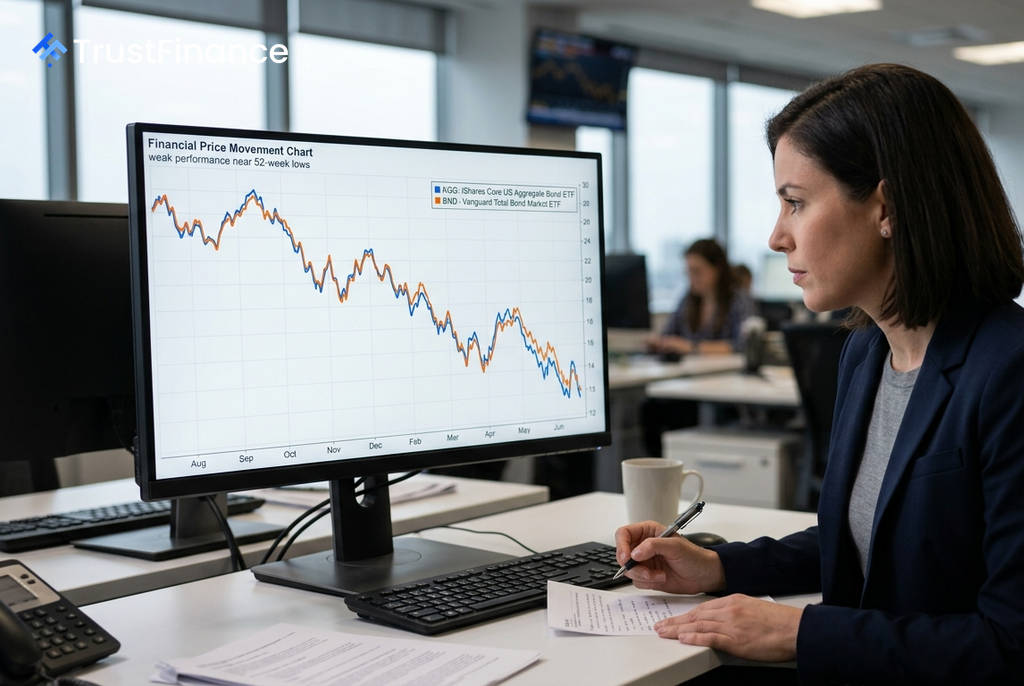
The two leading U.S. aggregate bond exchange-traded funds (ETFs) are trading in lockstep, with performance figures showing a negligible difference between them over the past year. This convergence has effectively neutralized opportunities for traders seeking to profit from a relative value strategy between the iShares Core U.S. Aggregate Bond ETF (AGG) and the Vanguard Total Bond Market ETF (BND).
Performance Breakdown
An analysis of recent returns underscores the minimal spread between the two funds. According to data from Investing.com, the performance gap is nearly non-existent across multiple time frames.
- Over the past year, AGG has returned -4.15%, trailing BND's -4.12% return by just 0.03 percentage points.
- The three-month figures show a similar pattern, with AGG down -2.08% compared to BND's decline of -2.03%.
This tight correlation suggests the funds are behaving as nearly identical exposures to the U.S. investment-grade bond market, rather than as a differentiated pair trade.
Technicals Signal Weakness
 Ad
Both bond ETFs are facing significant technical pressure, trading near their 52-week lows, according to the source. Technical indicators present a mixed but predominantly bearish picture for both securities.
On one hand, both ETFs remain below their short-term moving averages with negative momentum indicators, signaling a strong downtrend. On the other, Relative Strength Index (RSI) readings near 32 place both funds close to oversold territory, which could potentially set the stage for a short-term rebound.
Implications for Investors
The lack of a meaningful performance differential means that a relative value trade—betting on one fund to outperform the other—has not been a profitable strategy. For a clear trading signal to emerge, one ETF would need to establish a sustained period of outperformance over several weeks.
For now, both AGG and BND are reflecting the broader weakness in the U.S. bond market. The source notes that until a decisive performance gap appears, the choice between the two funds for most investors will likely depend on factors other than short-term returns, such as expense ratios or broker-specific trading commissions.
Read next
More on Stocks
FTC Orders Walmart, Uber, Delta to Disclose Data on Personalized Pricing
The U.S. Federal Trade Commission is demanding nine major companies, including leading retail, travel, and gig economy firms, to provide information on how they use consumer data for setting individual prices and wages.

Google Launches Gemini 4 Carbon AI Model to Bolster Cybersecurity Capabilities
Alphabet's Google has unveiled Gemini 4 Carbon, its latest AI model specifically designed for advanced cybersecurity tasks like vulnerability detection and secure code generation. The launch escalates competition with rivals OpenAI and Anthropic in the enterprise AI market.

Oracle Shares Surge After Unveiling $225 Billion Revenue Target for 2030
Oracle stock rose sharply after the company presented a long-term financial outlook targeting at least $225 billion in annual revenue by fiscal 2030, driven by its expanding AI infrastructure business.

DOJ Scrutinizes Nvidia's $12.9B Hugging Face Deal Amid Broader Antitrust Probe, Sources Say
The U.S. Department of Justice is reportedly examining Nvidia's planned $12.93 billion acquisition of AI platform Hugging Face as part of a wider, ongoing antitrust investigation into the chipmaker's market conduct.