
Story
US Auto Insurance Rates Fell 0.2% in July, Morgan Stanley Reports
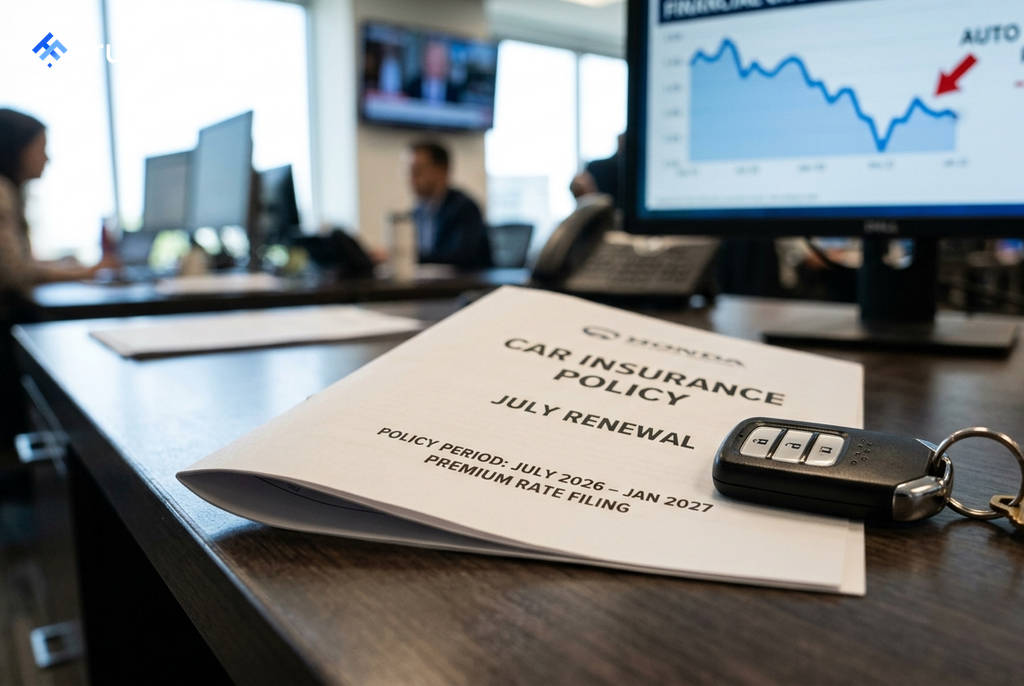
U.S. auto insurance rates decreased by 0.2% in July, signaling a potential shift in the market as carriers grapple with intense competition, according to a new analysis from Morgan Stanley.
Industry-Wide Trend
The decline, based on rate filings, affected approximately $61 billion in auto premiums across the property and casualty insurance industry, the investment bank reported. Morgan Stanley's analysts stated they expect this trend of negative pricing to persist through 2026 as insurers increasingly prioritize new business growth and customer retention.
This marks a notable change in a sector that has recently been characterized by significant rate hikes to offset rising claims costs. The current competitive environment appears to be forcing a strategic pivot toward capturing market share.
Divergent Carrier Strategies
While the industry average showed a slight decrease, major carriers exhibited varied pricing strategies in July, according to the report:
 Ad
- Progressive Corp. (PGR) led the downward trend with a 1.3% premium-weighted rate decrease, affecting $12.7 billion in premiums. Morgan Stanley anticipates further negative filings from the carrier for the remainder of the year.
- Allstate Corp. (ALL), in contrast, recorded a 0.9% rate increase impacting $4.6 billion in premiums. However, the firm expects Allstate to pursue negative rate filings in 2026 as it focuses on its "Transformative Growth" initiative.
- Travelers Companies (TRV) also implemented a rate increase of 1.1% on $1.2 billion of its auto premium base. Morgan Stanley projects a moderation in its pricing going forward.
- The Hartford (HIG) posted a modest 0.3% rate increase on approximately $70 million in premiums. The bank expects rates to moderate further as the company's personal insurance segment meets profitability targets.
What It Means for Investors
The July data suggests the personal auto insurance market may be entering a new phase of the pricing cycle. After a period of aggressive rate increases to combat inflation and high loss costs, the focus appears to be shifting toward a competitive battle for market share.
For investors, this signals a need to monitor how individual carriers balance the pursuit of premium growth with maintaining underwriting profitability in a softer pricing environment. The performance of insurers like Progressive, which are actively cutting rates, will be closely watched against those still seeking modest increases.
Read next
More on Stocks
FTC Orders Walmart, Uber, Delta to Disclose Data on Personalized Pricing
The U.S. Federal Trade Commission is demanding nine major companies, including leading retail, travel, and gig economy firms, to provide information on how they use consumer data for setting individual prices and wages.

Google Launches Gemini 4 Carbon AI Model to Bolster Cybersecurity Capabilities
Alphabet's Google has unveiled Gemini 4 Carbon, its latest AI model specifically designed for advanced cybersecurity tasks like vulnerability detection and secure code generation. The launch escalates competition with rivals OpenAI and Anthropic in the enterprise AI market.

Oracle Shares Surge After Unveiling $225 Billion Revenue Target for 2030
Oracle stock rose sharply after the company presented a long-term financial outlook targeting at least $225 billion in annual revenue by fiscal 2030, driven by its expanding AI infrastructure business.

DOJ Scrutinizes Nvidia's $12.9B Hugging Face Deal Amid Broader Antitrust Probe, Sources Say
The U.S. Department of Justice is reportedly examining Nvidia's planned $12.93 billion acquisition of AI platform Hugging Face as part of a wider, ongoing antitrust investigation into the chipmaker's market conduct.