
Story
Telecom Earnings Week Sees AT&T Rise, T-Mobile Tumble on Shifting Narratives
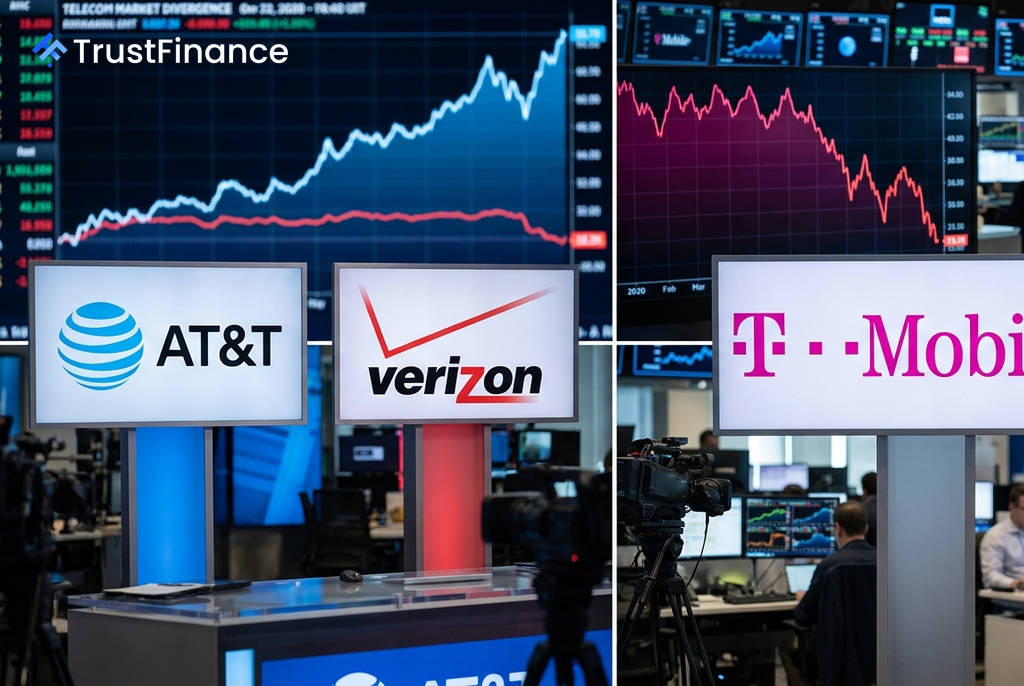
A busy earnings week for the U.S. telecom sector resulted in sharply diverging market reactions for its three biggest players. While AT&T surged on a subscriber beat, T-Mobile tumbled despite strong earnings, highlighting shifting investor concerns over competition from satellite internet and differing long-term growth prospects.
A Tale of Three Reports
The market delivered a paradoxical verdict after all three telecom giants reported Q2 results within a 48-hour window. The performance and subsequent stock movements underscored distinct investor sentiment for each company.
- AT&T (T): The stock climbed 5% after the company reported adding 432,000 wireless subscribers, significantly beating estimates of 339,000. It maintained its full-year free cash flow (FCF) guidance despite a slight revenue miss.
- T-Mobile (TMUS): Shares plunged 10.75% in a stark contrast to its strong operational results. The company beat EPS estimates by 10.5%, added 277,000 postpaid accounts, and raised its full-year FCF guidance by $200 million.
- Verizon (VZ): The company missed revenue estimates by nearly $1 billion, coming in at $34.3 billion versus an expected $35.3 billion. Verizon maintained its full-year FCF guidance.
Satellite Competition Reshapes Valuations
A central theme driving the market's divergence is the perceived long-term threat from satellite broadband services like Starlink. According to analyst commentary, this risk is not distributed evenly across the sector.
AT&T is seen as bearing the most risk due to its significant investment in a fiber network expansion. A Morgan Stanley report projects Starlink could reach approximately 16 million U.S. broadband subscribers by 2030, creating a direct challenge to AT&T's growth model, particularly in rural markets where fiber deployment is less economical.
 Ad
Conversely, analysts believe T-Mobile is the most insulated. Benchmark argues that for mobile use cases, satellite technology cannot currently match the latency, density, or cost-effectiveness of established terrestrial networks. Verizon is viewed as being in the middle, with some buffer from its enterprise business mix and an ongoing restructuring aimed at creating a leaner cost structure.
Diverging Valuations and Outlooks
The market's reaction has created distinct profiles for each stock. AT&T’s performance positions it as a value play, trading at a low 7.3x trailing P/E ratio. Strong execution in adding both wireless and fiber subscribers has built investor confidence, though the long-term satellite risk remains a key consideration.
Verizon's appeal centers on its high dividend yield of 6.5% and defensive characteristics, reflected in its low beta of 0.24. Investors are weighing near-term restructuring costs against the potential for a more efficient company in the future, with Scotiabank maintaining a Sector Outperform rating.
T-Mobile's sharp sell-off presents a contrarian growth case. Despite the market's reaction, analysts at KeyBanc and Benchmark reiterated their positive ratings, pointing to a significant disconnect between the stock price and the company's strong EPS growth trajectory and raised FCF guidance. The market appears to be pricing in subscriber growth concerns that management has described as temporary.
Read next
More on Stocks
FTC Orders Walmart, Uber, Delta to Disclose Data on Personalized Pricing
The U.S. Federal Trade Commission is demanding nine major companies, including leading retail, travel, and gig economy firms, to provide information on how they use consumer data for setting individual prices and wages.

Google Launches Gemini 4 Carbon AI Model to Bolster Cybersecurity Capabilities
Alphabet's Google has unveiled Gemini 4 Carbon, its latest AI model specifically designed for advanced cybersecurity tasks like vulnerability detection and secure code generation. The launch escalates competition with rivals OpenAI and Anthropic in the enterprise AI market.

Oracle Shares Surge After Unveiling $225 Billion Revenue Target for 2030
Oracle stock rose sharply after the company presented a long-term financial outlook targeting at least $225 billion in annual revenue by fiscal 2030, driven by its expanding AI infrastructure business.

DOJ Scrutinizes Nvidia's $12.9B Hugging Face Deal Amid Broader Antitrust Probe, Sources Say
The U.S. Department of Justice is reportedly examining Nvidia's planned $12.93 billion acquisition of AI platform Hugging Face as part of a wider, ongoing antitrust investigation into the chipmaker's market conduct.