
Story
Sezzle Stock Plummets on Weak Growth Outlook Despite Q2 Beat
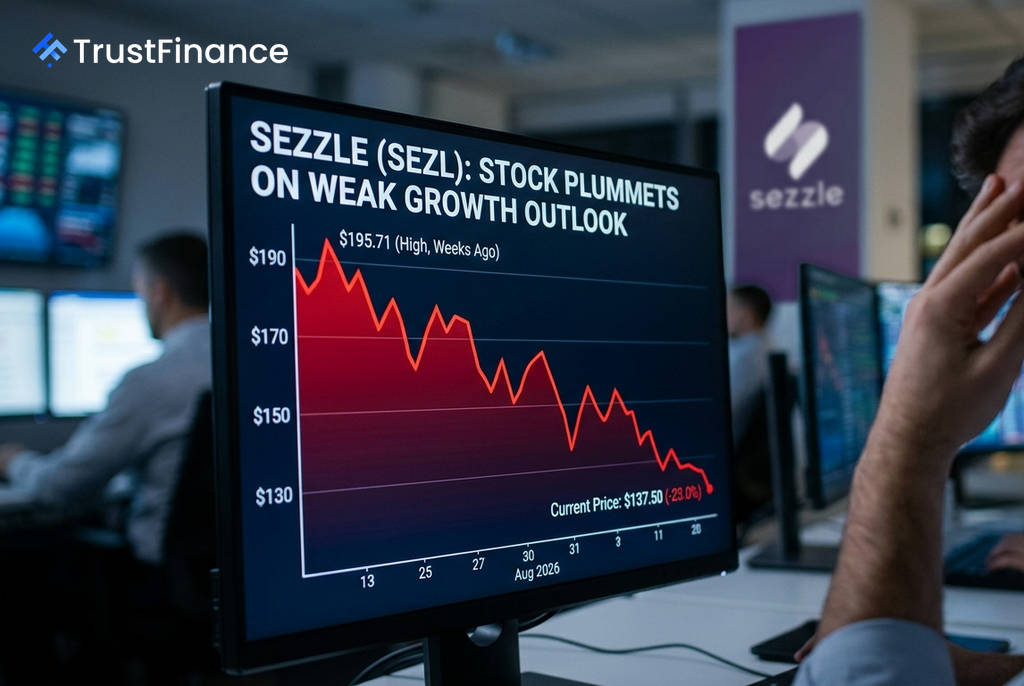
Shares of Sezzle (SEZL) plunged in pre-market trading Friday after the buy-now-pay-later (BNPL) company signaled a significant slowdown in growth for the remainder of the year, overshadowing strong second-quarter results.
A 'Beat-and-Lower' Quarter
Sezzle reported its Q2 2026 results after the market closed on Thursday, initially appearing strong. The company's performance surpassed analyst expectations, but its forward-looking guidance triggered the sell-off.
- Q2 Revenue: $149.7 million, an increase of 51.7% year-over-year and ahead of the estimated $136 million.
- Q2 Gross Merchandise Volume (GMV): A record $1.28 billion, up 37.9% from the prior year.
- The Issue: Management guided for revenue growth to slow to approximately 30% in the second half of 2026.
This dynamic, where a company reports strong past results but provides a weaker outlook, is often referred to as a "beat-and-lower" and typically prompts a negative investor reaction.
Guidance Triggers Repricing
 Ad
The market's sharp response reflects a recalibration of Sezzle's growth trajectory. The company's management indicated that its revenue yield, which was elevated in the second quarter, is expected to normalize to around 11.4%. This, combined with the decelerating top-line growth, led investors to aggressively reprice the stock, sending it down 23.0% to $137.50 in pre-open trading, according to Investing.com.
While Sezzle raised its full-year 2026 guidance—projecting 35% revenue growth and $185 million in adjusted net income—this was not enough to offset concerns about the near-term slowdown. The company also noted that new strategic initiatives, such as a planned bank charter application and new product launches, would have a minimal impact on near-term results.
Market Context
The sell-off is specific to Sezzle, as the broader market was stable, with the S&P 500 and NASDAQ both edging higher. The stock's vulnerability was amplified by its recent performance; it had been trading near its 52-week high of $195.71, leaving little room for disappointment.
Recent analyst downgrades from firms including Oppenheimer and Keefe Bruyette, which had cited the stock's stretched valuation, also contributed to the negative sentiment. The combination of a high valuation and a reset in growth expectations created the conditions for Friday's significant decline.
Read next
More on Stocks
FTC Orders Walmart, Uber, Delta to Disclose Data on Personalized Pricing
The U.S. Federal Trade Commission is demanding nine major companies, including leading retail, travel, and gig economy firms, to provide information on how they use consumer data for setting individual prices and wages.

Google Launches Gemini 4 Carbon AI Model to Bolster Cybersecurity Capabilities
Alphabet's Google has unveiled Gemini 4 Carbon, its latest AI model specifically designed for advanced cybersecurity tasks like vulnerability detection and secure code generation. The launch escalates competition with rivals OpenAI and Anthropic in the enterprise AI market.

Oracle Shares Surge After Unveiling $225 Billion Revenue Target for 2030
Oracle stock rose sharply after the company presented a long-term financial outlook targeting at least $225 billion in annual revenue by fiscal 2030, driven by its expanding AI infrastructure business.

DOJ Scrutinizes Nvidia's $12.9B Hugging Face Deal Amid Broader Antitrust Probe, Sources Say
The U.S. Department of Justice is reportedly examining Nvidia's planned $12.93 billion acquisition of AI platform Hugging Face as part of a wider, ongoing antitrust investigation into the chipmaker's market conduct.