
Story
Dollar Strengthens on Safe-Haven Demand as Middle East Tensions Escalate
Summary
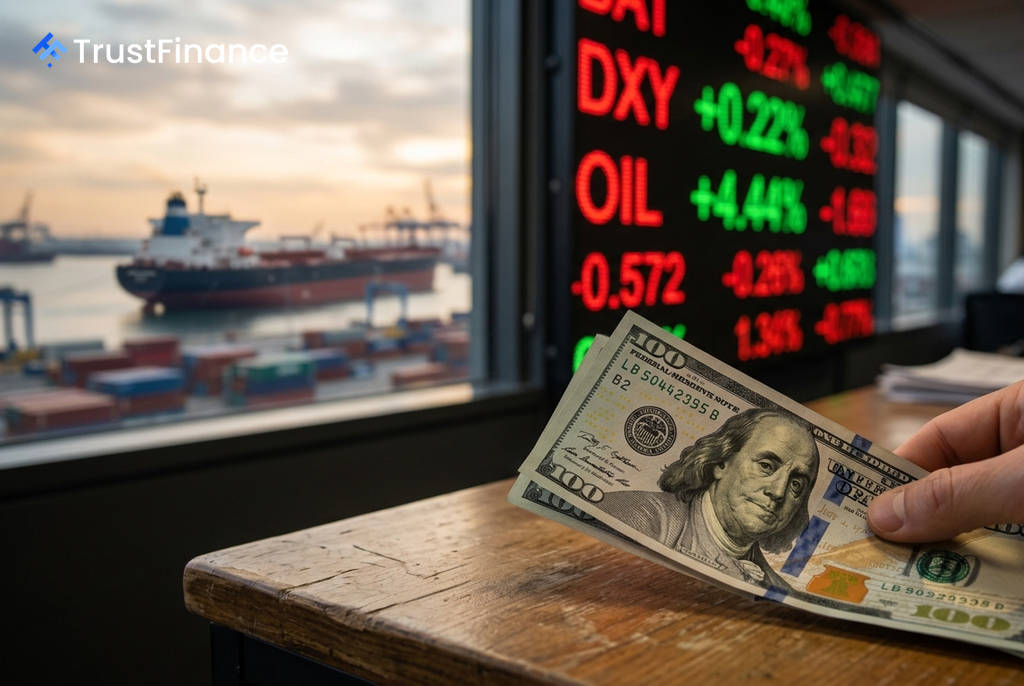
The U.S. dollar gained on Tuesday as its safe-haven appeal increased following reports of attacks on oil tankers in the Strait of Hormuz and a subsequent U.S. move to revoke an Iranian oil license. The geopolitical flare-up sent oil prices sharply higher and shifted market focus away from central bank policy.
The U.S. dollar strengthened against a basket of major currencies on Tuesday, as escalating geopolitical tensions in the Middle East drove investors toward safe-haven assets. The U.S. dollar index (DXY), which measures the greenback against six major peers, rose 0.2% to 101.10.
U.S. Revokes Iran Oil License
The primary catalyst for the dollar's move was a decision by the U.S. Treasury Department to revoke a general license authorizing the sale of Iranian crude oil and petroleum products. Citing a U.S. official, both Reuters and Axios reported the move was a direct response to recent attacks on commercial ships in the Gulf.
- The United Kingdom Maritime Trade Operations (UKMTO) said it received reports of attacks on three separate oil tankers near the critical Strait of Hormuz within 24 hours.
- The agency noted two tankers were hit by unknown projectiles and a third was struck by a drone, with no casualties reported.
- Qatar and Saudi Arabia identified two of the affected vessels as the Al-Rekayyat and the Vijian, respectively, and condemned the attacks.
This escalation has heightened regional uncertainty, causing oil prices to spike more than 5%.
Currency Market Reactions
 Ad
AdThe shift to safety impacted other major currencies. The euro (EUR/USD) fell 0.3% to $1.1411, as a cautious economic outlook from European Central Bank official Fabio Panetta overshadowed stronger-than-expected German industrial production data for May.
Meanwhile, the Japanese yen remained near multi-decade lows against the dollar, with the USD/JPY pair trading around 162.10. The yen also touched its lowest level against the British pound since 2007, keeping traders on alert for potential intervention from Japanese authorities to support the currency.
Focus Shifts from Fed Policy
Prior to the geopolitical flare-up, the dollar's direction was primarily driven by expectations for U.S. monetary policy. Investors are now awaiting the minutes from the Federal Reserve's June meeting, scheduled for release Wednesday, for further insight into policymakers' thinking on interest rates.
Last week, a softer-than-expected U.S. jobs report had led to speculation that the Fed might have room to keep rates on hold. However, the renewed geopolitical risk has re-established the dollar's role as the market's preferred haven in times of global instability.