
Story
Deutsche Bank Ends Overweight Call on European Software After 13% Rally
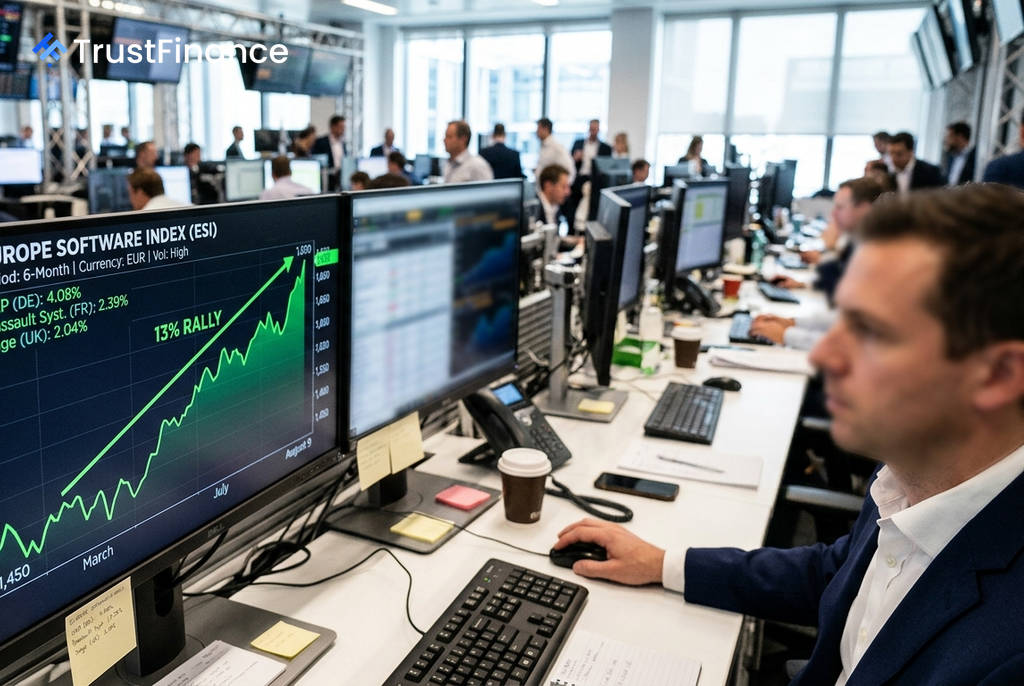
Deutsche Bank has closed its tactical overweight recommendation on European software stocks after the sector surged 13% over the past month, advising clients that the next phase of growth must be driven by new buying from long-term investors.
In a research note titled "Semi convinced II," strategists led by Maximilian Uleer and Johannes Schaller recommended a neutral stance across technology sub-sectors, citing shifting market dynamics and uncertainty around artificial intelligence.
Tactical Shift After Strong Gains
The bank's decision comes after a period of significant outperformance. The software sector's 13% gain in the last month far outpaced the 2% rise in the broader European STOXX 600 index and contrasted sharply with a 17% decline in tech hardware stocks over the same period.
Deutsche Bank initially recommended an overweight position in European software in March as a hedge against volatility in the semiconductor industry. The strategists noted that an equally weighted portfolio of software and semiconductor stocks since March 10 delivered a Sharpe ratio of 4.7, indicating superior risk-adjusted returns compared to a pure semiconductor allocation, which had a ratio of 3.8.
Short Squeeze Fades, Long-Only Buyers Needed
A key driver of the recent rally was the unwinding of short positions. Short interest in the sector, which was near peak levels when the bank turned bullish in March, has now returned to its historical average. This suggests the tailwind from short covering has largely dissipated.
 Ad
"This means that the next leg of the rally will have to be driven by long-only investors," the report stated. The bank highlighted several companies where short interest has notably decreased:
- SAP SE (SAPG)
- Dassault Systèmes SE (DAST)
- Hexagon AB (HEXAb)
- The Sage Group plc (SGE)
- Nemetschek SE (NEKG)
- Temenos AG (TEMN)
Valuation and Future Outlook
Despite closing the tactical call, Deutsche Bank's analysis suggests that European software valuations still reflect overly pessimistic long-term growth assumptions. Current market pricing implies a terminal growth rate of around 2% for leading software firms after 2030, up from near-zero in February but still underestimating their ability to adapt.
The report also flagged potential headwinds from the evolving "agentic AI" paradigm, which could weigh on sentiment until companies provide clearer evidence of future growth. However, it noted that data center capacity constraints for major cloud providers, or "hyperscalers," could be a net positive for software, as the market is unlikely to punish these providers for lower capital expenditures if supply remains tight.
Read next
More on Stocks
FTC Orders Walmart, Uber, Delta to Disclose Data on Personalized Pricing
The U.S. Federal Trade Commission is demanding nine major companies, including leading retail, travel, and gig economy firms, to provide information on how they use consumer data for setting individual prices and wages.

Google Launches Gemini 4 Carbon AI Model to Bolster Cybersecurity Capabilities
Alphabet's Google has unveiled Gemini 4 Carbon, its latest AI model specifically designed for advanced cybersecurity tasks like vulnerability detection and secure code generation. The launch escalates competition with rivals OpenAI and Anthropic in the enterprise AI market.

Oracle Shares Surge After Unveiling $225 Billion Revenue Target for 2030
Oracle stock rose sharply after the company presented a long-term financial outlook targeting at least $225 billion in annual revenue by fiscal 2030, driven by its expanding AI infrastructure business.

DOJ Scrutinizes Nvidia's $12.9B Hugging Face Deal Amid Broader Antitrust Probe, Sources Say
The U.S. Department of Justice is reportedly examining Nvidia's planned $12.93 billion acquisition of AI platform Hugging Face as part of a wider, ongoing antitrust investigation into the chipmaker's market conduct.