
Story
China Taps Special Bonds to Recapitalize State Insurers, Potentially Boosting Stock Investments
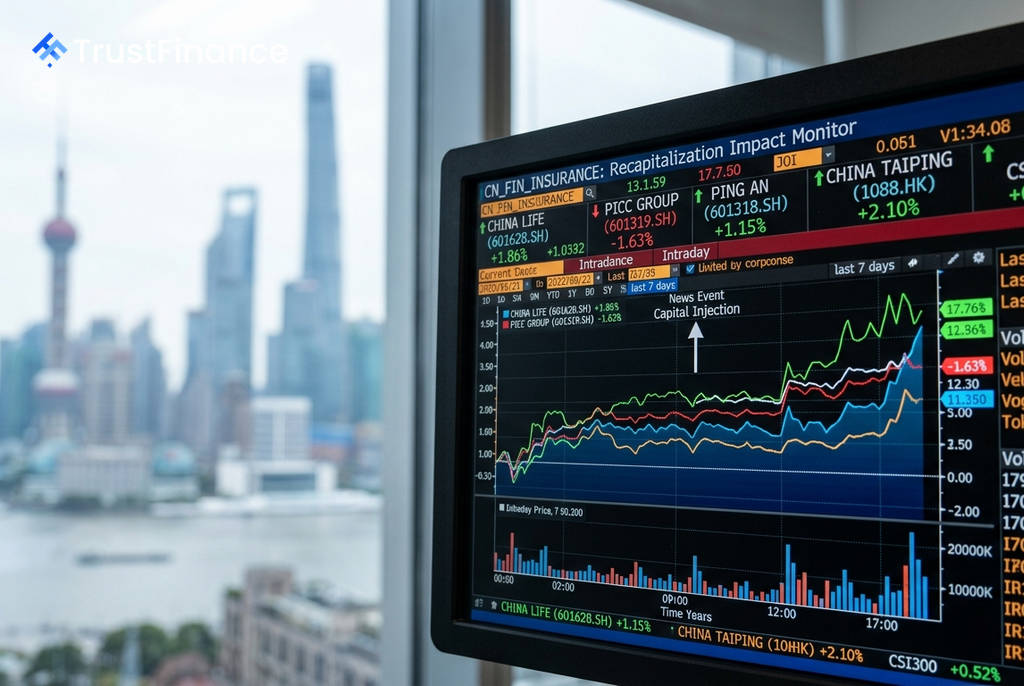
China is set to inject capital into its major state-owned insurers, a move designed to ease financial constraints and potentially increase their investment in the country's stock market. The plan, announced Sunday, involves the Ministry of Finance issuing 300 billion yuan in special bonds, a financing tool previously reserved for recapitalizing banks, according to the state-run Xinhua News Agency.
The Recapitalization Plan
Five state-owned insurers and three banks will raise a combined total of up to 360 billion yuan ($53.6 billion) from the Ministry of Finance and other shareholders. The five insurers will receive a total of 70 billion yuan from the ministry.
Specific capital injections announced include:
- China Life Insurance (Group) Co: 35 billion yuan
- China Taiping Insurance Group: 7 billion yuan
- PICC Group: Up to 15 billion yuan through a private A-share placement to the finance ministry
This marks the first time Beijing has utilized special bonds to bolster the insurance sector, signaling a strategic effort to strengthen these key financial institutions.
Market Implications
 Ad
Analysts expect the fresh capital to alleviate pressure on insurers' solvency ratios, which have been strained by declining government bond yields. According to a note from Zhongtai Securities, the injection will immediately ease solvency concerns, and in the medium term, it removes a key constraint on insurers boosting their long-term equity holdings.
This aligns with Beijing's directive from early 2025 that asked insurers to invest 30% of new premiums into stocks. However, Gary Ng, senior economist for Asia-Pacific at Natixis, noted that the actual share of assets invested in equities by five major mainland insurers was only 21% at the end of 2025. "The state-led injection will make it easier for insurers to buy equities and meet solvency requirements," Ng said.
Investor Reaction and Context
While the capital support arrived sooner than the market's 2027 expectation, the scale was smaller than the 200 billion yuan some had anticipated. In a report, Citi analysts suggested this "downsized package underscores the healthier capital positions of Chinese insurers, indicating an overall lower urgency for aggressive capital replenishment."
Despite the supportive policy, insurance stocks fell on Monday as investors weighed the impact of earnings dilution. The CSI Founder Fubon Insurance Theme Index dropped 2.1%, and the Hang Seng Composite Index - Financials fell 0.9%, even as the broader CSI300 index gained 0.2%. Some market participants remain cautious, with Charles Wang, chairman of Shenzhen Dragon Pacific Capital Management Co., noting that the move "does not necessarily translate into more money flowing into the real economy."
Read next
More on Stocks
FTC Orders Walmart, Uber, Delta to Disclose Data on Personalized Pricing
The U.S. Federal Trade Commission is demanding nine major companies, including leading retail, travel, and gig economy firms, to provide information on how they use consumer data for setting individual prices and wages.

Google Launches Gemini 4 Carbon AI Model to Bolster Cybersecurity Capabilities
Alphabet's Google has unveiled Gemini 4 Carbon, its latest AI model specifically designed for advanced cybersecurity tasks like vulnerability detection and secure code generation. The launch escalates competition with rivals OpenAI and Anthropic in the enterprise AI market.

Oracle Shares Surge After Unveiling $225 Billion Revenue Target for 2030
Oracle stock rose sharply after the company presented a long-term financial outlook targeting at least $225 billion in annual revenue by fiscal 2030, driven by its expanding AI infrastructure business.

DOJ Scrutinizes Nvidia's $12.9B Hugging Face Deal Amid Broader Antitrust Probe, Sources Say
The U.S. Department of Justice is reportedly examining Nvidia's planned $12.93 billion acquisition of AI platform Hugging Face as part of a wider, ongoing antitrust investigation into the chipmaker's market conduct.