
Story
Asian Stocks Decline as Oil Prices Surge on Strait of Hormuz Tensions
Summary
Asian equity markets fell and oil prices jumped on Monday after Iran claimed to have closed the Strait of Hormuz, escalating geopolitical tensions and renewing global inflation concerns.
Asian share markets slipped on Monday and oil prices surged after intensifying conflict in the Gulf, where Iran claimed to have closed the vital Strait of Hormuz shipping lane, according to a report from Reuters.
The development immediately rekindled global inflation risks, pushing government bond yields and the U.S. dollar higher as traders increased bets on Federal Reserve interest rate hikes.
Oil Surge Hits Equities
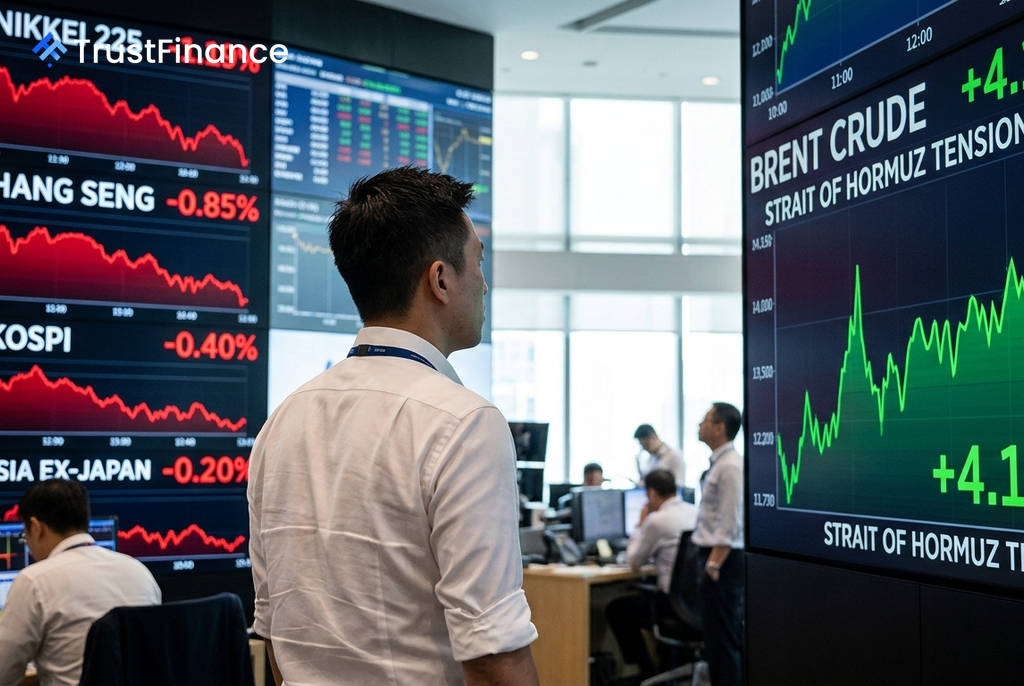
Fears of a supply disruption sent oil prices sharply higher in early trade. Brent crude climbed 3.3% to $78.50 a barrel, while U.S. crude added 3.4% to $73.83 a barrel. U.S. officials reported that around 20 vessels had been escorted through the strait in the prior 24 hours, though the source noted that ship tracking sites showed limited traffic.
The risk-off sentiment weighed on equity markets. In Asia, Japan’s Nikkei fell 1.0% and MSCI’s broadest index of Asia-Pacific shares outside Japan declined 0.2%. In the U.S., S&P 500 futures eased 0.3% and Nasdaq futures lost 0.5%.
Inflation Fears Pressure Bonds and Currencies
 Ad
AdThe spike in energy costs boosted expectations for persistent inflation, impacting fixed-income and currency markets. The yield on 10-year U.S. Treasury notes rose 2 basis points to 4.59%. Consequently, Fed fund futures slipped, implying 34 basis points of policy tightening by the end of the year.
This outlook supported the U.S. dollar index, which held firm at 101.12. The euro, sensitive to Europe's reliance on foreign oil, eased to $1.1403. Higher yields also weighed on non-interest-bearing gold, which slipped 1.1% to $4,076 an ounce.
Looking Ahead
Investors are now turning their attention to a busy week for economic and corporate news. Federal Reserve Chair Kevin Warsh is scheduled to testify before Congress, and June inflation data is due on Tuesday. The U.S. corporate earnings season also kicks off, with major banks, Netflix, and General Electric set to report.
Market participants are also closely watching South Korea's market, which fell 0.4% after shedding almost 8% last week. The market is seen as a potential bellwether for the global semiconductor sector amid pressure on leveraged bets in chip shares.