
Story
U.S. Stocks Close Lower as Tech Weakness Weighs on Major Averages
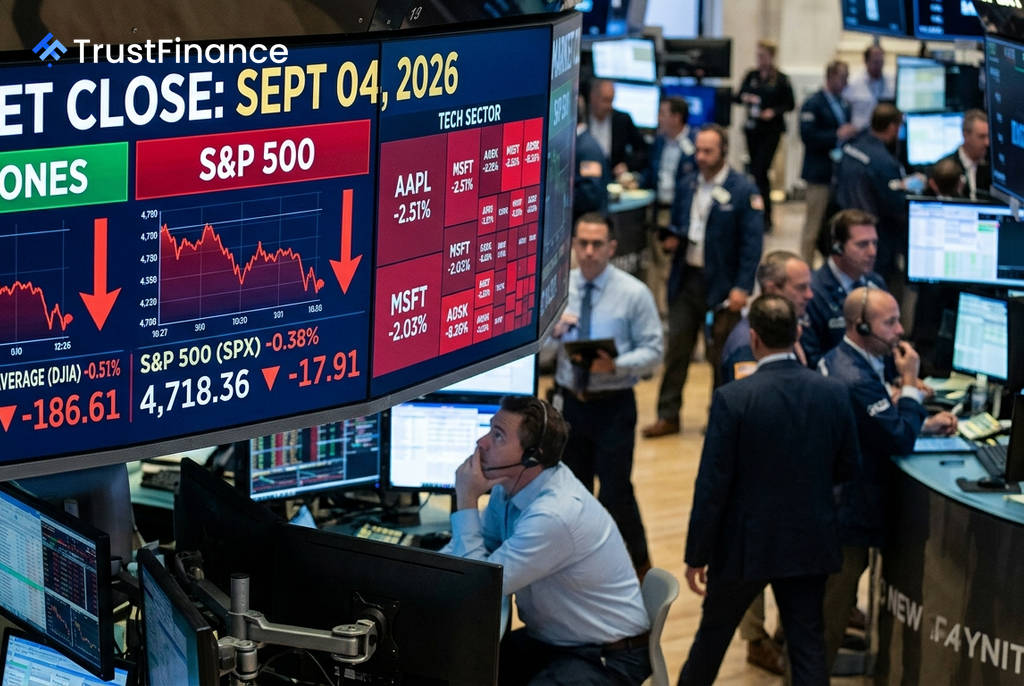
U.S. equities closed lower on Friday, with all three major indices ending the session in negative territory as significant losses in mega-cap technology stocks pressured the broader market.
How the Markets Closed
The Dow Jones Industrial Average led the decline, falling 0.51%. The benchmark S&P 500 index shed 0.38%, while the technology-focused Nasdaq Composite registered a smaller loss of 0.29%.
Reflecting a slight increase in investor caution, the CBOE Volatility Index (VIX), a key measure of expected market volatility, rose by 1.40% to 14.52.
Sector and Stock Movers
The session's downturn was primarily influenced by losses in the Consumer Goods, Telecoms, and Healthcare sectors. Heavyweight technology stocks were among the biggest drags on the major indices.
Key performers on the Dow Jones Industrial Average included:
 Ad
- Best Performers: Caterpillar Inc. (CAT) rose 1.72%, while Honeywell International Inc. (HON) added 0.95%.
- Worst Performers: Apple Inc. (AAPL) fell 2.51%, Microsoft Corporation (MSFT) declined 2.03%, and Salesforce Inc. (CRM) was down 1.97%.
Within the S&P 500, Lululemon Athletica Inc. (LULU) was a notable decliner, plunging 17.39% to a reported five-year low. In contrast, semiconductor equipment maker KLA Corporation (KLAC) was a top gainer, surging 7.32%.
Broader Market Internals
Market internals presented a mixed picture that points to the outsized influence of large-cap stocks. On the New York Stock Exchange, declining stocks narrowly outnumbered advancers 1,387 to 1,304.
However, on the Nasdaq Stock Exchange, advancing stocks (1,825) actually outnumbered decliners (1,563). This divergence suggests the Nasdaq's negative close was driven by weakness in its largest constituents rather than broad-based selling across the exchange.
In other markets, the U.S. Dollar Index Futures rose 0.25%. In commodities, December Gold Futures fell 1.39%, while crude oil prices were mixed.
Read next
More on Stocks
FTC Orders Walmart, Uber, Delta to Disclose Data on Personalized Pricing
The U.S. Federal Trade Commission is demanding nine major companies, including leading retail, travel, and gig economy firms, to provide information on how they use consumer data for setting individual prices and wages.

Google Launches Gemini 4 Carbon AI Model to Bolster Cybersecurity Capabilities
Alphabet's Google has unveiled Gemini 4 Carbon, its latest AI model specifically designed for advanced cybersecurity tasks like vulnerability detection and secure code generation. The launch escalates competition with rivals OpenAI and Anthropic in the enterprise AI market.

Oracle Shares Surge After Unveiling $225 Billion Revenue Target for 2030
Oracle stock rose sharply after the company presented a long-term financial outlook targeting at least $225 billion in annual revenue by fiscal 2030, driven by its expanding AI infrastructure business.

DOJ Scrutinizes Nvidia's $12.9B Hugging Face Deal Amid Broader Antitrust Probe, Sources Say
The U.S. Department of Justice is reportedly examining Nvidia's planned $12.93 billion acquisition of AI platform Hugging Face as part of a wider, ongoing antitrust investigation into the chipmaker's market conduct.