
Story
US Equity Funds Post $11.1B Outflow Amid Geopolitical Tensions, Rising Yields
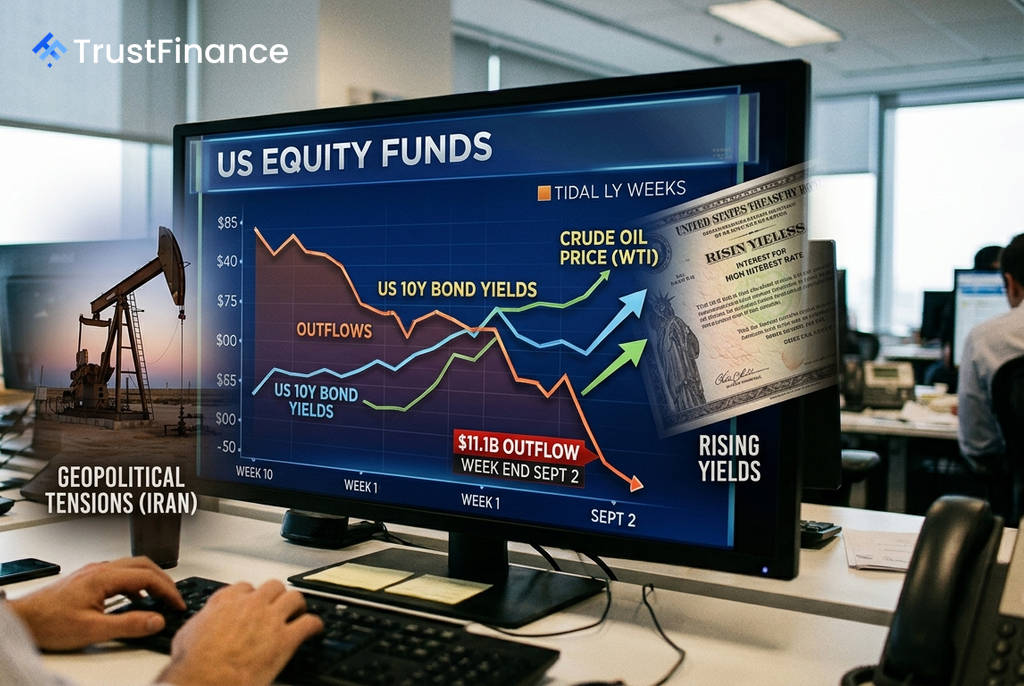
U.S. equity funds recorded a second consecutive week of net withdrawals as investors reacted to rising bond yields and renewed geopolitical tensions in the Middle East. For the week ending September 2, investors pulled a net $11.12 billion from U.S. equity funds, a significant but smaller outflow than the $22.72 billion withdrawn the prior week, according to LSEG Lipper data.
Investor Sentiment Sours
The shift in sentiment was largely attributed to a surge in oil prices and bond yields following U.S. military strikes on Iranian targets near the Strait of Hormuz. The escalation prompted a move away from riskier assets, though the selloff was tempered by continued optimism in the artificial intelligence sector.
Strong quarterly results from technology firms like Nvidia and Dell Technologies suggested to market participants that corporate spending on AI remains robust, helping to limit broader market declines.
A Closer Look at Fund Flows
The outflows were widespread across market capitalizations, with the largest withdrawals coming from large-cap funds.
 Ad
- Large-cap funds: $7.52 billion in net outflows
- Small-cap funds: $1.83 billion in net outflows
- Mid-cap funds: $572 million in net outflows
Sectoral funds also experienced significant selling, with net withdrawals totaling $3.48 billion. The technology sector saw the largest outflow at $1.39 billion, followed by financials ($1.31 billion) and industrials ($620 million).
Flight to Safety Evident
In a classic risk-off move, investors flocked to the relative safety of cash. U.S. money market funds attracted $48.76 billion in new assets, their highest weekly intake in four weeks.
Meanwhile, inflows into U.S. bond funds slowed to a five-week low of $4.27 billion. Demand remained concentrated in shorter-duration government debt, with short-to-intermediate government and Treasury funds attracting $4.53 billion.
Read next
More on Stocks
FTC Orders Walmart, Uber, Delta to Disclose Data on Personalized Pricing
The U.S. Federal Trade Commission is demanding nine major companies, including leading retail, travel, and gig economy firms, to provide information on how they use consumer data for setting individual prices and wages.

Google Launches Gemini 4 Carbon AI Model to Bolster Cybersecurity Capabilities
Alphabet's Google has unveiled Gemini 4 Carbon, its latest AI model specifically designed for advanced cybersecurity tasks like vulnerability detection and secure code generation. The launch escalates competition with rivals OpenAI and Anthropic in the enterprise AI market.

Oracle Shares Surge After Unveiling $225 Billion Revenue Target for 2030
Oracle stock rose sharply after the company presented a long-term financial outlook targeting at least $225 billion in annual revenue by fiscal 2030, driven by its expanding AI infrastructure business.

DOJ Scrutinizes Nvidia's $12.9B Hugging Face Deal Amid Broader Antitrust Probe, Sources Say
The U.S. Department of Justice is reportedly examining Nvidia's planned $12.93 billion acquisition of AI platform Hugging Face as part of a wider, ongoing antitrust investigation into the chipmaker's market conduct.