
Story
US Alleges Chinese AI Firms, Including Alibaba and DeepSeek, Engaged in 'Industrial-Scale' Model Extraction
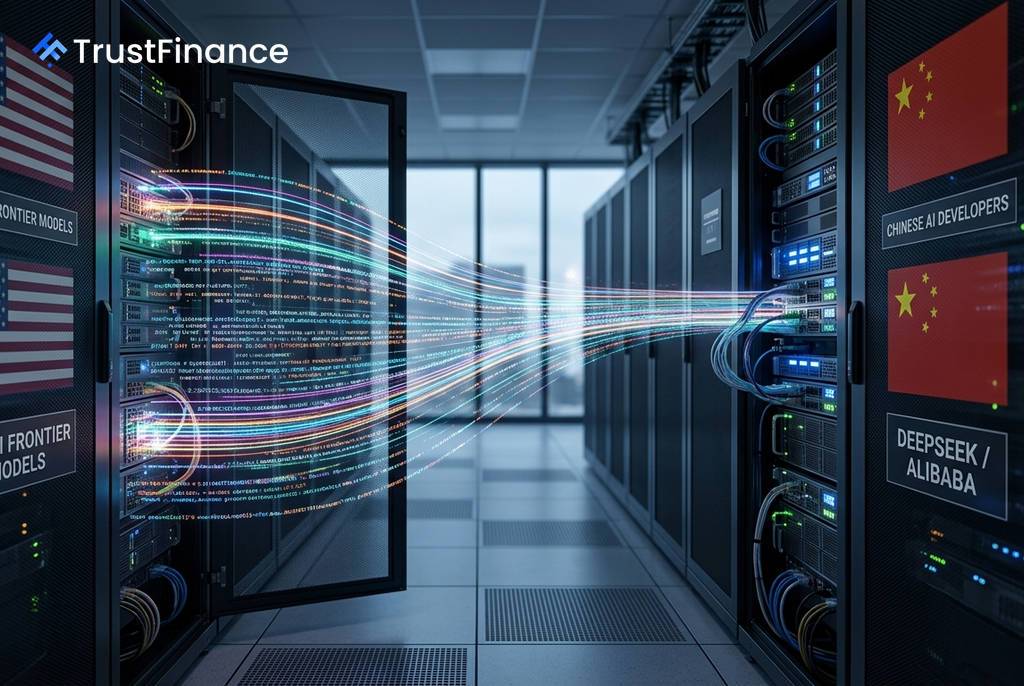
A group of U.S. federal agencies has accused several prominent Chinese artificial intelligence firms of conducting an “industrial-scale” campaign to extract capabilities from leading U.S. AI models. The effort was allegedly designed to cut development costs and close the technological gap between the two nations.
Details of the Allegations
In a joint advisory released Tuesday, the Cybersecurity and Infrastructure Security Agency (CISA), the National Security Agency (NSA), and the Federal Bureau of Investigation (FBI) named the companies involved. The list includes Alibaba, DeepSeek, Moonshot AI, MiniMax, StepFun, and Z.AI.
The agencies stated that these firms have extracted billions of tokens across millions of exchanges from U.S. models since at least late 2024. The advisory asserts that these campaigns have likely occurred with the awareness of the Chinese government.
For example, the report specifically claims that DeepSeek ran organized campaigns to develop its R1 and V3 models by targeting reasoning and other specialized functions. It also alleges that Alibaba used industrial-scale distillation techniques to enhance its Qwen family of models.
Methods and Targets
 Ad
The advisory details a multi-pronged approach used to circumvent safeguards. The Chinese firms allegedly used various channels to access the U.S. models, including direct APIs, cloud providers, third-party aggregators, and a gray market of proxies known as "transfer stations" to bypass geographic restrictions.
To avoid detection, the companies reportedly employed fraudulent accounts, bulk subscriptions, and automated systems. The targeted U.S. models included well-known platforms such as Claude, Gemini, GPT, and Grok. The capabilities extracted ranged from reasoning and coding to agentic functions and question-and-answer optimization, according to the agencies.
Agency Recommendations and Market Impact
The U.S. agencies recommended that American AI companies strengthen their defenses. Key suggestions include enhancing monitoring for anomalous usage, altering model responses to suspected distillation attempts, and increasing intelligence sharing between model providers, cloud platforms, and API aggregators.
The allegations highlight the escalating technological competition between the U.S. and China in the critical AI sector. For investors and market participants, this development underscores the significant intellectual property risks facing leading AI developers and could foreshadow further regulatory scrutiny or trade restrictions on technology transfer.
Read next
More on Stocks
FTC Orders Walmart, Uber, Delta to Disclose Data on Personalized Pricing
The U.S. Federal Trade Commission is demanding nine major companies, including leading retail, travel, and gig economy firms, to provide information on how they use consumer data for setting individual prices and wages.

Google Launches Gemini 4 Carbon AI Model to Bolster Cybersecurity Capabilities
Alphabet's Google has unveiled Gemini 4 Carbon, its latest AI model specifically designed for advanced cybersecurity tasks like vulnerability detection and secure code generation. The launch escalates competition with rivals OpenAI and Anthropic in the enterprise AI market.

Oracle Shares Surge After Unveiling $225 Billion Revenue Target for 2030
Oracle stock rose sharply after the company presented a long-term financial outlook targeting at least $225 billion in annual revenue by fiscal 2030, driven by its expanding AI infrastructure business.

DOJ Scrutinizes Nvidia's $12.9B Hugging Face Deal Amid Broader Antitrust Probe, Sources Say
The U.S. Department of Justice is reportedly examining Nvidia's planned $12.93 billion acquisition of AI platform Hugging Face as part of a wider, ongoing antitrust investigation into the chipmaker's market conduct.