
Story
Tesla Stock Down 30% in 2026 Amid Margin Pressure and Restructuring Concerns
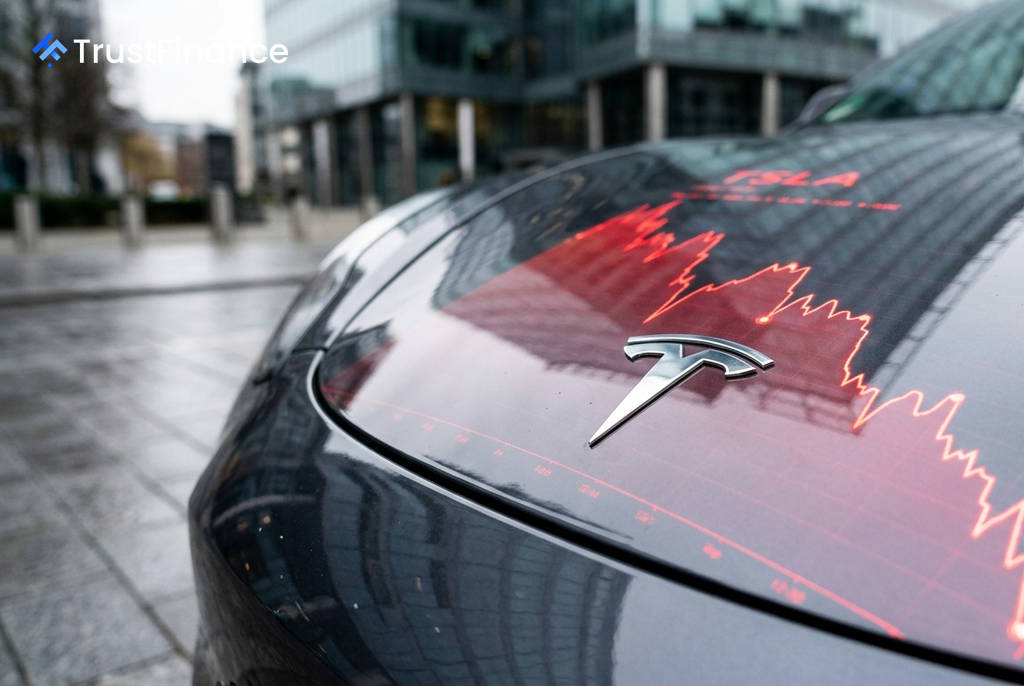
Tesla (TSLA) shares have fallen approximately 30% year-to-date, trading near their 52-week low as investors grapple with signs of significant margin compression and a substantial earnings miss. The decline to $319.53 per share persists despite a strong Q2 revenue beat and robust delivery growth in China, fueling a sharp debate over the electric vehicle maker's $1.27 trillion market valuation.
A Quarter of Contrasting Signals
Tesla's second-quarter 2026 financial results presented a conflicting narrative for the market. While the company posted revenue of $28.24 billion, beating analyst estimates by over 10%, its profitability came under pressure.
- Adjusted EPS: Missed expectations significantly at $0.33, compared to an estimate of $0.49.
- Auto Gross Margin: Fell to 16.3%, a notable decline from 21.1% in the first quarter of 2026.
The company attributed the margin squeeze to lower average selling prices, a $240 million energy warranty adjustment, and rising costs for interest-rate subventions. This trend of rising volume but falling profitability has led at least 15 analysts to revise their future earnings estimates downward, according to Investing.com data.
Strategic Uncertainty and Geographic Splits
 Ad
Adding to the complexity is a divergence in regional performance and reports of a potential corporate restructuring. While deliveries in China surged 37.8% year-over-year in July to 93,579 units, performance in some European markets has faltered, with Spain seeing an 81.3% YoY drop in July deliveries.
A significant overhang for investors is a report that Tesla executives were instructed to prepare for a separation of the company's China business—via a spinoff, sale, or closure—ahead of a potential merger with SpaceX (SPCX). This introduces a layer of structural uncertainty that complicates traditional valuation models.
A Future Bet on Robotics and AI
Tesla's management is increasingly framing the company's long-term thesis around robotics and artificial intelligence, shifting focus from its core auto business. The company outlined ambitious production targets for its Optimus humanoid robot and plans for capital expenditures to exceed $25 billion in 2026 to fund its Robotaxi, semiconductor, and AI infrastructure projects.
This strategy represents a massive bet on future revenue streams that have yet to materialize. The bull case for the stock largely depends on the success of these ventures, while bears point to the immediate risk of such high cash burn amid declining automotive profitability. Near-term risks also include an ongoing NHTSA probe into suspension failures in 1.2 million vehicles and regulatory headwinds for its Full Self-Driving (FSD) technology in Europe.
Read next
More on Stocks
FTC Orders Walmart, Uber, Delta to Disclose Data on Personalized Pricing
The U.S. Federal Trade Commission is demanding nine major companies, including leading retail, travel, and gig economy firms, to provide information on how they use consumer data for setting individual prices and wages.

Google Launches Gemini 4 Carbon AI Model to Bolster Cybersecurity Capabilities
Alphabet's Google has unveiled Gemini 4 Carbon, its latest AI model specifically designed for advanced cybersecurity tasks like vulnerability detection and secure code generation. The launch escalates competition with rivals OpenAI and Anthropic in the enterprise AI market.

Oracle Shares Surge After Unveiling $225 Billion Revenue Target for 2030
Oracle stock rose sharply after the company presented a long-term financial outlook targeting at least $225 billion in annual revenue by fiscal 2030, driven by its expanding AI infrastructure business.

DOJ Scrutinizes Nvidia's $12.9B Hugging Face Deal Amid Broader Antitrust Probe, Sources Say
The U.S. Department of Justice is reportedly examining Nvidia's planned $12.93 billion acquisition of AI platform Hugging Face as part of a wider, ongoing antitrust investigation into the chipmaker's market conduct.