
Story
SoftBank Shares Plunge Over 11% After OpenAI CEO Rules Out 2026 IPO
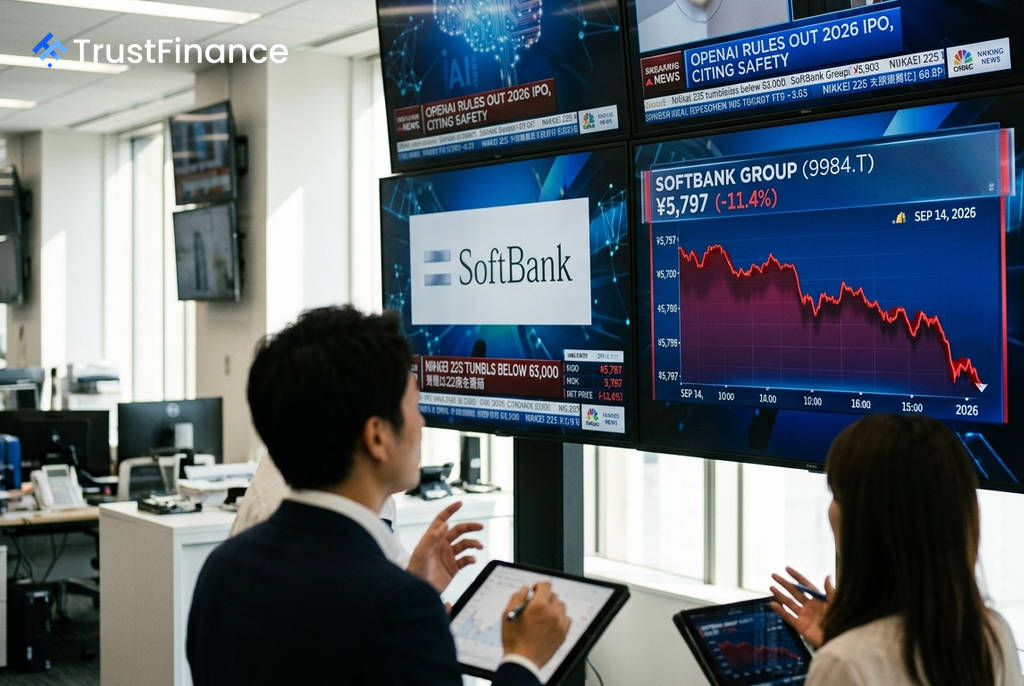
SoftBank Group shares plummeted on Monday after OpenAI CEO Sam Altman stated in a magazine interview that the artificial intelligence firm will not pursue an initial public offering in 2026. The news erased a key near-term catalyst for the Japanese investment giant, sending its stock down 11.4% to close at ¥5,797.
IPO Delay Rattles Investors
Altman's comments, which cited concerns over AI safety, directly impact SoftBank's investment thesis. The market had widely anticipated a public listing as a crucial liquidity event for SoftBank, which has committed approximately $64.6 billion to the AI developer.
The delay, which pushes the prospect of an IPO to at least 2027, complicates SoftBank's financial position. The company is reportedly carrying a substantial bridge loan tied to its OpenAI investment strategy while continuing to fund its commitment, making the timeline for a return on its capital a critical factor for investors.
Broader AI Sector Headwinds
The cautious sentiment was echoed by Anthropic CEO Dario Amodei, who separately called on the AI industry to slow the development of its most advanced models. This contributed to a broader reassessment of risk among investors in the AI sector.
 Ad
The fallout was not limited to SoftBank. Other Japanese stocks with significant AI exposure also fell sharply during the session, underscoring a sector-wide shift in sentiment. SoftBank was among the worst-performing stocks on the Nikkei 225 index.
Macroeconomic Pressures
The sell-off occurred within a weak broader market, offering no support for the stock. Japan's Nikkei 225 index fell 1.7% to a six-week low as several macroeconomic factors weighed on equities.
Concerns over energy supply, driven by rising crude oil prices after Saudi Arabia shut down its East-West pipeline, added to market pressure. These higher energy costs have strengthened expectations for tighter monetary policy, with both the U.S. Federal Reserve and the Bank of Japan anticipated to raise interest rates.
Read next
More on Stocks
FTC Orders Walmart, Uber, Delta to Disclose Data on Personalized Pricing
The U.S. Federal Trade Commission is demanding nine major companies, including leading retail, travel, and gig economy firms, to provide information on how they use consumer data for setting individual prices and wages.

Google Launches Gemini 4 Carbon AI Model to Bolster Cybersecurity Capabilities
Alphabet's Google has unveiled Gemini 4 Carbon, its latest AI model specifically designed for advanced cybersecurity tasks like vulnerability detection and secure code generation. The launch escalates competition with rivals OpenAI and Anthropic in the enterprise AI market.

Oracle Shares Surge After Unveiling $225 Billion Revenue Target for 2030
Oracle stock rose sharply after the company presented a long-term financial outlook targeting at least $225 billion in annual revenue by fiscal 2030, driven by its expanding AI infrastructure business.

DOJ Scrutinizes Nvidia's $12.9B Hugging Face Deal Amid Broader Antitrust Probe, Sources Say
The U.S. Department of Justice is reportedly examining Nvidia's planned $12.93 billion acquisition of AI platform Hugging Face as part of a wider, ongoing antitrust investigation into the chipmaker's market conduct.