
Story
Seattle Times and Newsday Sue OpenAI, Microsoft for Copyright Infringement
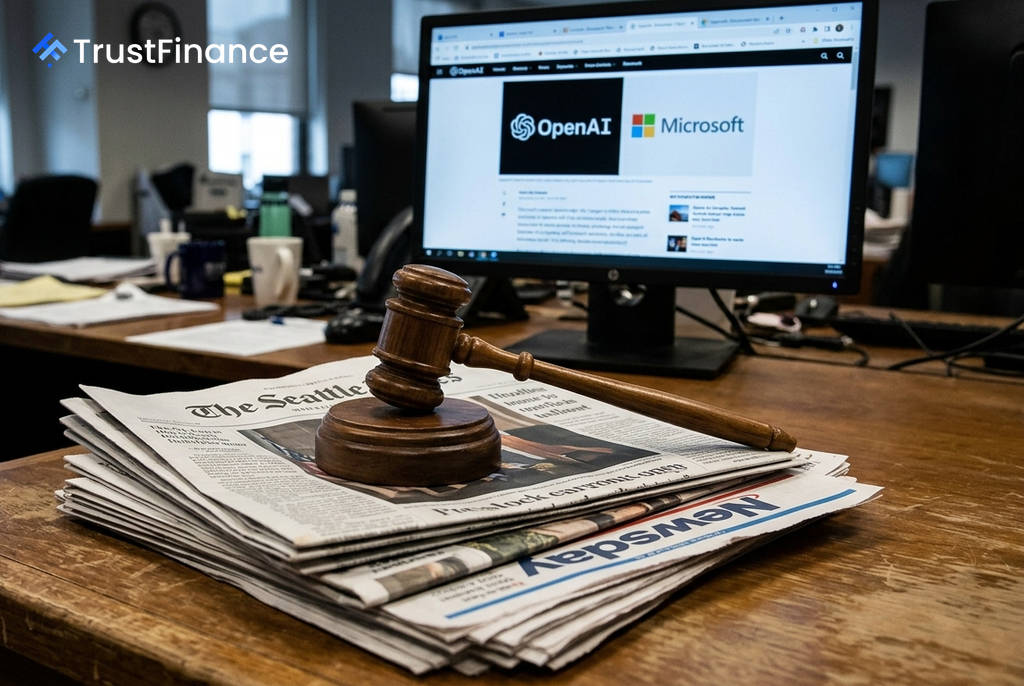
The Seattle Times and Newsday have sued OpenAI and its primary financial backer, Microsoft (MSFT), for copyright infringement, escalating the legal battle between media outlets and technology firms over the use of proprietary content to train artificial intelligence systems.
Details of the Lawsuit
The complaint, filed on Friday in the U.S. District Court for the Southern District of New York, alleges that the tech companies unlawfully scraped and copied the newspapers' articles without permission. According to the suit, this content, including material from behind paywalls, was incorporated into datasets used to train and operate generative AI products like ChatGPT, Microsoft Copilot, and Bing's AI features.
The newspapers argue that these AI products can reproduce their reporting verbatim or in close paraphrase, which diminishes the value of their journalism and reduces the incentive for readers to visit their websites or purchase subscriptions. "We feel strongly that we must defend our content - which we spend millions of dollars a year to produce - from being used without our consent or compensation," said Seattle Times President and CEO Alan Fisco in a statement reported by the newspaper.
Company Responses and Industry Context
A spokesperson for OpenAI stated that its models are trained on publicly available data and that its practices are grounded in the legal doctrine of fair use. Microsoft, in an emailed statement, called the lawsuit a "surprise" but added, "we appreciate the importance of local journalism and we’re always happy to sit down and explore solutions to this type of dispute."
 Ad
This legal action follows a similar high-profile case filed by The New York Times (NYT) in 2023 and is one of dozens of lawsuits brought by copyright holders against AI developers. The plaintiffs are seeking a court order for the destruction of all AI models and training datasets that incorporate their copyrighted work.
Market and Investor Implications
The growing wave of litigation represents a significant operational and financial risk for AI companies and their investors. A legal precedent favoring the publishers could force AI developers to incur substantial costs to license training data, potentially impacting the profitability and business models of generative AI.
For investors, these lawsuits introduce regulatory uncertainty and the possibility of future liabilities for companies heavily invested in AI. The outcomes of these cases are being closely watched as they could reshape the economics of the entire artificial intelligence industry by defining the legal boundaries of data usage for model training.
Read next
More on Stocks
FTC Orders Walmart, Uber, Delta to Disclose Data on Personalized Pricing
The U.S. Federal Trade Commission is demanding nine major companies, including leading retail, travel, and gig economy firms, to provide information on how they use consumer data for setting individual prices and wages.

Google Launches Gemini 4 Carbon AI Model to Bolster Cybersecurity Capabilities
Alphabet's Google has unveiled Gemini 4 Carbon, its latest AI model specifically designed for advanced cybersecurity tasks like vulnerability detection and secure code generation. The launch escalates competition with rivals OpenAI and Anthropic in the enterprise AI market.

Oracle Shares Surge After Unveiling $225 Billion Revenue Target for 2030
Oracle stock rose sharply after the company presented a long-term financial outlook targeting at least $225 billion in annual revenue by fiscal 2030, driven by its expanding AI infrastructure business.

DOJ Scrutinizes Nvidia's $12.9B Hugging Face Deal Amid Broader Antitrust Probe, Sources Say
The U.S. Department of Justice is reportedly examining Nvidia's planned $12.93 billion acquisition of AI platform Hugging Face as part of a wider, ongoing antitrust investigation into the chipmaker's market conduct.