
Story
Rumble Secures $13.7B GPU Deal in Pivot to AI, Highlighting Undercovered Mid-Caps
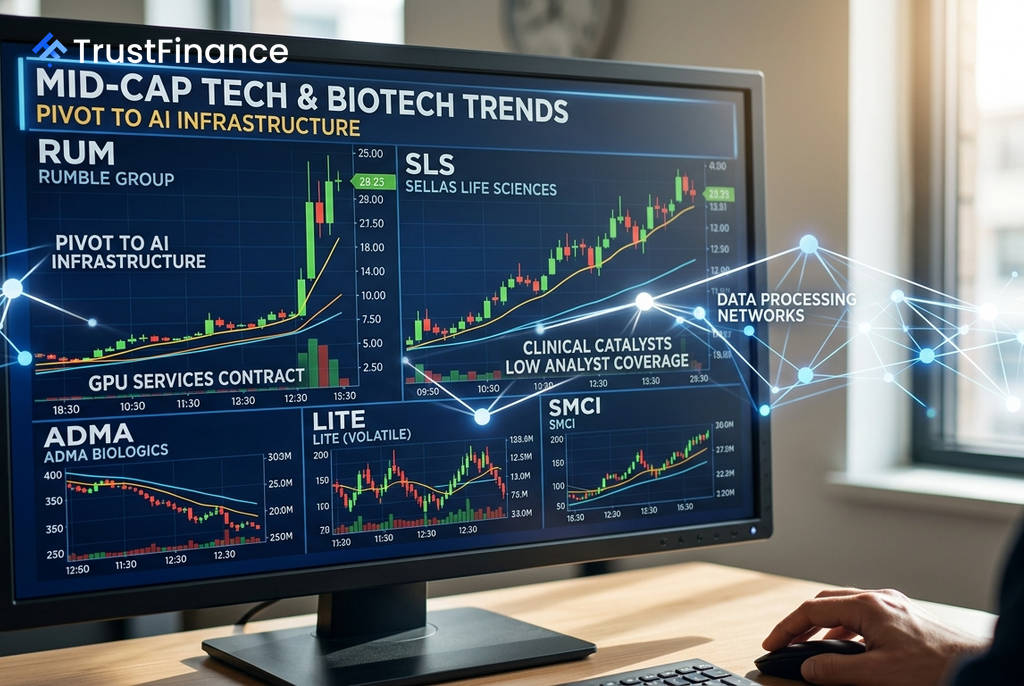
Video platform Rumble (NASDAQ: RUM) has secured a landmark $13.7 billion, six-year GPU services contract, marking a significant strategic pivot toward AI infrastructure and cloud services. The deal, the largest in the company's history, is with an undisclosed U.S. cloud customer and highlights a broader theme among a handful of mid-cap stocks receiving little attention from Wall Street analysts.
Rumble's AI Infrastructure Shift
Rumble has rebranded its cloud division to RUM Group and is positioning itself as a key player in the AI compute market. The company reported that the market currently values it on a media company multiple of approximately 1x enterprise value to revenue, while comparable AI compute firms trade closer to 3.5x forward revenue.
This valuation gap is central to the investment thesis. The new contract, based at its Maysville, Georgia facility, supports management's claims of significant growth potential. The company reported second-quarter revenue of $40.4 million, a 61% year-over-year increase, and has guided for third-quarter revenue between $87 million and $93 million. Currently, only one analyst officially covers the stock, according to Investing.com data.
Contrasting Biotech Narratives
Within the biotechnology sector, two other companies with limited analyst coverage offer starkly different profiles.
Sellas: The Momentum Story
 Ad
Sellas Life Sciences (NASDAQ: SLS) has experienced a dramatic rise, with its stock surging 683% over the past year. Despite the significant rally, the clinical-stage biotech firm maintains a strong financial health rating, an unusual feature for a company at its stage. With coverage from only two analysts, bulls point to potential further upside, but investors face the risk that momentum could reverse sharply on any negative developments.
ADMA: The Value Play
In contrast, ADMA Biologics (NASDAQ: ADMA) represents a potential value opportunity. The plasma-derived therapeutics company is profitable, trading at a price-to-earnings (P/E) ratio of 13.7x. However, its stock has fallen 44% over the last year. Five analysts cover the company, seeing an average upside target of 78%, suggesting the recent selloff may be overdone. The stock has shown signs of stabilizing, gaining over 16% in the past three months.
The Low-Coverage Factor
The common thread connecting these companies is their minimal analyst coverage, which can lead to market mispricing. For Rumble, it may mean its AI pivot is not fully appreciated. For Sellas and ADMA, it points to stories that are not yet widely understood by institutional investors.
While a lack of Wall Street coverage can present an opportunity for investors to get in ahead of broader market discovery, it also carries risks. These stocks often exhibit lower trading liquidity and higher volatility compared to their more widely followed peers, as sentiment can shift rapidly on limited information.
Read next
More on Stocks
FTC Orders Walmart, Uber, Delta to Disclose Data on Personalized Pricing
The U.S. Federal Trade Commission is demanding nine major companies, including leading retail, travel, and gig economy firms, to provide information on how they use consumer data for setting individual prices and wages.

Google Launches Gemini 4 Carbon AI Model to Bolster Cybersecurity Capabilities
Alphabet's Google has unveiled Gemini 4 Carbon, its latest AI model specifically designed for advanced cybersecurity tasks like vulnerability detection and secure code generation. The launch escalates competition with rivals OpenAI and Anthropic in the enterprise AI market.

Oracle Shares Surge After Unveiling $225 Billion Revenue Target for 2030
Oracle stock rose sharply after the company presented a long-term financial outlook targeting at least $225 billion in annual revenue by fiscal 2030, driven by its expanding AI infrastructure business.

DOJ Scrutinizes Nvidia's $12.9B Hugging Face Deal Amid Broader Antitrust Probe, Sources Say
The U.S. Department of Justice is reportedly examining Nvidia's planned $12.93 billion acquisition of AI platform Hugging Face as part of a wider, ongoing antitrust investigation into the chipmaker's market conduct.