
Story
Outgoing CFPB Chief Defends Agency Overhaul Amid Fierce Democratic Criticism
Summary
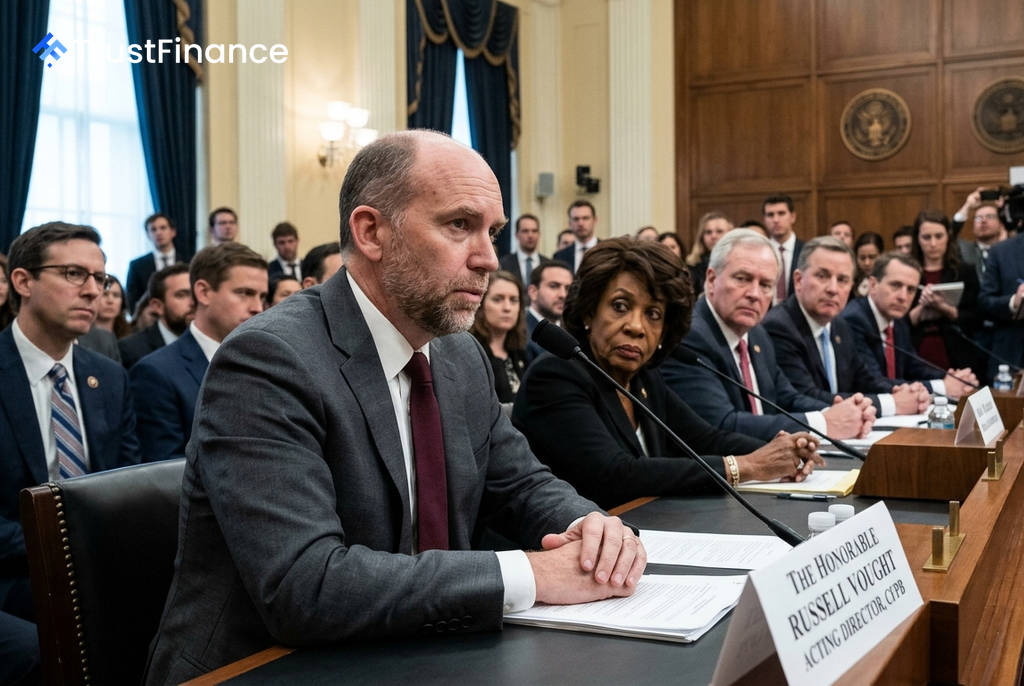
Russell Vought, the outgoing interim director of the Consumer Financial Protection Bureau, clashed with Democratic lawmakers in a congressional hearing, defending his efforts to shrink the agency as economically beneficial while facing accusations of undermining consumer protections.
Russell Vought, President Donald Trump’s outgoing interim director of the Consumer Financial Protection Bureau (CFPB), defended his controversial tenure during a contentious hearing before the House Financial Services Committee on Wednesday. Vought argued that his administration's efforts to scale back the agency's operations and regulations successfully eliminated economic burdens on consumers and businesses.
Heated Congressional Testimony
The hearing was marked by sharp partisan divides. Vought, who is also the White House budget director, is set to step down in two weeks after serving for a year and a half in an acting capacity. During his testimony, he faced intense questioning and criticism from Democrats.
"Sir, I am glad you are leaving," Representative Gregory Meeks told Vought, according to Reuters, alleging the director had flouted the laws that established the agency. The committee's top Democrat, Maxine Waters, warned Vought to expect continued oversight, stating, "Let me be clear, we are not done with you." Waters suggested that a Democratic majority after the November midterm elections could lead to a formal investigation into Vought's actions at the CFPB.
Dueling Views on Regulation
Republicans on the committee voiced support for Vought's policy changes, arguing the CFPB had engaged in politicized enforcement that harmed free enterprise. Representative Andy Barr, the top Republican on a key subcommittee, compared the agency's enforcement to "Gestapo tactics," as reported by Reuters.
 Ad
AdVought justified his actions by citing a report from the White House Council of Economic Advisers, which claimed CFPB regulations imposed hundreds of billions of dollars in costs on consumers by raising costs and limiting access to credit. He described the agency as "invasive" and operating outside of congressional oversight. However, the source material notes that consumer advocates and other experts have strongly disputed the White House report's methodology and conclusions.
Context and Agency Future
The CFPB was established by Congress in the wake of the 2008 financial crisis with a mandate to police predatory lending and oversee complex financial products. Vought's leadership was characterized by attempts to fire a majority of agency staff, rescind regulations, and halt many of the bureau's regular activities.
President Trump last month nominated Brian Johnson, a Capital One executive and former CFPB official, to serve as the agency's next permanent director. The confirmation process and the upcoming election will be critical in determining the future direction and enforcement posture of the powerful consumer watchdog.
Read next
More on Stocks
UBS Lifts AI Spending Forecast to $1.4 Trillion by 2027, Cites Soaring Memory Costs
UBS has dramatically raised its forecast for artificial intelligence capital expenditure, projecting it will reach nearly $1 trillion this year and $1.4 trillion in 2027, driven almost entirely by surging memory prices.

CFDA CEO Steven Kolb Resigns Following Physical Altercation with Protesters
Steven Kolb has stepped down as CEO of the Council of Fashion Designers of America after twenty years, following a widely publicized incident where he physically restrained animal rights activists at a New York Fashion Week show.

Anthropic Weighs New AI Model Release to Counter OpenAI Ahead of IPO, Sources Say
AI developer Anthropic is reportedly considering a new model launch to compete with OpenAI's recent success, a move that comes as the company prepares for an IPO and shortly after its CEO advocated for a slowdown in AI development.

Paramount, States Discuss CNN Oversight in Warner Bros. Merger Settlement Talks, Sources Say
Paramount and a dozen states are reportedly discussing a settlement to clear its $110 billion acquisition of Warner Bros. Discovery, with potential terms including independent monitoring of CNN and a commitment to theatrical film releases.