
Story
Oil Prices Hover Near $100 as Markets Weigh US-Iran Talks Against Inventory Build
Summary
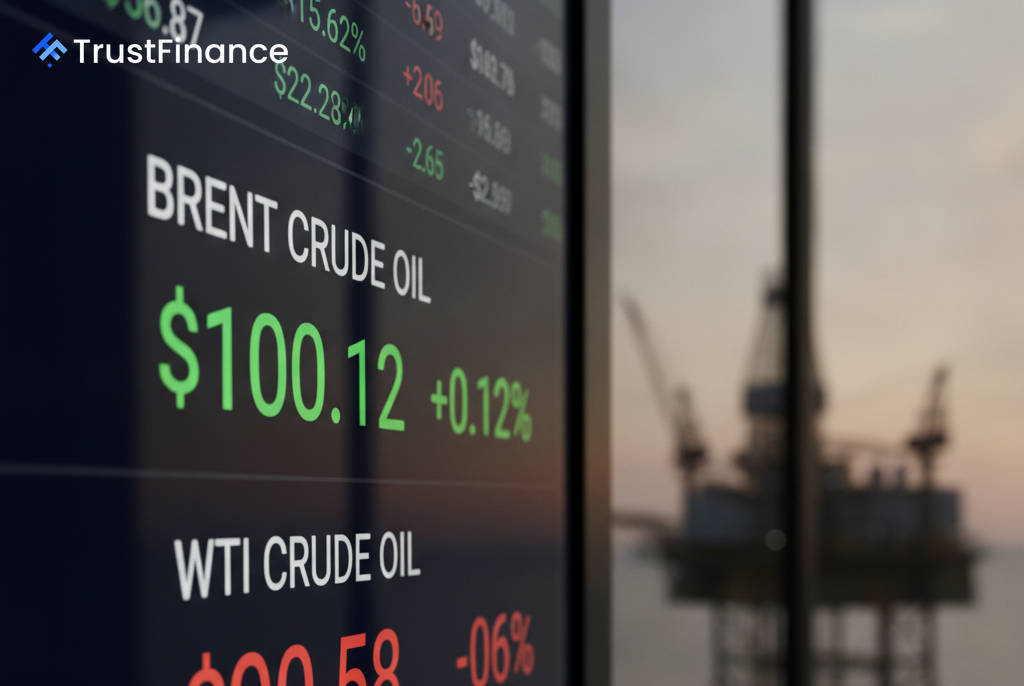
Brent crude traded around the key $100 per barrel level as investor hopes for a diplomatic breakthrough between the U.S. and Iran were tempered by a surprise increase in U.S. crude stockpiles.
Oil prices fluctuated around the key $100 per barrel mark for Brent crude on Wednesday as traders weighed signs of diplomatic progress between the U.S. and Iran against a surprise build in American crude inventories.
As of 8:06 AM ET, Brent crude futures, the international benchmark, were up 1.1% at $100.30 per barrel. U.S. West Texas Intermediate (WTI) crude futures edged up 0.1% to $90.64 per barrel. The move follows a session on Tuesday where both contracts fell over 1%, with Brent closing below $100 for the first time since September 8.
Diplomatic Hopes Weigh on Prices
Market sentiment was influenced by comments from U.S. President Donald Trump, who described a recent three-hour meeting between his team and Iranian representatives in New York as "very smooth" and productive. The statement has fueled investor optimism that a diplomatic solution could ease tensions in the Persian Gulf.
A potential de-escalation could lead to the reopening of the Strait of Hormuz, a critical chokepoint for global energy shipments. Iran has reportedly indicated it could reopen the strait within seven days if Washington eases military pressure, though Tehran has not formally confirmed an agreement is in place.
Supply-Side Factors Add Pressure
 Ad
AdAdding to downward pressure on prices, data showed that U.S. crude oil inventories unexpectedly rose by 1.7 million barrels last week. This contrasted with analyst expectations for a draw of 578,000 barrels, according to a forecast from ING.
In another supply-side development, Saudi Arabia has reportedly restarted its East-West pipeline, which offers an alternative route to the Strait of Hormuz by transporting crude to the Red Sea. The pipeline was previously shut down following a drone attack, and a full return to its capacity of roughly 7 million barrels per day may take another six to eight weeks as repairs continue.
Market Context
Despite the recent volatility, oil prices remain significantly elevated for the year. Analysts at ING noted that crude has still gained over 60% year-to-date. Before the recent conflict, the Strait of Hormuz was the transit point for about one-fifth of the world's oil and liquefied natural gas supply, underscoring the high stakes of the ongoing negotiations.
Read next
More on Commodities
European Gas Prices Rebound as Traders Reassess US-Iran Diplomatic Hopes
European natural gas futures recovered from a sharp sell-off on Tuesday as traders tempered expectations for a swift diplomatic breakthrough between the U.S. and Iran. The move follows Monday's steep decline, which was driven by optimism over potential talks at the United Nations.

Russia Confirms Diplomatic Talks with Turkey on Black Sea Grain Corridor
Moscow is in discussions with Ankara over a new proposal for a secure grain shipping lane, Kremlin spokesman Dmitry Peskov confirmed, as Russia also seeks alternative export routes amid heightened regional tensions.

Bank of America Raises H2 2026 Brent Crude Forecast to $95 on Mideast Supply Risks
Bank of America has increased its price forecast for Brent crude in the second half of 2026 to $95 per barrel, up from $83, citing severe supply disruptions from ongoing geopolitical conflicts, particularly Iran's blockade of the Strait of Hormuz.

Wheat Futures Decline on Profit-Taking Ahead of US Market Open
Wheat futures fell in pre-market trading, driven by profit-taking as traders assessed geopolitical developments in the Black Sea and harvest progress in Ukraine.