
Story
HealthEquity Stock Falls as In-Line Earnings Disappoint Investors
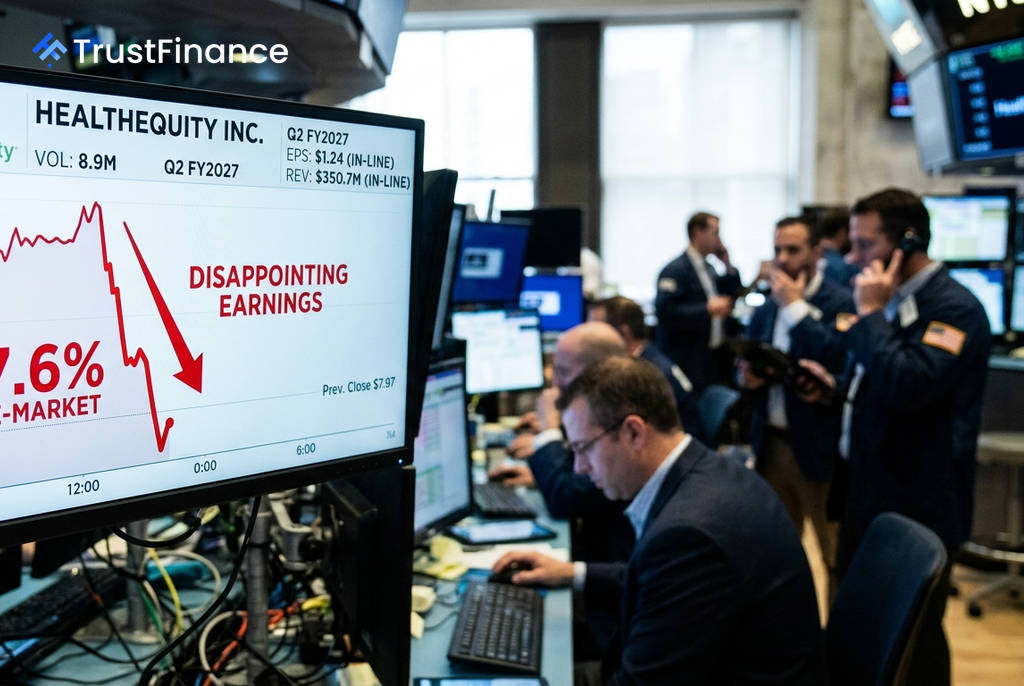
HealthEquity, Inc. (HQY) shares fell sharply in pre-market trading despite the company reporting second-quarter fiscal 2027 results that met Wall Street forecasts. The sell-off suggests investors were anticipating a more substantial earnings beat to justify the stock's recent rally to near 52-week highs.
Results Meet, But Don't Exceed, Expectations
The health savings account (HSA) administrator reported revenue of $350.7 million, an 8% year-over-year increase that was closely aligned with the analyst consensus of $349.22 million. Non-GAAP net income per diluted share rose 15% to $1.24, narrowly beating the expected $1.19.
Following the pre-market announcement, the company's stock dropped 7.6%. The market's reaction indicates that the modest beat was insufficient for a stock that had run up significantly ahead of the earnings release.
Strong Operations vs. High Expectations
Despite the negative stock performance, HealthEquity's underlying business metrics showed record strength. In the earnings release, CEO Scott Cutler highlighted several operational achievements for the quarter:
 Ad
- A record Adjusted EBITDA margin of 48%.
- A record 10.7 million HSA accounts.
- Record HSA Assets under management, reaching nearly $38 billion.
The company also returned $108.1 million to shareholders through stock repurchases. However, this operational strength appears to have been already priced into the stock, leading to a classic "sell the news" event when the financial results did not deliver a major upside surprise.
Guidance and Market Context
Management raised its guidance for the full fiscal year 2027, but this failed to stem the pre-market decline. Investors may have been disappointed by the flat sequential earnings, as the Q2 non-GAAP EPS of $1.24 was unchanged from the first quarter.
The decline in HealthEquity shares was company-specific, occurring while the broader S&P 500 and NASDAQ indices were trading higher. The market environment, marked by recent increases in Treasury yields following inflation data, can also create headwinds for growth stocks trading at high valuations.
Read next
More on Stocks
FTC Orders Walmart, Uber, Delta to Disclose Data on Personalized Pricing
The U.S. Federal Trade Commission is demanding nine major companies, including leading retail, travel, and gig economy firms, to provide information on how they use consumer data for setting individual prices and wages.

Google Launches Gemini 4 Carbon AI Model to Bolster Cybersecurity Capabilities
Alphabet's Google has unveiled Gemini 4 Carbon, its latest AI model specifically designed for advanced cybersecurity tasks like vulnerability detection and secure code generation. The launch escalates competition with rivals OpenAI and Anthropic in the enterprise AI market.

Oracle Shares Surge After Unveiling $225 Billion Revenue Target for 2030
Oracle stock rose sharply after the company presented a long-term financial outlook targeting at least $225 billion in annual revenue by fiscal 2030, driven by its expanding AI infrastructure business.

DOJ Scrutinizes Nvidia's $12.9B Hugging Face Deal Amid Broader Antitrust Probe, Sources Say
The U.S. Department of Justice is reportedly examining Nvidia's planned $12.93 billion acquisition of AI platform Hugging Face as part of a wider, ongoing antitrust investigation into the chipmaker's market conduct.