
Story
Deutsche Bank: SpaceX Orbital Data Centers Could Match Ground Costs by Early 2030s
Summary
A Deutsche Bank analysis suggests SpaceX could achieve cost parity between its planned orbital data centers and terrestrial facilities by the early 2030s, driven by Starship launch scalability and vertical integration.
SpaceX could make orbital data centers as cost-effective as their terrestrial counterparts by the early 2030s, according to a new analysis released Tuesday by Deutsche Bank. The bank projects that advancements in launch reusability with Starship and satellite optimization will be key to closing the existing cost gap for the company's ambitious space-based computing infrastructure.
The Path to Cost Parity
Deutsche Bank estimates that deploying a 1-gigawatt space data center constellation currently costs six times more than an equivalent ground-based facility, excluding the cost of the computing hardware itself. The bank, citing analysis from Epoch AI, places the five-year cost for a 1-gigawatt terrestrial AI compute center at approximately $42.5 billion, including $38 billion in upfront capital expenditure and $900 million in annual operating expenses.
However, the report forecasts this significant cost premium will shrink dramatically. Analysts expect the cost gap to narrow to a factor of 1.0 to 1.5 times by the end of this decade. By the early-to-mid 2030s, the bank believes the orbital model could become cheaper than building on the ground, a shift largely dependent on the successful scaling and full reusability of SpaceX's Starship launch system.
Starmind's Technical Foundation
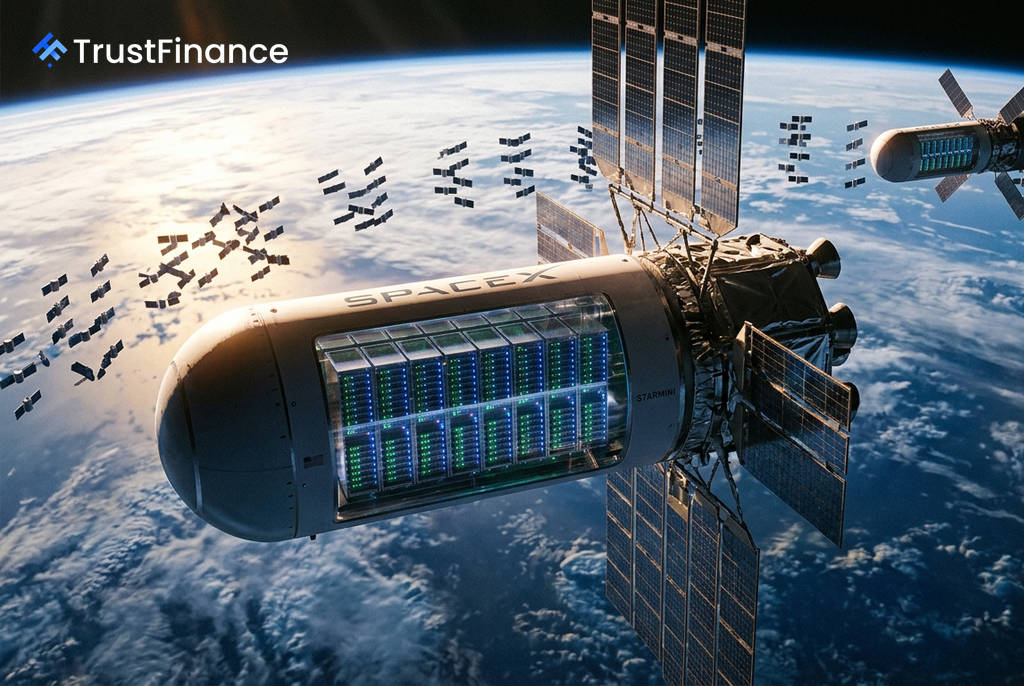
The analysis centers on SpaceX’s proposed "Starmind" constellation, which would consist of specialized "AI1" satellites. These satellites are designed to function as data centers in low Earth orbit, routing traffic through the existing Starlink network using optical inter-satellite links rather than complex phased-array antennas.
 Ad
AdKey details of the AI1 satellite design include:
- Power Consumption: Each satellite is expected to run at approximately 120 kilowatts, a power draw comparable to a single NVIDIA GB300 NVL72 server rack.
- Open Platform: SpaceX has indicated a willingness to host a variety of AI accelerators, including GPUs from Nvidia, TPUs from Google, and chips from Amazon and Tesla.
- Scale: FCC filings have outlined a potential constellation of up to one million satellites, with prototype deployments targeted for late next year.
Vertical Integration and Network Capacity
SpaceX’s strategy of vertical integration is a critical component of its cost-reduction efforts. The company is currently building a solar cell manufacturing facility in Bastrop, Texas, targeting 10 gigawatts of capacity to power its future constellations. Production is slated to ramp up by the end of 2027.
Network capacity is also set to expand significantly. Deutsche Bank noted that recent FCC rule changes could allow for up to seven times more capacity from the same number of satellites. SpaceX is utilizing a wide range of spectrum, including E-band, V-band, and W-band, to enhance the data backhaul capabilities of its network gateways.
Read next
More on Stocks
UBS Lifts AI Spending Forecast to $1.4 Trillion by 2027, Cites Soaring Memory Costs
UBS has dramatically raised its forecast for artificial intelligence capital expenditure, projecting it will reach nearly $1 trillion this year and $1.4 trillion in 2027, driven almost entirely by surging memory prices.

CFDA CEO Steven Kolb Resigns Following Physical Altercation with Protesters
Steven Kolb has stepped down as CEO of the Council of Fashion Designers of America after twenty years, following a widely publicized incident where he physically restrained animal rights activists at a New York Fashion Week show.

Anthropic Weighs New AI Model Release to Counter OpenAI Ahead of IPO, Sources Say
AI developer Anthropic is reportedly considering a new model launch to compete with OpenAI's recent success, a move that comes as the company prepares for an IPO and shortly after its CEO advocated for a slowdown in AI development.

Paramount, States Discuss CNN Oversight in Warner Bros. Merger Settlement Talks, Sources Say
Paramount and a dozen states are reportedly discussing a settlement to clear its $110 billion acquisition of Warner Bros. Discovery, with potential terms including independent monitoring of CNN and a commitment to theatrical film releases.