
Story
CITIC Securities: China's A-Shares in Oversold Bounce, Recommends Shift to Core Assets
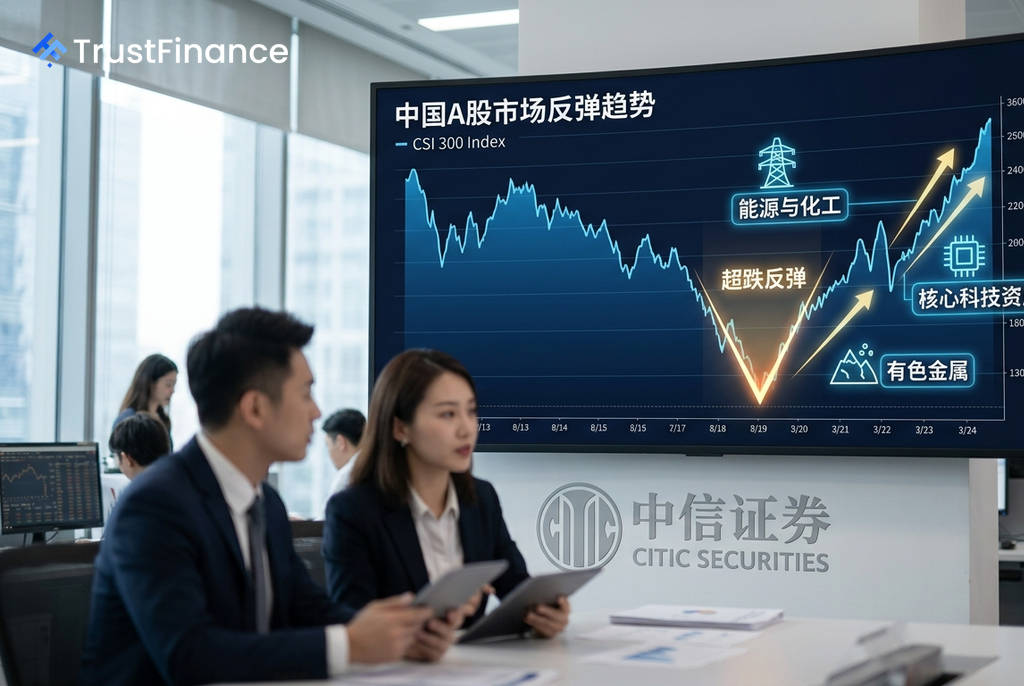
China's A-share market is currently in an oversold bounce phase following a sharp sell-off in July, according to a new research report from CITIC Securities. The brokerage notes that the rebound is being led by the hardest-hit sectors, but advises investors to begin shifting from a purely technical rebound strategy toward a more balanced portfolio focused on fundamentals.
A Technical Rebound
The market's early August recovery is primarily a technical reaction to prior losses, not yet a shift driven by fundamental trends, CITIC stated. The firm highlighted a strong negative correlation of -0.85 between sector performance in July and the first week of August.
This trend indicates that the sectors with the deepest declines saw the strongest rebounds. For example:
- PCBs, which fell 35.4% in July, rallied 33.0% in the first week of August.
- Semiconductor materials, down 43.8% in July, gained 27.6%.
- Cables, after a 45.4% drop in July, bounced 23.4%.
CITIC's analysis suggests this pattern is consistent with historical liquidity-driven sell-offs, where oversold bounces typically materialize within 5 to 10 trading days from the market bottom.
Gauging Sector Health
 Ad
CITIC Securities assessed the market's health from three perspectives—holding costs, margin debt, and trading concentration—to determine the recovery's sustainability.
The brokerage found that significant unrealized losses, or "underwater" positions, are concentrated in technology growth and small-cap stocks, particularly in defense (-12.4% cost deviation), communications (-10.6%), and power equipment (-10.0%). Conversely, sectors like pharmaceuticals, non-ferrous metals, and energy have minimal holding cost pressure.
From a margin financing perspective, the deleveraging process for the market's recent leaders is about halfway complete. However, trading crowdedness remains high, with the top 5% of stocks accounting for 51.4% of trading volume, a level near a five-year peak. This concentration is still particularly high in the electronics and communications sectors.
Investment Outlook and Recommendations
Based on its analysis, CITIC Securities recommends investors use the rebound to rebalance their portfolios. The firm advises reducing exposure to speculative assets and rotating into core technology leaders and non-tech sectors with solid fundamentals and lower valuations.
Within the technology space, the report suggests shifting from AI-related stocks driven by price speculation toward core assets with more certain volume growth, such as those in gas turbines, wafer manufacturing, and semiconductor equipment. For non-tech allocations, CITIC recommends overweighting energy and chemicals, non-ferrous metals, innovative pharmaceuticals, and leading brokerage firms.
Read next
More on Stocks
FTC Orders Walmart, Uber, Delta to Disclose Data on Personalized Pricing
The U.S. Federal Trade Commission is demanding nine major companies, including leading retail, travel, and gig economy firms, to provide information on how they use consumer data for setting individual prices and wages.

Google Launches Gemini 4 Carbon AI Model to Bolster Cybersecurity Capabilities
Alphabet's Google has unveiled Gemini 4 Carbon, its latest AI model specifically designed for advanced cybersecurity tasks like vulnerability detection and secure code generation. The launch escalates competition with rivals OpenAI and Anthropic in the enterprise AI market.

Oracle Shares Surge After Unveiling $225 Billion Revenue Target for 2030
Oracle stock rose sharply after the company presented a long-term financial outlook targeting at least $225 billion in annual revenue by fiscal 2030, driven by its expanding AI infrastructure business.

DOJ Scrutinizes Nvidia's $12.9B Hugging Face Deal Amid Broader Antitrust Probe, Sources Say
The U.S. Department of Justice is reportedly examining Nvidia's planned $12.93 billion acquisition of AI platform Hugging Face as part of a wider, ongoing antitrust investigation into the chipmaker's market conduct.