
Story
Citi: Investor Sentiment Improves for China Stocks, Worsens for KOSPI
Summary
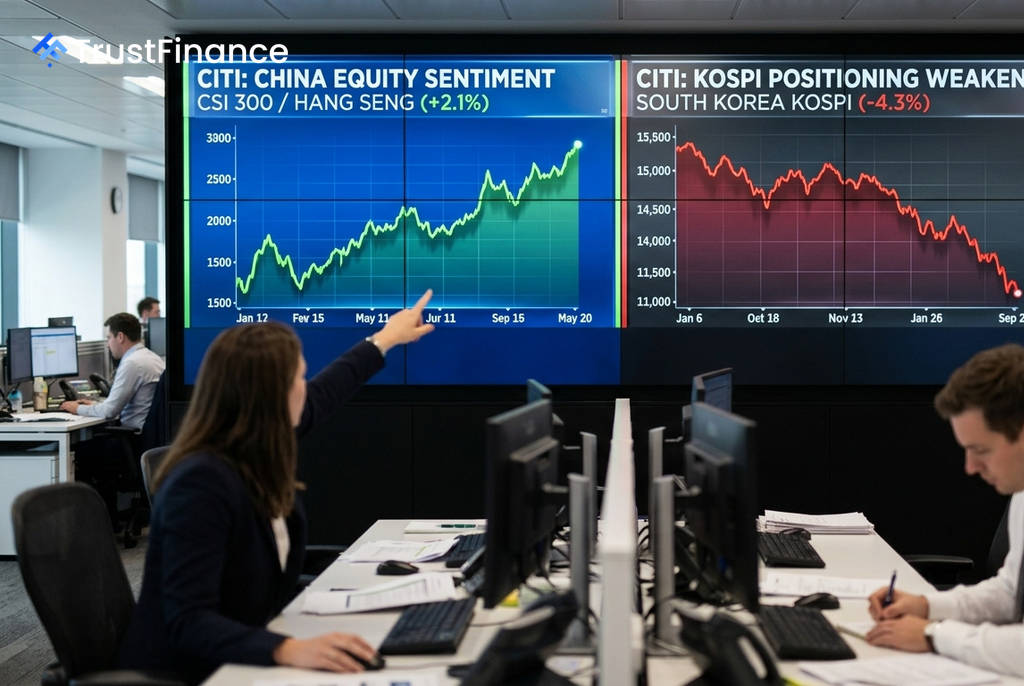
Investor positioning in Chinese equities has improved on short covering, while bearish bets have increased on South Korean and Japanese markets, according to a new Citi analysis. The report highlights the KOSPI's fragility and rising capitulation risk.
Investor positioning in Chinese equities has improved significantly, driven by short covering, while bearish sentiment has intensified for South Korean and Japanese markets, according to a new analysis from Citi. The divergence highlights a shifting risk appetite among investors in major Asian markets.
China Sentiment Shifts on Short Covering
Positioning in both the China A50 and Hang Seng indices saw a "meaningful improvement," with sentiment moving toward bullish territory, Citi reported. This shift was primarily attributed to short covering, where investors who had bet against the market buy back shares to close their positions.
The bank's analysts noted that this represents a "notable change in sentiment" toward Chinese equities, suggesting that the recent pessimism may be starting to ease.
Bearish Bets Mount on KOSPI and Nikkei
 Ad
AdIn contrast, bearish flows intensified for South Korea's KOSPI and Japan's Nikkei indices. According to Citi, this was driven mainly by investors initiating new short positions, indicating a more negative outlook for these markets.
Citi's report singled out the South Korean market as appearing particularly "fragile." While overall notional exposure has declined, making the headline positioning seem more neutral, many existing long positions are reportedly deeply in loss.
This underlying weakness raises concerns about potential forced selling. The firm warned that capitulation risk could increase further if the market weakness in South Korea continues, potentially leading to a sharper downturn as long-term holders are forced to sell.
Read next
More on Stocks
MOEX Russia Index Closes Flat Amid Mixed Trading and Falling Oil Prices
Russia's benchmark stock index, the MOEX, finished the trading session unchanged as gains in consumer and materials stocks were offset by weakness in other sectors. The flat close came despite a drop in global oil prices and a strengthening of the Russian ruble.

Boeing 737 MAX Software Glitch Affects Autopilot, Prompts FAA Review
Boeing has identified a software flaw in its 737 MAX jets that can disable some automated navigation functions during certain landing scenarios, according to a Wall Street Journal report. The issue has prompted an FAA investigation and requests from major U.S. airlines to halt deliveries of aircraft with the new software.

Trump Announces New Fuel Economy Rules to End Biden-Era EV Push
Former President Donald Trump stated he has approved new fuel economy standards designed to reverse the Biden administration's policies that encouraged electric vehicle production. The move, announced on social media, signals a major shift in U.S. automotive regulatory policy.

Boeing Discloses 737 MAX Software Flaw Affecting Landing Navigation
Boeing has identified a software glitch in its 737 MAX aircraft that could disable an automated navigation feature during landing, prompting an investigation by the FAA and requests from major airlines to avoid the flawed update.