
Story
Canadian Dollar Tumbles as Weak Jobs Report Diverges Sharply from US Payrolls
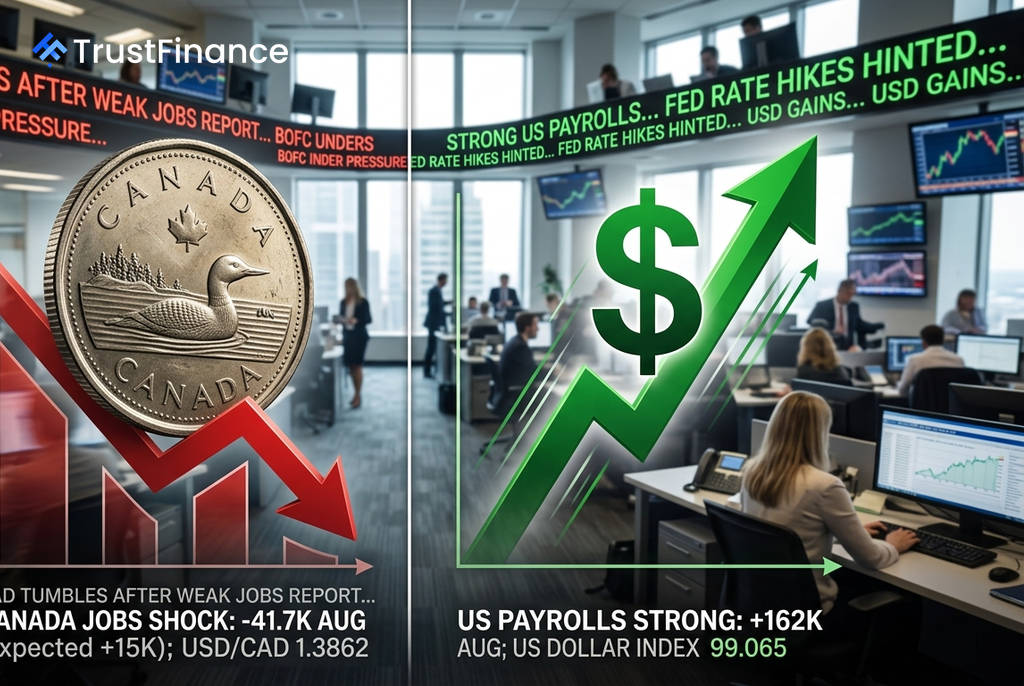
The Canadian dollar weakened significantly on Friday after a surprise drop in domestic employment created a stark contrast with a stronger-than-expected U.S. jobs report. The divergence in economic data bolstered the U.S. dollar and halted the loonie's recent gains, highlighting differing outlooks for the two North American economies.
A Tale of Two Labor Markets
Canada's economy unexpectedly shed 41,700 jobs in August, according to data from Statistics Canada. The figure was a significant disappointment compared to market expectations for a gain of about 15,000 positions. While the unemployment rate held steady at 6.4%, the employment rate ticked down 0.1 percentage points to 60.8%, and annual wage growth slowed to 2.0% from 2.8% in July.
In contrast, the U.S. labor market showed continued resilience. U.S. employers added 162,000 jobs in August, while the unemployment rate remained at 4.1%. This robust performance reinforced the view that the U.S. economy remains on solid footing.
Central Bank Implications
The diverging labor reports have significant implications for monetary policy at the Bank of Canada (BoC) and the U.S. Federal Reserve. The weak Canadian data may make it more difficult for the BoC to justify a hawkish policy stance, potentially giving it more room to remain accommodative.
 Ad
"The sharp decline in labor market puts pressure on the Canadian dollar... because the latest labor data now makes it harder for the Bank of Canada to justify a more hawkish stance," said Alex Tsepaev, Chief Strategy Officer of B2PRIME Group. He added that the strong U.S. report increases "the chances for the Fed to keep rates higher for a longer period," a policy divergence that supports the U.S. dollar.
Market Reaction
In response to the news, the USD/CAD currency pair rose approximately 0.5% to trade around 1.3862. The move marked a sharp reversal for the loonie, which had strengthened in recent sessions amid a broader U.S. dollar pullback and supportive oil prices.
The focus has now shifted abruptly to the relative economic strength between the two countries. Statistics Canada also noted that Canadian industries dependent on U.S. exports face an uncertain environment, with new tariffs adding to existing risks.
Read next
More on Forex
Polish Zloty Hits 11-Month Low Against Euro on Energy Price Pressure
The Polish zloty weakened to 4.410 against the euro, its lowest point since November 2023, as rising energy prices and caution ahead of a U.S. Federal Reserve decision weighed on the currency.

Sterling Slips as Dollar Strengthens Ahead of Fed Decision and UK Budget
The British pound lost ground against a resurgent U.S. dollar on Wednesday as market attention shifted from tech sector volatility to upcoming central bank decisions and the UK budget announcement.

Eurozone Bond Yields Climb as French Fiscal Concerns Return Ahead of Fed, ECB Decisions
Yields on French and German government bonds rose as relief from a ratings affirmation for France proved temporary, with investors refocusing on fiscal challenges and awaiting key policy verdicts from the U.S. Federal Reserve and the European Central Bank.

Canadian Dollar Slips as Markets Await Bank of Canada, Fed Decisions
The Canadian dollar edged lower against its U.S. counterpart, snapping a seven-day winning streak as investors adopted a cautious stance ahead of Wednesday's key interest rate announcements from both the Bank of Canada and the U.S. Federal Reserve.