
Story
Bank of America Launches $250 Billion Infrastructure Finance Initiative
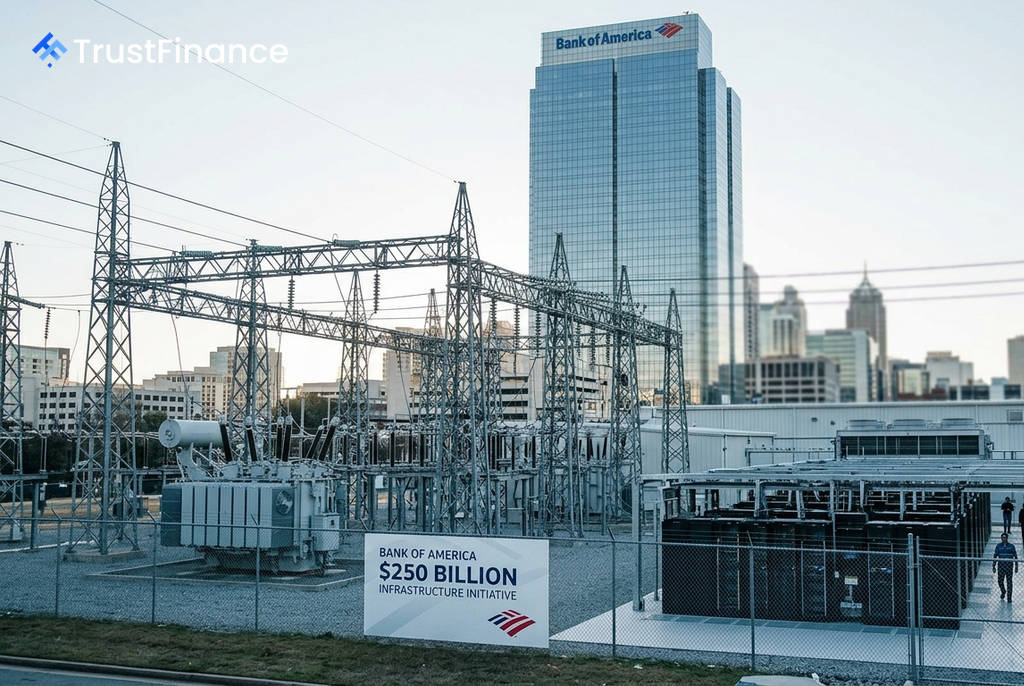
Bank of America announced on Wednesday it will deploy $250 billion in financing and advisory services to support U.S. infrastructure and digital projects by July 2027. The move positions the bank to capitalize on growing demand in high-growth sectors and aims to stimulate domestic economic growth.
Initiative Focus and Structure
The bank's "Critical Infrastructure Finance Initiative" will run for an 18-month period from January 1, 2026, to July 4, 2027, coinciding with the nation's 250th anniversary. According to the announcement, the capital will be directed toward three primary areas:
- Digital Infrastructure: Including AI data centers and computing facilities.
- Energy and Power: Focusing on renewable generation and energy storage.
- Core Infrastructure: Encompassing transportation and natural gas projects.
To support these projects, Bank of America will provide a range of financial services, including primary market lending, investments, capital markets access, and strategic advisory. "Meeting America’s growing infrastructure needs requires mobilizing capital at scale across increasingly interconnected sectors," said Karen Fang, global head of infrastructure and sustainable finance at Bank of America.
Competitive Landscape
 Ad
This commitment places Bank of America alongside other Wall Street giants that have recently launched similar large-scale financing programs. The move follows Morgan Stanley's plan to facilitate approximately $1.5 trillion over the next decade for technology and infrastructure, and JPMorgan Chase's $1.5 trillion initiative launched last year to fund industries critical to U.S. economic resilience.
These initiatives underscore a broader trend among major financial institutions to fund the modernization of the U.S. economy, particularly in areas like advanced manufacturing, energy infrastructure, and the build-out required for artificial intelligence.
Economic Impact and Outlook
Bank of America executives stated the initiative is expected to create tens of thousands of jobs and drive long-term economic prosperity. Fang noted that infrastructure projects typically involve construction loans with terms of five to seven years, which are often refinanced into longer-term debt once operational.
When asked about the potential for further investment beyond 2027, Fang suggested that the initial target could be surpassed. "If we all do our job right, we should be deploying more capital," she said, highlighting the significant and ongoing need for infrastructure investment in the U.S.
Read next
More on Stocks
FTC Orders Walmart, Uber, Delta to Disclose Data on Personalized Pricing
The U.S. Federal Trade Commission is demanding nine major companies, including leading retail, travel, and gig economy firms, to provide information on how they use consumer data for setting individual prices and wages.

Google Launches Gemini 4 Carbon AI Model to Bolster Cybersecurity Capabilities
Alphabet's Google has unveiled Gemini 4 Carbon, its latest AI model specifically designed for advanced cybersecurity tasks like vulnerability detection and secure code generation. The launch escalates competition with rivals OpenAI and Anthropic in the enterprise AI market.

Oracle Shares Surge After Unveiling $225 Billion Revenue Target for 2030
Oracle stock rose sharply after the company presented a long-term financial outlook targeting at least $225 billion in annual revenue by fiscal 2030, driven by its expanding AI infrastructure business.

DOJ Scrutinizes Nvidia's $12.9B Hugging Face Deal Amid Broader Antitrust Probe, Sources Say
The U.S. Department of Justice is reportedly examining Nvidia's planned $12.93 billion acquisition of AI platform Hugging Face as part of a wider, ongoing antitrust investigation into the chipmaker's market conduct.