
Story
Alphabet's $25B Bond Sale Highlights Widening Credit Spreads for Tech Giants
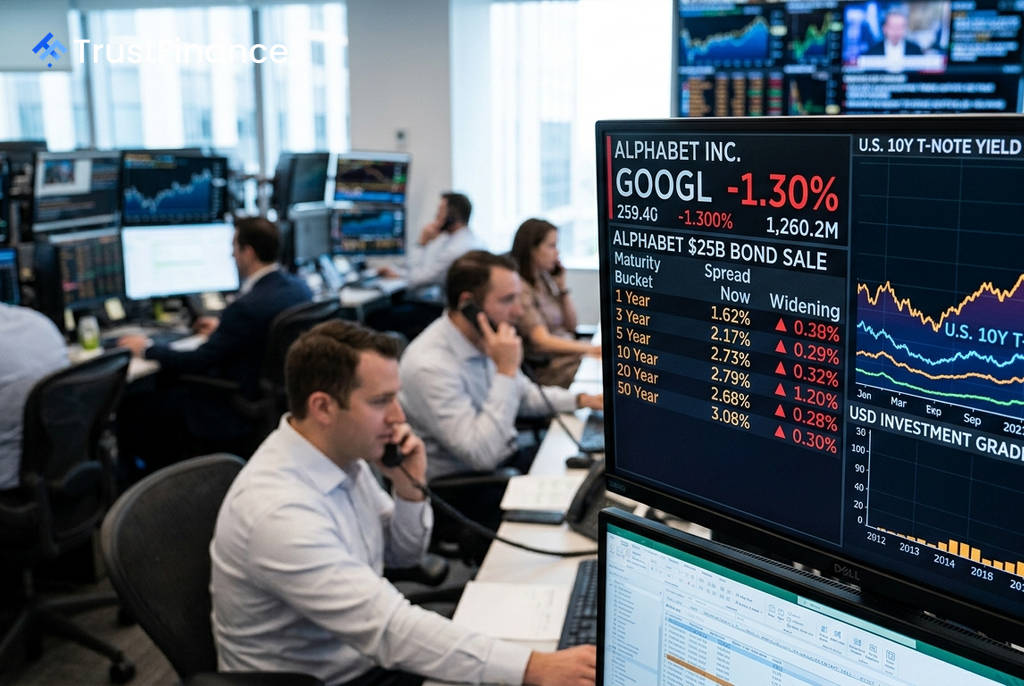
Alphabet's massive $25 billion bond sale on Thursday attracted strong investor demand, but the deal arrives amid growing signs of stress in credit markets for major technology firms. A surge in borrowing to fund AI infrastructure is causing credit spreads to widen across the "hyperscaler" sector, repricing the perceived risk for some of the market's most valuable companies.
The Alphabet Offering
Alphabet (GOOGL) announced the offering of up to $25 billion in new debt across as many as 10 tranches, with maturities ranging from two to 40 years. The sale drew approximately $115 billion in orders, resulting in a robust 4.6x cover ratio, according to a report from Investing.com.
This significant capital raise follows the company's report of its first-ever negative free cash flow in the second quarter of 2026 and two upward revisions to its capital expenditure forecast this year. The funds are largely earmarked for building out the costly infrastructure required for artificial intelligence.
A Sector-Wide Trend
The Alphabet deal is part of a much larger trend. Major tech companies, including Amazon, Meta, and Oracle, have dramatically increased their borrowing to fund AI development. Combined, these firms issued approximately $194 billion in bonds through early July 2026, a 79% increase over the total for all of 2025, with Goldman Sachs projecting the total could reach $250 billion this year.
This flood of new supply has pushed borrowing costs higher. Credit spreads—the extra yield investors demand over benchmark government bonds—have widened across key maturities for these firms since early 2026:
 Ad
- 2–4 Year Maturities: Widened by 10 basis points to 40 bps
- 5–7 Year Maturities: Widened by 10 basis points to 60 bps
- 20+ Year Maturities: Widened by 9.5 basis points to 118 bps
The report notes that 78 of the 91 hyperscaler bonds issued in 2026 are now trading at wider yields than at their issuance, with a median widening of approximately 22 basis points.
Market Signals and What to Watch
The widening spreads in the cash bond market are mirrored in the market for Credit Default Swaps (CDS), which function as insurance against a company's default. Analysts point to several factors driving a repricing of risk, including signs of supply saturation, as average cover ratios for hyperscaler deals fell from around 5x in February to below 2x in July.
While Alphabet's strong showing is a positive single-name event, the broader trend is being driven by shifting credit fundamentals. A historically strong credit like Alphabet reporting negative free cash flow serves as a key catalyst for re-evaluating risk, while massive off-balance-sheet spending commitments, such as Meta's disclosed $700 billion, are also being priced into CDS contracts.
The final pricing on Alphabet's longest-dated 40-year bond will be a crucial market signal. A price tighter than current market levels could stabilize sentiment, while a weaker outcome could signal further credit pressure for the entire sector.
Read next
More on Stocks
FTC Orders Walmart, Uber, Delta to Disclose Data on Personalized Pricing
The U.S. Federal Trade Commission is demanding nine major companies, including leading retail, travel, and gig economy firms, to provide information on how they use consumer data for setting individual prices and wages.

Google Launches Gemini 4 Carbon AI Model to Bolster Cybersecurity Capabilities
Alphabet's Google has unveiled Gemini 4 Carbon, its latest AI model specifically designed for advanced cybersecurity tasks like vulnerability detection and secure code generation. The launch escalates competition with rivals OpenAI and Anthropic in the enterprise AI market.

Oracle Shares Surge After Unveiling $225 Billion Revenue Target for 2030
Oracle stock rose sharply after the company presented a long-term financial outlook targeting at least $225 billion in annual revenue by fiscal 2030, driven by its expanding AI infrastructure business.

DOJ Scrutinizes Nvidia's $12.9B Hugging Face Deal Amid Broader Antitrust Probe, Sources Say
The U.S. Department of Justice is reportedly examining Nvidia's planned $12.93 billion acquisition of AI platform Hugging Face as part of a wider, ongoing antitrust investigation into the chipmaker's market conduct.