
Story
U.S. Treasury Yields Surge, Testing Recent Yen Intervention Efforts
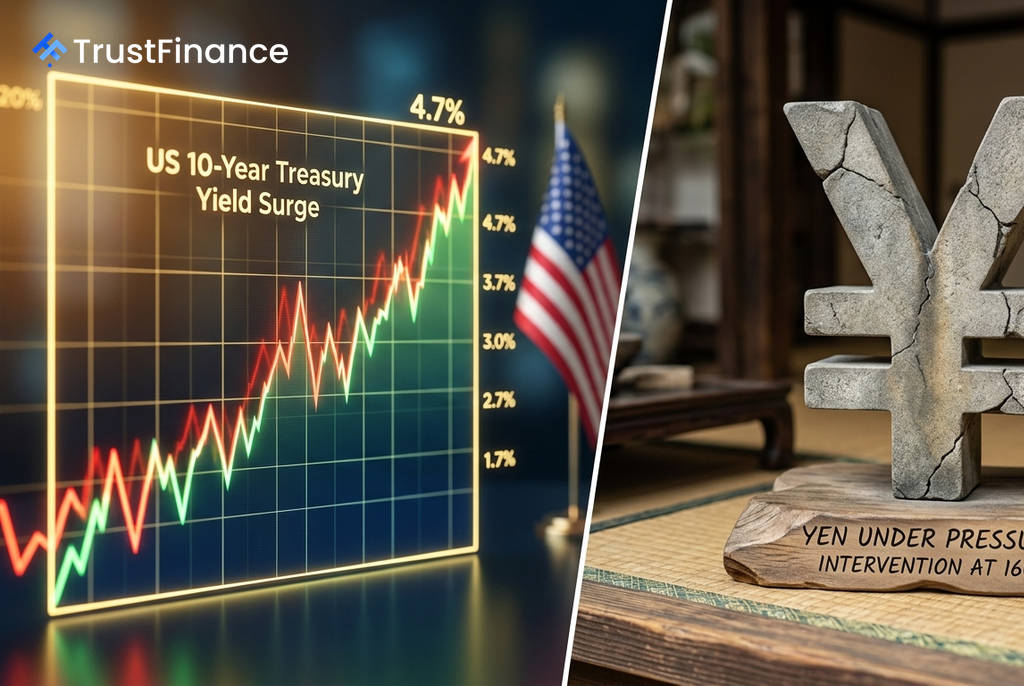
A sharp rise in U.S. government bond yields is putting significant pressure on the recent joint effort by the U.S. and Japan to support the yen, threatening to undo the impact of the first such coordinated intervention in 28 years.
Yields Undermine FX Policy
The yield on the benchmark 10-year U.S. Treasury note reached 4.688% on Thursday morning, approaching its 52-week high of 4.748%, according to Investing.com data. This marks a substantial increase from the levels seen on July 30, 2026, when U.S. Treasury Secretary Scott Bessent participated in a coordinated operation to buy the Japanese yen as the USD/JPY exchange rate neared 164.
The rising yields create a powerful incentive for global investors to buy dollar-denominated assets, which in turn strengthens the U.S. dollar against other currencies, including the yen. This dynamic directly counteracts the goal of the intervention. The dollar-yen pair was trading at 158.62 on Thursday, creeping back toward levels that could trigger further action.
Treasury Responds to Bond Market Stress
In response to the broader bond market pressure, which saw the 30-year Treasury yield hit its highest level since 2007 this week, the U.S. Treasury Department took action. On August 19, it announced it would double its buyback operations for long-dated bonds (10-to-30-year maturities) to at least $4 billion per session in an attempt to stabilize the market.
 Ad
However, some analysts are skeptical of the measure's long-term effectiveness. J.P. Morgan described the buyback amount as "negligible in a $32.2 trillion market," according to the source material. The bank attributes the upward pressure on yields to persistent U.S. fiscal deficits, a national debt exceeding $40 trillion, and a growing inflation premium fueled by rising oil prices.
Market Outlook and Intervention Triggers
The conflict between U.S. monetary conditions and foreign exchange policy creates a difficult feedback loop for policymakers. The mechanics are straightforward:
- Higher U.S. yields attract capital, boosting the dollar.
- A stronger dollar weakens the yen, pushing USD/JPY higher.
- As the exchange rate rises, it increases the likelihood of another costly intervention.
Bank of America has identified the 160 level in USD/JPY as a critical trigger for potential new official action, a mark the market is now approaching. Meanwhile, traders are increasingly betting that the Bank of Japan will be forced to act, with markets now pricing in a 76% probability of a BOJ rate hike in September, up from just 24% at the time of the July intervention. A hike would help narrow the yield differential between the U.S. and Japan, providing more fundamental support for the yen.
Read next
More on Stocks
FTC Orders Walmart, Uber, Delta to Disclose Data on Personalized Pricing
The U.S. Federal Trade Commission is demanding nine major companies, including leading retail, travel, and gig economy firms, to provide information on how they use consumer data for setting individual prices and wages.

Google Launches Gemini 4 Carbon AI Model to Bolster Cybersecurity Capabilities
Alphabet's Google has unveiled Gemini 4 Carbon, its latest AI model specifically designed for advanced cybersecurity tasks like vulnerability detection and secure code generation. The launch escalates competition with rivals OpenAI and Anthropic in the enterprise AI market.

Oracle Shares Surge After Unveiling $225 Billion Revenue Target for 2030
Oracle stock rose sharply after the company presented a long-term financial outlook targeting at least $225 billion in annual revenue by fiscal 2030, driven by its expanding AI infrastructure business.

DOJ Scrutinizes Nvidia's $12.9B Hugging Face Deal Amid Broader Antitrust Probe, Sources Say
The U.S. Department of Justice is reportedly examining Nvidia's planned $12.93 billion acquisition of AI platform Hugging Face as part of a wider, ongoing antitrust investigation into the chipmaker's market conduct.