
Story
US Defense Drone Stocks Gain on Tariff Speculation as Chinese Rivals Falter
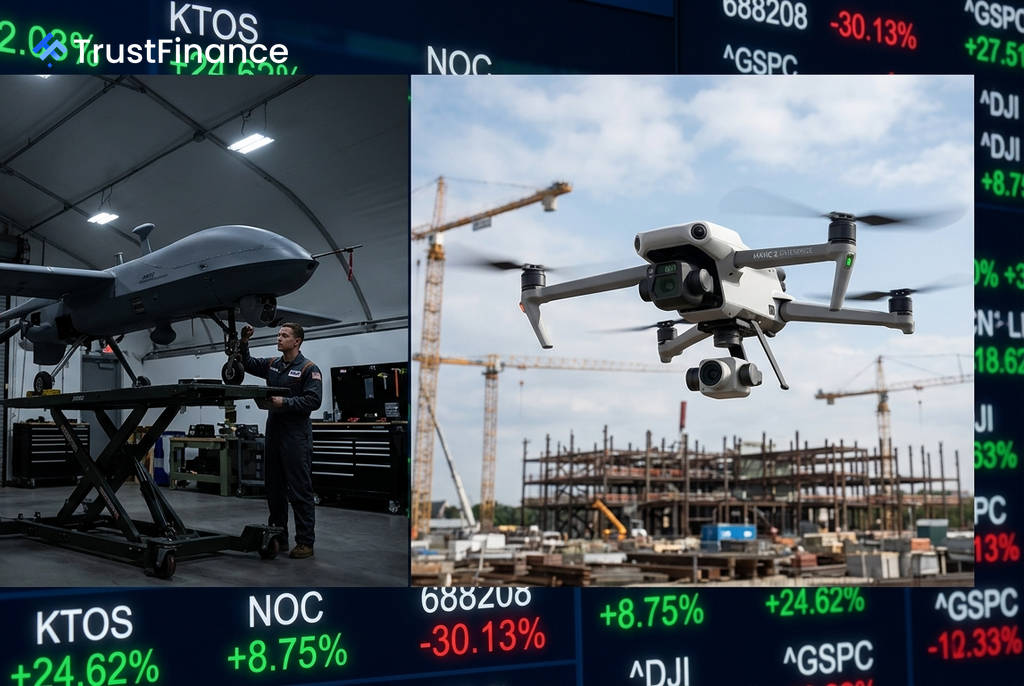
The potential for expanded U.S. tariffs on Chinese drones is reshaping investor positioning in the unmanned aerial systems sector, according to an analysis by Investing.com. The policy speculation has created a sharp divide, favoring domestic defense-focused manufacturers who stand to gain market share while posing significant headwinds for Chinese producers and U.S. commercial drone users.
Potential Winners: US Defense and Counter-Drone Tech
U.S. companies that manufacture drones for military and defense applications are seen as the primary beneficiaries. Tariffs on Chinese competitors could increase their pricing power and create a more protected domestic market. Investors appear to be pricing in this possibility, with notable gains in related stocks over the past month.
Key companies in this category include:
- AeroVironment (AVAV): A leading supplier of tactical drones to the U.S. military, its stock has risen 32.03% in one month.
- Kratos Defense (KTOS): Specializing in target drones and unmanned systems, its shares are up 24.62% over the same period.
- Textron (TXT): The parent company of Bell, which develops military vertical take-off and landing (VTOL) drones.
- Northrop Grumman (NOC): A major defense contractor with programs like the Global Hawk and Firebird.
Broader market sentiment is reflected in the Defiance Drone and Modern Warfare ETF (JEDI), which has gained 19.28% in the past month, Investing.com data shows.
Losers: Chinese Manufacturers and US Industries
 Ad
The direct targets of potential tariffs are Chinese drone manufacturers, who currently dominate the global market. The privately held DJI holds an estimated 80% share of the U.S. commercial drone market and would face a significant impact. Publicly traded competitor Autel Intelligent Technology (688208) has already seen its stock decline 30.13% over the past three months.
There is also significant collateral risk for U.S. industries that depend on cost-effective Chinese drones. Sectors such as agriculture, construction, real estate photography, and emergency services could face equipment cost increases of two to three times if forced to find alternatives, according to the analysis. For many prosumer and commercial applications, there are currently no U.S.-made alternatives at comparable price points.
Strategic Context and Market Outlook
The strategic logic behind such tariffs would follow a pattern seen in the semiconductor and solar panel industries: protecting and nurturing domestic manufacturing capacity, even at the cost of higher prices in the short term. The policy would primarily benefit the high-end defense and commercial drone segment, where drones can cost over $10,000 and U.S. firms are more competitive.
However, it would leave a significant gap in the consumer and prosumer markets, where Chinese drones priced between $500 and $2,000 are ubiquitous. The market's recent performance suggests investors are already anticipating this policy shift, rewarding U.S. defense players while punishing companies with exposure to Chinese manufacturing.
Read next
More on Stocks
FTC Orders Walmart, Uber, Delta to Disclose Data on Personalized Pricing
The U.S. Federal Trade Commission is demanding nine major companies, including leading retail, travel, and gig economy firms, to provide information on how they use consumer data for setting individual prices and wages.

Google Launches Gemini 4 Carbon AI Model to Bolster Cybersecurity Capabilities
Alphabet's Google has unveiled Gemini 4 Carbon, its latest AI model specifically designed for advanced cybersecurity tasks like vulnerability detection and secure code generation. The launch escalates competition with rivals OpenAI and Anthropic in the enterprise AI market.

Oracle Shares Surge After Unveiling $225 Billion Revenue Target for 2030
Oracle stock rose sharply after the company presented a long-term financial outlook targeting at least $225 billion in annual revenue by fiscal 2030, driven by its expanding AI infrastructure business.

DOJ Scrutinizes Nvidia's $12.9B Hugging Face Deal Amid Broader Antitrust Probe, Sources Say
The U.S. Department of Justice is reportedly examining Nvidia's planned $12.93 billion acquisition of AI platform Hugging Face as part of a wider, ongoing antitrust investigation into the chipmaker's market conduct.