
Story
U.S.-Canada Trade Tensions Put Automotive, Metals, and Energy Sectors on Alert
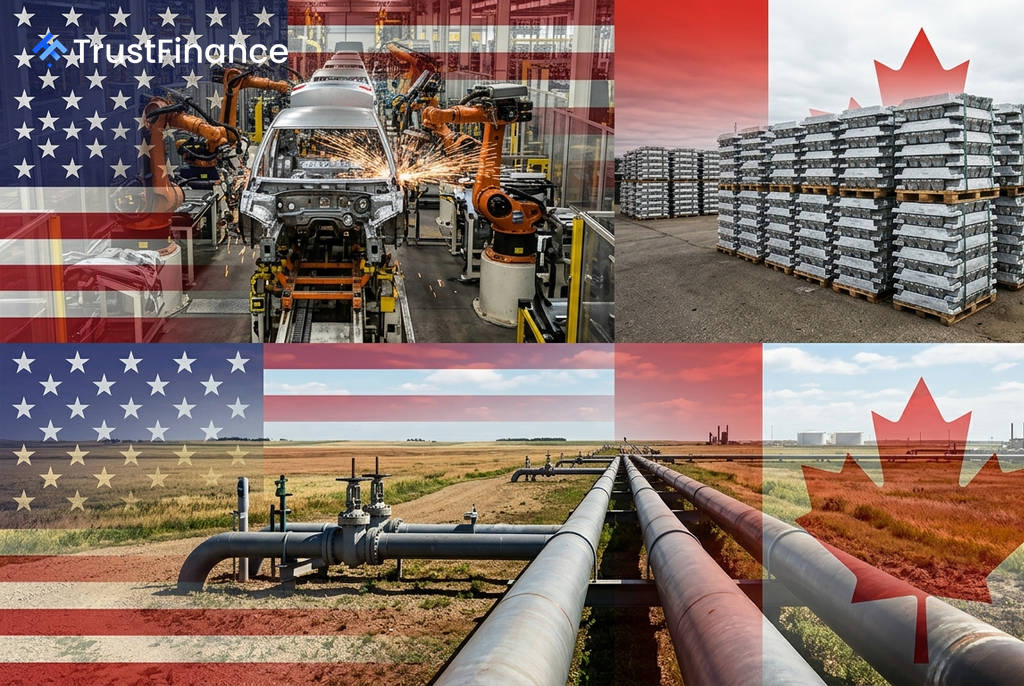
A severe deterioration in the U.S.-Canada trade relationship has placed key economic sectors on high alert following Washington's imposition of a 50% tariff on Canadian imports in August. With Ottawa vowing retaliatory measures, companies in industries with deeply integrated cross-border supply chains face significant uncertainty amid annual bilateral trade valued at approximately $780 billion.
Automotive Supply Chains at Risk
The automotive sector's reliance on "just-in-time" manufacturing makes it uniquely vulnerable to trade disruptions. Parts and materials frequently cross the U.S.-Canada border multiple times during a vehicle's assembly, with some components making the trip up to eight times. This means tariffs can compound at each stage, increasing costs and threatening production schedules.
Canadian-headquartered parts supplier Magna International (MGA) is highlighted as particularly exposed due to its vast network of over 325 manufacturing facilities across North America. The company's operations depend heavily on the seamless flow of goods between the two countries.
Aluminum and Metals Face Direct Tariff Impact
The metals industry, particularly aluminum, is at the center of the dispute. Canada is a critical supplier, accounting for 68% of all U.S. aluminum imports. In the first half of 2026, the U.S. imported 1.16 million tonnes of aluminum from Canada out of a total of 1.68 million tonnes.
 Ad
An analysis from Morgan Stanley suggests that even a reduction of the tariff from 50% to 25% could cause the U.S. Midwest aluminum premium to fall by 10-12 cents per pound, compressing margins for Canadian exporters like diversified miner Teck Resources (TECK). Conversely, U.S. domestic producers such as Nucor (NUE) could potentially benefit from reduced foreign competition.
Energy Interdependence Creates Vulnerability
The U.S. and Canadian energy markets are deeply interconnected, with Canada supplying roughly 60% of U.S. crude oil imports. This codependence means tariffs could disrupt a critical supply source for U.S. refiners while simultaneously harming Canadian producers who rely on the U.S. as their primary export market.
Major Canadian energy firms like Suncor Energy (SU) and Imperial Oil (IMO) have significant exposure to the U.S. market. While both have seen strong performance this year on the back of higher oil prices, new trade barriers could threaten their main revenue stream and disrupt established energy flows.
Read next
More on Stocks
FTC Orders Walmart, Uber, Delta to Disclose Data on Personalized Pricing
The U.S. Federal Trade Commission is demanding nine major companies, including leading retail, travel, and gig economy firms, to provide information on how they use consumer data for setting individual prices and wages.

Google Launches Gemini 4 Carbon AI Model to Bolster Cybersecurity Capabilities
Alphabet's Google has unveiled Gemini 4 Carbon, its latest AI model specifically designed for advanced cybersecurity tasks like vulnerability detection and secure code generation. The launch escalates competition with rivals OpenAI and Anthropic in the enterprise AI market.

Oracle Shares Surge After Unveiling $225 Billion Revenue Target for 2030
Oracle stock rose sharply after the company presented a long-term financial outlook targeting at least $225 billion in annual revenue by fiscal 2030, driven by its expanding AI infrastructure business.

DOJ Scrutinizes Nvidia's $12.9B Hugging Face Deal Amid Broader Antitrust Probe, Sources Say
The U.S. Department of Justice is reportedly examining Nvidia's planned $12.93 billion acquisition of AI platform Hugging Face as part of a wider, ongoing antitrust investigation into the chipmaker's market conduct.