
Story
Under Armour Voting Share Premium Widens to 2.3%, Drawing Arbitrage Attention
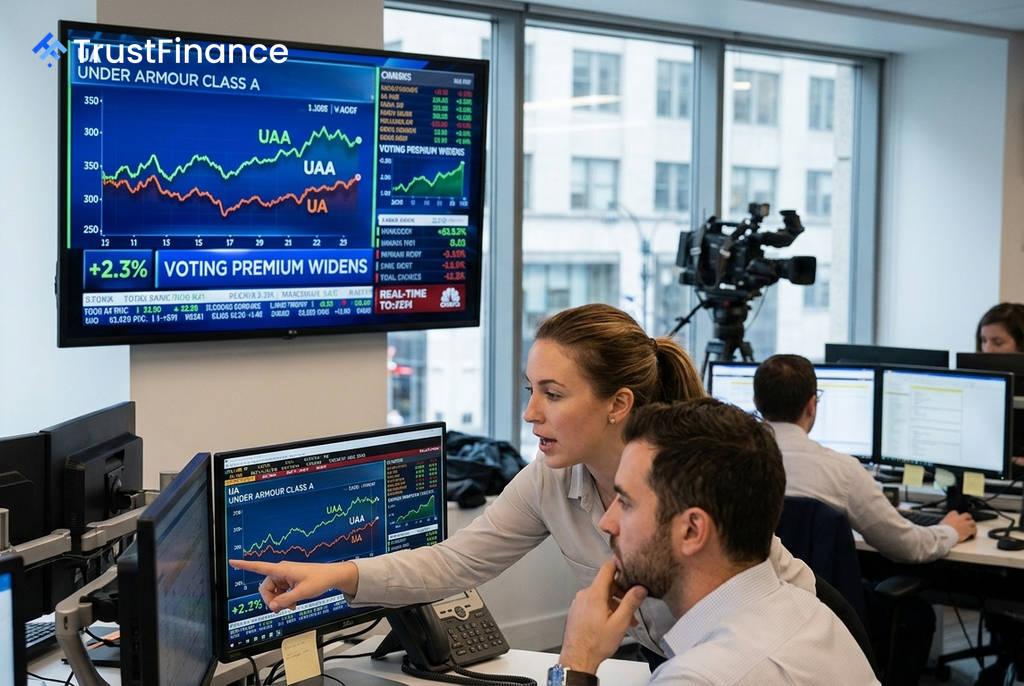
The price premium for Under Armour's voting stock has expanded to a notable level, creating one of the widest spreads among major U.S. companies with dual-class share structures. This development has drawn attention from traders who specialize in arbitrage strategies focused on these pricing disparities.
The Widening Spread
According to market data from August 13, 2026, Under Armour's Class A voting shares (UAA) traded at $5.35, while its Class C non-voting shares (UA) were priced at $5.23. This $0.12 difference represents a 2.29% premium for the voting rights.
The divergence has become more pronounced following a difficult period for the company's stock, with both share classes having declined by approximately 21% over the past month. The widening spread during a sharp selloff suggests a potential dislocation that arbitrage traders look to exploit.
Context on Dual-Class Arbitrage
Dual-class share structures allow companies to issue stock to the public while concentrating voting power with founders or insiders. While both classes typically have identical economic rights to dividends and assets, the shares with superior voting rights almost always trade at a premium.
Arbitrage traders engage in a market-neutral strategy known as pairs trading to capitalize on these spreads. By going long the cheaper, non-voting shares and simultaneously shorting the more expensive voting shares, they bet that the price gap will eventually converge to its historical average. This strategy isolates the trade from the overall direction of the underlying stock.
 Ad
For comparison, other major dual-class stocks exhibit much tighter spreads, highlighting the unusual nature of Under Armour's current gap:
- Alphabet (GOOGL/GOOG): The premium for its voting shares was just 0.54%.
- Berkshire Hathaway (BRKa/BRKb): The premium based on its conversion ratio was a minimal 0.07%.
Potential and Risks
The investment thesis for an Under Armour pairs trade is based on mean reversion—the idea that the historically wide 2.29% spread will narrow toward its long-term average. However, such strategies are not without risk.
Key risks for this trade include a potential liquidity trap, as the non-voting UA shares are less actively traded than the UAA class. Furthermore, a catalyst such as an activist investor campaign or a merger-and-acquisition event could cause the voting premium to expand dramatically. Finally, the costs associated with borrowing UAA shares to maintain a short position could erode potential profits.
Read next
More on Stocks
FTC Orders Walmart, Uber, Delta to Disclose Data on Personalized Pricing
The U.S. Federal Trade Commission is demanding nine major companies, including leading retail, travel, and gig economy firms, to provide information on how they use consumer data for setting individual prices and wages.

Google Launches Gemini 4 Carbon AI Model to Bolster Cybersecurity Capabilities
Alphabet's Google has unveiled Gemini 4 Carbon, its latest AI model specifically designed for advanced cybersecurity tasks like vulnerability detection and secure code generation. The launch escalates competition with rivals OpenAI and Anthropic in the enterprise AI market.

Oracle Shares Surge After Unveiling $225 Billion Revenue Target for 2030
Oracle stock rose sharply after the company presented a long-term financial outlook targeting at least $225 billion in annual revenue by fiscal 2030, driven by its expanding AI infrastructure business.

DOJ Scrutinizes Nvidia's $12.9B Hugging Face Deal Amid Broader Antitrust Probe, Sources Say
The U.S. Department of Justice is reportedly examining Nvidia's planned $12.93 billion acquisition of AI platform Hugging Face as part of a wider, ongoing antitrust investigation into the chipmaker's market conduct.