
Story
TSMC Financials Show Strong AI-Driven Growth Amid Valuation Scrutiny
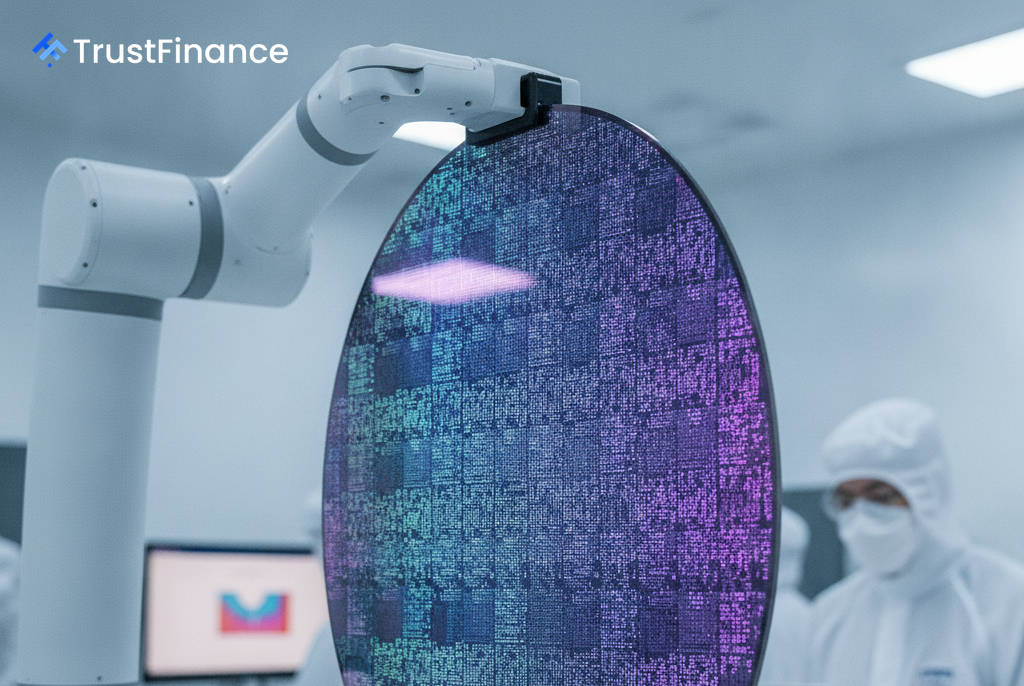
Taiwan Semiconductor Manufacturing Co. (TSMC), the world's leading chip foundry, continues to demonstrate robust financial performance fueled by the artificial intelligence boom, posting a 77% year-over-year jump in net profit for the second quarter of 2026, according to an analysis by Investing.com. Despite beating earnings estimates for the eighth consecutive quarter, the market's reaction has been muted, signaling that investor expectations for the pivotal chipmaker are exceptionally high.
Dominant Financial Performance
TSMC's role as the primary manufacturer for advanced chips from companies like NVIDIA and Apple has translated into remarkable growth. The company more than doubled its revenue from $57.2 billion in fiscal 2021 to $121.4 billion in fiscal 2025, representing a compound annual growth rate (CAGR) of 23.3%, the report stated. Net income saw a cumulative jump of 153% over the same period, reaching $54.1 billion.
Profitability metrics remain elite for a company of its scale. The gross margin for Q2 2026 reached 67.7%, well above consensus, while the net margin for fiscal 2025 expanded to 44.6%. Furthermore, TSMC's capital efficiency is strong, with a Return on Invested Capital (ROIC) of 32.5%.
Valuation and Market Outlook
The company's stock valuation reflects its market leadership, creating a debate between bulls and bears. As of late June 2026, TSMC traded at a forward price-to-earnings (P/E) ratio of 22.7x, a figure some analysts consider reasonable given its growth trajectory. CEO C.C. Wei has reinforced the bullish outlook, noting the AI megatrend is "stronger and stronger," prompting the company to raise its full-year 2026 revenue growth guidance to slightly above 40%.
 Ad
Analyst sentiment remains positive, with a consensus target indicating a potential 22.2% upside and DA Davidson raising its price target to $500 post-earnings, according to Investing.com. However, the stock's recent 8% decline after its strong Q2 report suggests the market is pricing in flawless execution.
Key Risks: Capex and Geopolitics
Investors are closely watching two primary risks: capital spending and geopolitics. Management has signaled that capital expenditures over the next three years, in the $64 billion range, will significantly exceed the past three. While the company frames this as a signal of high demand, some investors interpret the heavy spending as a potential drag on free cash flow (FCF).
Separately, the geopolitical risk associated with Taiwan remains a persistent structural concern for investors. This factor, combined with the stock trading near its 52-week high, has created a cautious environment where strong results are expected and any perceived weakness could be scrutinized.
Read next
More on Stocks
FTC Orders Walmart, Uber, Delta to Disclose Data on Personalized Pricing
The U.S. Federal Trade Commission is demanding nine major companies, including leading retail, travel, and gig economy firms, to provide information on how they use consumer data for setting individual prices and wages.

Google Launches Gemini 4 Carbon AI Model to Bolster Cybersecurity Capabilities
Alphabet's Google has unveiled Gemini 4 Carbon, its latest AI model specifically designed for advanced cybersecurity tasks like vulnerability detection and secure code generation. The launch escalates competition with rivals OpenAI and Anthropic in the enterprise AI market.

Oracle Shares Surge After Unveiling $225 Billion Revenue Target for 2030
Oracle stock rose sharply after the company presented a long-term financial outlook targeting at least $225 billion in annual revenue by fiscal 2030, driven by its expanding AI infrastructure business.

DOJ Scrutinizes Nvidia's $12.9B Hugging Face Deal Amid Broader Antitrust Probe, Sources Say
The U.S. Department of Justice is reportedly examining Nvidia's planned $12.93 billion acquisition of AI platform Hugging Face as part of a wider, ongoing antitrust investigation into the chipmaker's market conduct.