
Story
Trump Administration Announces 'Most-Favored-Nation' Drug Pricing Deals with Nine Firms
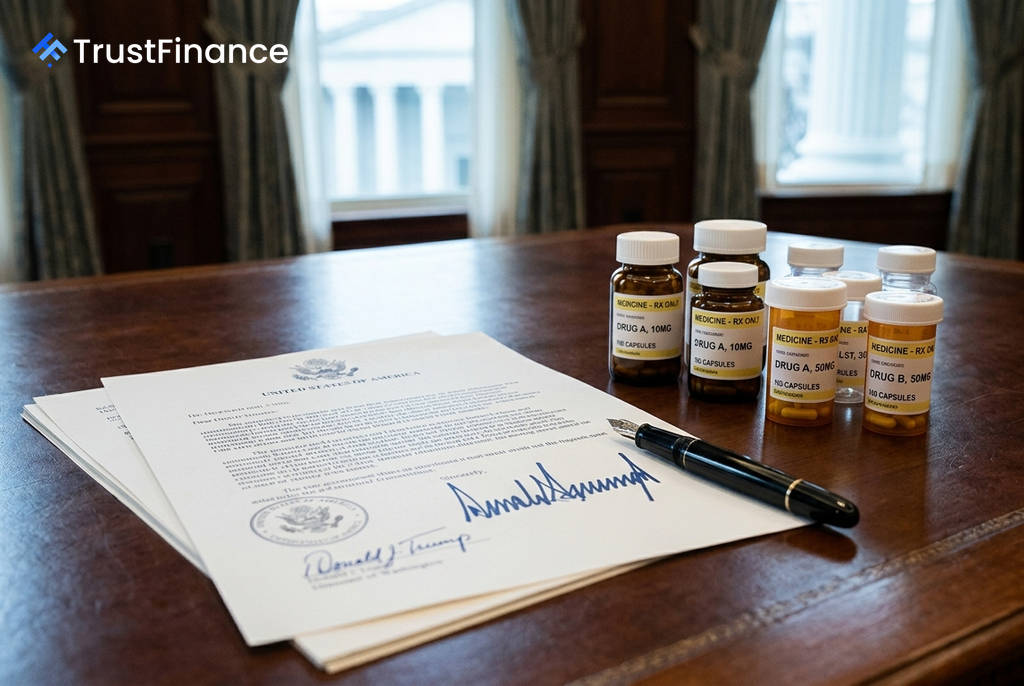
President Donald Trump on Monday announced drug pricing agreements with nine pharmaceutical companies aimed at lowering costs for state Medicaid programs. The deals are based on a most-favored-nation pricing model, which ties U.S. prices to those paid in other developed countries.
Details of the Agreements
The agreements were formalized during an Oval Office event with company executives. Under the terms, the firms will provide drugs to state Medicaid programs at what the administration described as a significant discount. President Trump stated this represents "a tremendous discount, which should bring down the cost of your medical care by tremendous amounts."
According to the announcement, the companies involved in the new agreements include:
- Astellas (TYO:4503)
- BeOne Medicines (SHH:688235)
- CSL (ASX:CSL)
- BridgeBIO (NASDAQ:BBIO)
- Sun Pharmaceutical (NSE:SUN)
- Teva (TASE:TEVA)
- UCB SA (EBR:UCB)
Context and Background
 Ad
This initiative is part of a broader administration effort to tackle high prescription drug costs in the United States, where consumers pay, on average, nearly three times more for medicines than patients in other developed nations. The most-favored-nation pricing model is designed to compel drugmakers to offer prices in the U.S. that are comparable to lower prices paid internationally.
The new deals expand upon a program started last year, which secured similar agreements with 17 other major pharmaceutical companies, including Pfizer (NYSE:PFE), Eli Lilly (NYSE:LLY), and Amgen (NASDAQ:AMGN). Those arrangements involved price reductions for certain federal health programs and direct-to-patient sales in exchange for tariff relief, according to reports.
Implications for the Sector
For the participating companies, these agreements are likely to put downward pressure on revenues and profit margins from sales within the large U.S. Medicaid market. The full financial impact will depend on the specific drugs and discount levels negotiated.
Investors and the broader pharmaceutical industry will be closely monitoring whether this pricing model is extended to other government programs, such as Medicare, or if it influences future pricing negotiations with commercial insurers. The continued political focus on drug pricing remains a key consideration and potential risk factor for the healthcare sector.
Read next
More on Stocks
FTC Orders Walmart, Uber, Delta to Disclose Data on Personalized Pricing
The U.S. Federal Trade Commission is demanding nine major companies, including leading retail, travel, and gig economy firms, to provide information on how they use consumer data for setting individual prices and wages.

Google Launches Gemini 4 Carbon AI Model to Bolster Cybersecurity Capabilities
Alphabet's Google has unveiled Gemini 4 Carbon, its latest AI model specifically designed for advanced cybersecurity tasks like vulnerability detection and secure code generation. The launch escalates competition with rivals OpenAI and Anthropic in the enterprise AI market.

Oracle Shares Surge After Unveiling $225 Billion Revenue Target for 2030
Oracle stock rose sharply after the company presented a long-term financial outlook targeting at least $225 billion in annual revenue by fiscal 2030, driven by its expanding AI infrastructure business.

DOJ Scrutinizes Nvidia's $12.9B Hugging Face Deal Amid Broader Antitrust Probe, Sources Say
The U.S. Department of Justice is reportedly examining Nvidia's planned $12.93 billion acquisition of AI platform Hugging Face as part of a wider, ongoing antitrust investigation into the chipmaker's market conduct.