
Story
Toyota Explores Hydrogen-Powered Trucks for Supply Chain Amid Elevated Fuel Costs
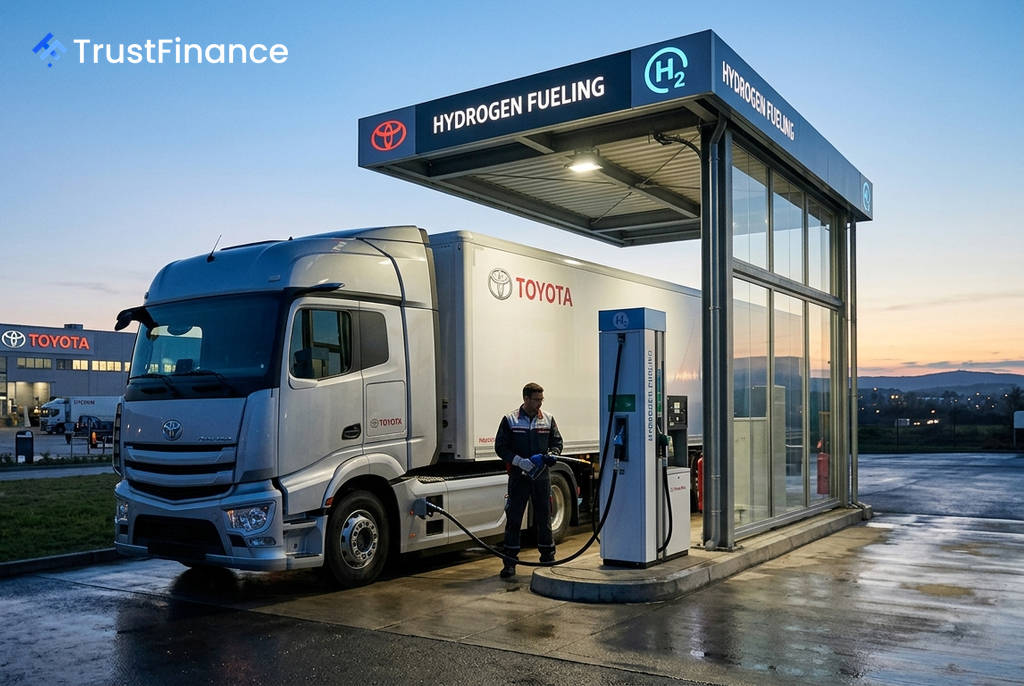
Toyota Motor Corp. (NYSE:TM) is evaluating the use of hydrogen to power trucks within its auto parts supply chain, a strategic consideration driven by elevated fuel costs and supply strains. The potential shift reflects a growing industry focus on finding viable commercial applications for alternative fuels.
A Strategic Pivot to Hydrogen
In an interview with Bloomberg, Toyota Vice Chairman Koji Sato stated that the automaker could also deploy hydrogen as an energy source within its factories. Sato added that integrating the fuel across its suppliers' logistics networks is another option under consideration.
The exploration comes as fuel prices remain high following the recent conflict in Iran, pushing major industrial players to accelerate their search for gasoline alternatives. For Toyota, this involves a potential large-scale industrial use case for hydrogen beyond the consumer market.
Context and Challenges
Hydrogen has long been viewed as a key component in the global transition to carbon-neutral energy, but its adoption has been hindered by significant hurdles. The primary challenges include:
 Ad
- High Costs: Production of green hydrogen remains expensive compared to traditional fuels.
- Inefficiency: The processes of producing, storing, and transporting hydrogen are complex and can be inefficient.
These factors have severely limited the market for hydrogen fuel-cell passenger cars, which have seen minimal sales in Japan and other markets. As a result, both government officials and corporate executives are recalibrating their strategies.
Focus Shifts to Commercial Vehicles
The industry is increasingly pivoting toward a more pragmatic approach by focusing on commercial vehicles as the most promising near-term application for hydrogen fuel. The predictable routes and centralized refueling infrastructure of logistics and trucking operations make them a more suitable testbed for the technology than the widespread network required for passenger cars.
Toyota's consideration of hydrogen for its own logistics underscores this strategic shift. A successful implementation could provide a scalable model for decarbonizing heavy transport and industrial operations, offering a more immediate return on investment than the struggling consumer segment.
Read next
More on Stocks
FTC Orders Walmart, Uber, Delta to Disclose Data on Personalized Pricing
The U.S. Federal Trade Commission is demanding nine major companies, including leading retail, travel, and gig economy firms, to provide information on how they use consumer data for setting individual prices and wages.

Google Launches Gemini 4 Carbon AI Model to Bolster Cybersecurity Capabilities
Alphabet's Google has unveiled Gemini 4 Carbon, its latest AI model specifically designed for advanced cybersecurity tasks like vulnerability detection and secure code generation. The launch escalates competition with rivals OpenAI and Anthropic in the enterprise AI market.

Oracle Shares Surge After Unveiling $225 Billion Revenue Target for 2030
Oracle stock rose sharply after the company presented a long-term financial outlook targeting at least $225 billion in annual revenue by fiscal 2030, driven by its expanding AI infrastructure business.

DOJ Scrutinizes Nvidia's $12.9B Hugging Face Deal Amid Broader Antitrust Probe, Sources Say
The U.S. Department of Justice is reportedly examining Nvidia's planned $12.93 billion acquisition of AI platform Hugging Face as part of a wider, ongoing antitrust investigation into the chipmaker's market conduct.